Google My Business & the Power of “Near Me” Searches for Small Businesses
If you’re a small business owner, chances are you’ve Googled yourself at least once. Maybe twice. Okay, daily. No judgment.
What you probably noticed is this: Google My Business (GMB) listings often appear before websites, before ads, and sometimes before common sense. That’s not an accident. Google is obsessed with local intent, and “near me” searches are one of its favorite signals.
Let’s break down how Google My Business works, why “near me” searches matter, and how small businesses can turn this free tool into a lead-generating machine.
What Is Google My Business (Really)?
Google My Business is your digital storefront on Google. It controls how your business appears on:
- Google Search
- Google Maps
- Local 3-Pack results
It’s not just a profile—it’s a trust signal.
A well-optimized GMB listing tells Google:
“This business exists, it’s active, customers interact with it, and it deserves visibility.”
A neglected listing tells Google:
“This place might be abandoned… or run by a raccoon.”
Guess which one ranks.
Why “Near Me” Searches Are Exploding
Searches like:
- “coffee shop near me”
- “plumber near me”
- “SEO company near me”
have exploded over the last few years, especially on mobile.
Why?
Because people don’t search for brands first.
They search for solutions, urgently, and locally.
Google knows this—and prioritizes businesses that:
- Are geographically close
- Have strong reviews
- Are active on GMB
- Match search intent
This is where small businesses can punch way above their weight.
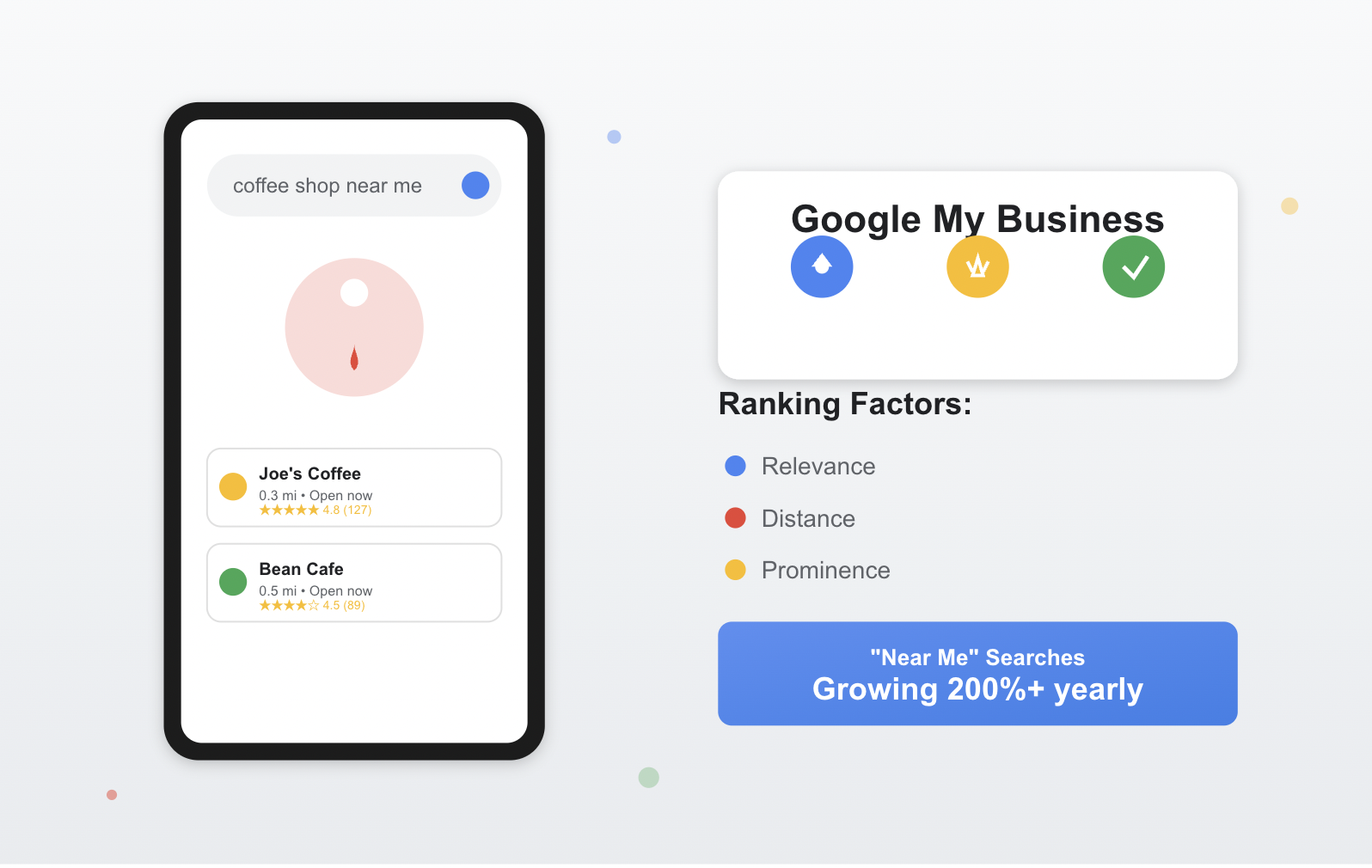
How Google Decides Who Shows Up in “Near Me” Results
Google uses three main factors for local rankings:
1. Relevance
Does your business match what the user is searching for?
This depends on:
- Your business category
- Services listed
- Description content
- Keywords in reviews
2. Distance
How close is your business to the searcher?
You can’t control this fully—but you can dominate within your service radius.
3. Prominence
How trusted and well-known your business appears online.
This includes:
- Reviews (quality + quantity)
- Photos
- Updates & posts
- Website authority
This is where smart SEO and local optimization intersect.
Where Most Small Businesses Get It Wrong
Let’s be blunt.
Most businesses:
- Set up GMB once
- Add an address and phone number
- Forget it exists
That’s like opening a shop and never turning the lights on.
Google favors activity, not existence.
Businesses that win locally:
- Add photos regularly
- Post updates
- Reply to reviews (yes, even bad ones)
- Keep services and hours accurate
This is low effort, high return work—and it’s still ignored by most competitors.
The SEO + GMB Combo That Actually Works
Here’s where things get interesting.
A strong GMB listing performs even better when it’s supported by a well-optimized website. Google cross-checks data between your site and your listing constantly.
This is why businesses working with experienced SEO teams often see faster local growth. For example, agencies like
👉 https://www.inboundfactor.com/seo-company-in-egypt/
focus heavily on aligning on-page SEO, local signals, and Google Business optimization—because Google rewards consistency.
Think of it like this:
- GMB = your local authority signal
- Website SEO = your credibility engine
One without the other leaves money on the table.
Reviews: The Hidden Ranking Weapon
Reviews don’t just influence customers—they influence Google.
Best practices:
- Ask happy customers (politely)
- Respond to every review
- Use natural language, not templates
- Don’t panic over one bad review
A business with 30 real reviews and responses will usually outperform one with 100 silent reviews.
Google prefers conversations, not trophies.
Photos & Updates: Yes, They Matter (A Lot)
Businesses that upload photos regularly:
- Get more clicks
- Get more calls
- Rank higher locally
Photos prove freshness. Updates prove activity.
Even simple posts like:
- “New project completed”
- “Holiday hours update”
- “Behind the scenes”
send positive signals.
Google doesn’t need perfection—it needs proof you’re alive.
Why This Is a Big Opportunity for Small Businesses
Here’s the truth big brands don’t want you to know:
Local SEO is one of the last unfair advantages left.
You don’t need:
- A massive budget
- Thousands of backlinks
- Years of authority
You need:
- A properly optimized Google My Business profile
- Consistent activity
- A solid website foundation
Many small businesses working with SEO-focused partners like
👉 https://www.inboundfactor.com/
see results faster locally than nationally—because competition is weaker and intent is higher.
Final Thoughts: Simple, Not Easy
Google My Business isn’t magic.
“Near me” rankings aren’t luck.
They’re the result of:
- Consistency
- Accuracy
- Activity
- Trust
The good news? Most of your competitors are still asleep.
If you show up, stay active, and play the long game, Google will do what it always does—reward businesses that help users the most.
And yes, that can absolutely be you.