Unlocking Rankings with SEO Traffic Services
At their core, SEO traffic services are all about influencing what happens after you rank. They’re designed to boost the number of high-quality visitors you get from search engines, not just by climbing the results page, but by shaping how users interact with your listing once they see it.
This is a crucial distinction. These services send powerful, positive engagement signals to engines like Google, indicating your site is a popular and valuable destination.
Why Traditional SEO Is No Longer Enough
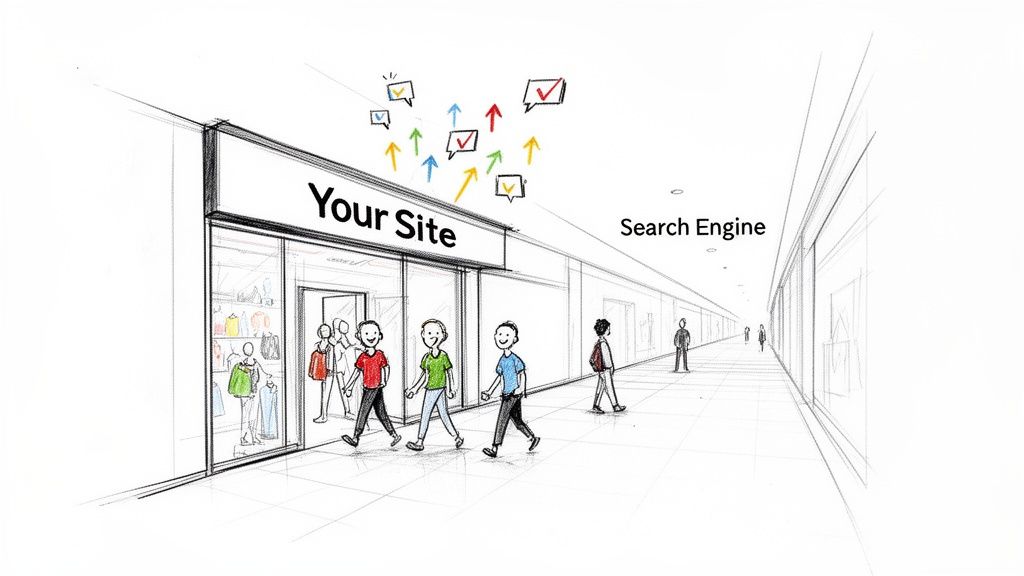
In today's crowded market, just creating great content and earning backlinks is the bare minimum—it’s simply the price of entry. Those efforts get your website on the map, but they don't guarantee you'll get any visitors. This is where the old-school approach to SEO starts to show its limits.
Think of it this way: you’ve poured your heart into a fantastic new retail shop. The products are top-notch, the design is beautiful, and your pricing is competitive. But your shop is tucked away in a quiet back alley. Traditional SEO is like putting up a few signs pointing people in your direction. It helps, sure, but it’s not enough to draw a real, bustling crowd.
To give you a clearer picture, let's look at the main ways businesses try to get traffic. The table below breaks down the most common service types you'll encounter.
Core Types of SEO Traffic Services
| Service Type | Primary Goal | Common Method |
|---|---|---|
| Organic SEO | Improve search rankings for target keywords. | Content creation, on-page optimization, technical fixes. |
| Link Building | Build authority and trust with search engines. | Guest posting, digital PR, broken link building. |
| CTR Optimization | Increase clicks from existing search impressions. | Title/meta description testing, rich snippet optimization, user signal generation. |
| Paid Acquisition | Drive immediate, targeted traffic. | Google Ads, social media ads, sponsored content. |
As you can see, each approach has a different goal. While traditional organic SEO and link building lay the foundation, they often fall short of driving the kind of user behavior that Google now rewards.
The Shift to User Behavior Signals
Search engines have gotten a lot smarter. Google no longer just catalogs web pages; it actively measures how satisfied users are with the results. It watches how real people interact with the search engine results page (SERP) to figure out which pages are genuinely the most helpful. This is the new frontier.
SEO traffic services are the digital equivalent of sending waves of enthusiastic shoppers into your store. Those shoppers signal to the mall owner—Google—that your spot is popular, engaging, and deserves to be moved to the front entrance where everyone can see it.
This whole process centers on influencing a few key user behavior signals, which tell search engines a lot about your page's quality.
- Click-Through Rate (CTR): This is the percentage of users who click your link after seeing it. A high CTR tells Google your listing is highly relevant to their search.
- Dwell Time: This measures how long a visitor stays on your page before going back to the search results. Longer dwell times suggest your content is valuable and engaging.
- Pogo-sticking: This is when someone clicks your result, immediately hits the back button, and clicks on a competitor instead. It's a major red flag for search engines.
The Growing Market and Need for an Edge
The race to capture valuable organic traffic is fueling explosive industry growth. The global SEO services market is projected to hit $108.28 billion by 2026, a huge jump from $81.46 billion in 2024. That 32.9% growth shows just how fiercely businesses are competing for visibility.
This is where platforms like ClickSEO come in. They are built to deliver this exact competitive edge by generating the positive user signals that traditional methods can't reliably produce. As conventional SEO alone becomes less effective, smart marketers are adopting more advanced strategies, like using AI for lead generation, to ensure the traffic they get actually converts. By simulating authentic user engagement, these services help prove to search engines that your site is the best answer for their users.
The Different Kinds of SEO Traffic Services
Trying to figure out which SEO traffic service is right for you can be overwhelming. It feels like every company is selling a different approach, and it’s hard to know what actually works. Think of it like this: you have a toolbox, and each type of service is a different tool designed for a specific job.
The key is knowing which tool to use and when. The market for these services really breaks down into four main categories. Understanding how each one works is the first step to putting together a smart SEO plan that brings in real, measurable traffic.
Foundational Organic SEO Services
This is the bedrock. Seriously, you can't skip this part. Foundational SEO is all about building your website into a high-quality asset that both people and search engines love. It’s about making sure your site is technically perfect, easy to use, and packed with valuable content that solves your audience's problems.
This is your long-term play, and it involves two core activities:
- Technical SEO: This is the nuts and bolts. We're talking about site speed, mobile-friendliness, and making sure Google can easily crawl and understand your pages. It’s like ensuring your physical store has a solid foundation and the doors are unlocked.
- Content Creation: This means writing the blog posts, articles, and guides that are built around the keywords your customers are searching for. This is the product on your shelves that brings people in.
While this approach is absolutely essential for sustainable success, it’s a slow burn. It builds value over time but doesn't always deliver the immediate jolt of traffic you need to get ahead of the competition.
Link Building Authority Services
If foundational SEO is about building a great store, link building is about generating buzz and word-of-mouth referrals. These services are laser-focused on getting other websites—especially respected ones in your industry—to link back to yours. In Google’s eyes, every one of those backlinks is a vote of confidence.
Think of it this way: a strong backlink profile tells search engines that other key players in your field trust your content. It’s the digital version of a respected critic giving you a glowing review, which instantly boosts your credibility and gets you noticed.
This is especially crucial for newer websites trying to establish authority, but it’s just as important for any business that wants to rank for competitive, high-value keywords. Without those external endorsements, even the best content can get lost in the noise.
Paid Search Acquisition
Paid search, usually run through platforms like Google Ads, is the express lane. It's like renting a billboard on the busiest highway in town. Instead of earning your spot at the top of the search results over months, you pay to be there instantly. This gives you incredible speed and control, letting you turn targeted traffic on like a faucet.
The catch? You’re just renting that space. The second you turn off your ad spend, your visibility disappears. It's a fantastic tool for things like product launches or flash sales, but it's not a strategy for building a lasting asset. It’s a powerful tactic, but relying on it exclusively can get very expensive.
User Engagement Optimization
This is where everything comes together. User engagement services, which is exactly what we do here at ClickSEO, are designed to influence how real people perceive and interact with your website in the search results. This is the secret sauce that bridges the gap between simply ranking and actually getting the click.
You’ve done the hard work—your site is solid, you have some good links—but you're still stuck on page two. This is where you can directly influence the behavioral signals Google cares about so much. By simulating authentic user searches and clicks, these services boost your click-through rate (CTR). This sends a powerful signal to Google that says, "When people search for this term, they really, really like this result."
Organic search is still king, driving an average of 53.3% of all website traffic and consistently showing the highest ROI. That’s why optimizing your performance there is so important.
If you’re interested in exploring specific platforms that help with this, take a look at our curated list of tools to generate website traffic.
How Click-Through Rate Shapes Your Rankings
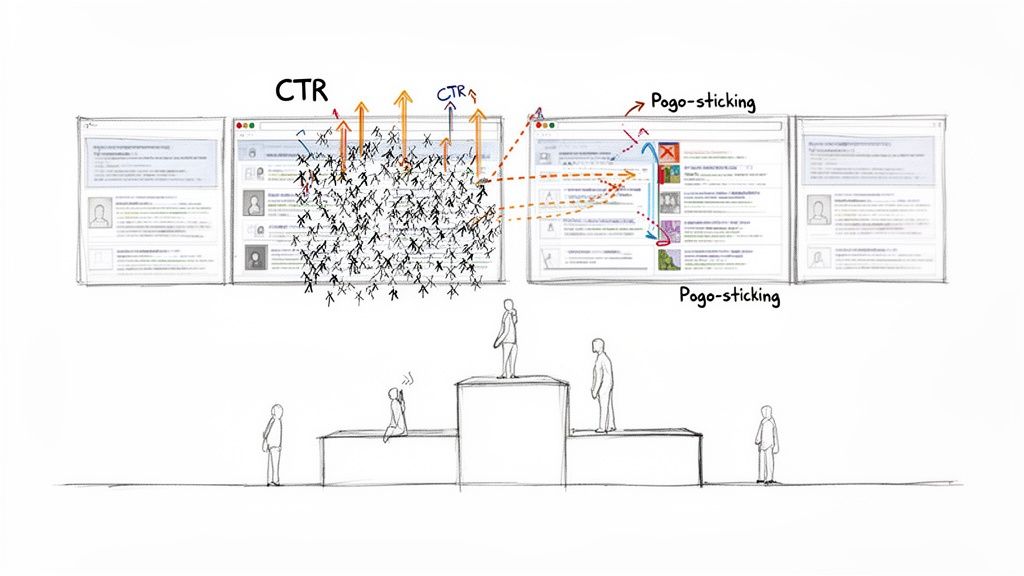
Think of Google's search results as a massive, real-time popularity contest. Every time someone searches, they get a list of contenders. When they choose to click one, they’re casting a vote and telling Google, "This one looks like the best answer."
That vote is what we in the SEO world call the click-through rate (CTR). It’s a simple but incredibly powerful metric—the percentage of people who see your link and actually click on it. More than almost anything else, it's how Google gets direct feedback from real users about your content's appeal. A high CTR is a clear sign that your title and meta description are compelling and relevant.
The Power of the First Click
The value of that click isn't spread evenly down the page. The data on this is pretty dramatic and shows just how much click-through rates can make or break your SEO efforts. The #1 spot on Google absolutely dominates, pulling in a massive 39.8% CTR. This drops off a cliff to just 18.7% for the second position and 10.2% for the third.
Those numbers show why getting to the top is so fiercely competitive. The vast majority of user attention—and traffic—is concentrated right there. This is precisely why a strong CTR is so vital. If you have two pages with similar content and backlinks, but one consistently gets more clicks, Google’s algorithm will logically assume it’s the better result. Over time, that page is going to climb the rankings.
Engagement Signals That Matter
But here's the catch: getting the click is only half the battle. What happens after someone lands on your site is just as critical. Search engines are always on the lookout for a behavior called pogo-sticking. This is when someone clicks your link, glances at your page, and immediately hits the "back" button to go back to the search results.
This is a huge red flag for Google. It’s the user’s way of saying, "Nope, that wasn't it. The page didn't deliver on its promise." A high rate of pogo-sticking can wipe out all the benefits of a good CTR and can actually hurt your rankings. It signals a major disconnect between what your search result promised and what your page delivered.
To really earn Google's trust, you need to back up that initial click with real, sustained engagement. This is where a quality SEO traffic service like ClickSEO can completely change the game.
When a user clicks your link and then stays, you're not just getting a pageview—you're getting a vote of confidence. A long dwell time confirms to Google that your content is not just appealing, but also satisfying.
This kind of positive engagement is measured by a few key signals:
- Dwell Time: This is simply how long a visitor stays on your page before leaving. Longer is almost always better, as it tells Google the content is valuable.
- Bounce Rate: The percentage of people who visit your site and leave after viewing only that first page. You want this number to be as low as possible.
- Pages Per Session: The average number of pages someone views on your site in one visit. If they click around to other pages, it shows they’re genuinely interested in what you have to offer.
By sending real human visitors who stick around and interact with your site, ClickSEO helps you send all the right signals to search engines. If you want to dive deeper into this core metric, check out our guide on what click-through rate is and why it matters.
Of course, knowing what a "good" rate even looks like is key to setting the right goals. You can get a better sense of industry benchmarks by exploring what makes a good CTR for creators and founders. Ultimately, these positive user signals are exactly what modern algorithms are designed to reward, helping you lock in and improve your spot on the SERP.
How Human-Powered SEO Traffic Services Actually Work
Alright, let's get past the theory and look at how these services operate in the real world. It’s one thing to know what an SEO traffic service is, but seeing the step-by-step mechanics is what really helps you understand its potential impact. We’ll walk through the journey of a single click, as managed by a platform like ClickSEO.
This isn't about bots or crude automation. It’s about mimicking the subtle, authentic behavior of a real person who’s genuinely interested in what you have to offer.
The Foundation: A Global Network of Real People
Everything starts with a massive, worldwide network of actual human beings. These aren't sketchy traffic farms; they're regular people using their own phones and computers at home. This is the absolute key difference between a legitimate service and a risky one.
Every person in the network has a unique residential or mobile IP address, which means their digital footprint is completely authentic. Because it is authentic. They're real users, in real locations, on the same internet connections your customers use.
Simulating the Search and Click
Once your campaign is live, a user in the network gets a task. It's not as simple as "go to this website." The instructions are designed to replicate the entire organic search journey from start to finish.
- The Search: The user gets your target keyword and is told to type it into Google, just like anyone else would.
- The Discovery: They then scroll through the search results (the SERP) to find your site’s listing. This action of scrolling and finding your link looks perfectly natural.
- The Click: After spotting your URL, they click on it. That click is what directly boosts your click-through rate for that keyword.
The ClickSEO dashboard below shows just how granular you can get, controlling everything from keywords and location targeting to how many clicks you want per day.
As you can see, you’re in the driver’s seat, defining the exact parameters for every single click.
Engagement on Your Website
Just getting a click isn't enough. If that person leaves immediately (a "bounce"), it can actually signal a bad user experience to Google. The magic happens after the click.
That's why the process includes clear instructions for on-page engagement:
- Dwell Time: The user must stay on your page for a specific, pre-set amount of time. This directly improves one of your most important metrics: average session duration.
- Internal Browsing: After spending time on the first page, the user is instructed to navigate to one or two other pages on your site. This simple action slashes your bounce rate and increases your pages-per-session.
This whole sequence perfectly mirrors the actions of someone who landed on your site, loved what they found, and decided to stick around. It's a complete behavioral loop designed to signal high user satisfaction.
Tying Actions to SEO Signals
Every single step in this process sends a clear, measurable signal to search engines. These aren't vague concepts—they are concrete data points that algorithms use to judge your site's quality and relevance. A good SEO traffic service is built to influence these specific data points in your favor.
The core idea is simple: You are replicating the behavior of your ideal visitor, but at scale. In doing so, you're giving Google's algorithm the exact proof it looks for when deciding to rank a page higher.
Ultimately, this human-powered activity gives a direct boost to the metrics that define user experience. It systematically improves your CTR, lengthens dwell time, and lowers your bounce rate. When combined, these signals tell search engines that your page isn't just a relevant result for a keyword—it's a genuinely helpful destination for users. And that’s what earns you a better spot on the SERP.
Choosing and Using a Traffic Service Safely
Let’s be honest: diving into SEO traffic services can feel like a high-wire act. Make the right moves, and you can gain a serious edge over the competition. But one wrong step—choosing a shady provider—can bring your rankings crashing down. The secret is learning how to spot the difference between a high-risk gamble and a legitimate, human-powered service that actually works.
So, how do you do this without getting burned? It all comes down to asking the right questions before you spend a dime. You have to get picky and understand exactly where that traffic is coming from.
Bot Traffic: The Big Red Flag
The biggest danger by far comes from services peddling cheap, automated bot traffic. Search engines are incredibly good at sniffing this out, and the penalties can be severe. We’re talking about more than just a slap on the wrist; you could see your site vanish from search results entirely. These risky services often hide behind vague promises and a total lack of transparency.
At the end of the day, the only thing that separates a safe service from a dangerous one is its origin. Is the click from a real person on their home Wi-Fi, or is it a script running on a data center server? One looks like genuine interest, while the other is a digital footprint that algorithms are built to find and punish.
To help you tell them apart, it's essential to compare what you're actually getting. The difference between a cheap bot and a real human click is night and day.
Bot Traffic vs Human-Powered Clicks
| Feature | Automated Bot Traffic | ClickSEO Human-Powered Network |
|---|---|---|
| Traffic Source | Data center IPs (easily flagged) | 100% Residential & Mobile IPs |
| User Behavior | Repetitive, robotic patterns | Natural, varied human behavior |
| Risk of Penalty | Very high; can lead to de-indexing | Extremely low; mimics real users |
| Targeting | Limited or non-existent | Precise geo-targeting by country/city |
| Engagement | Unrealistic; often just a simple bounce | Customizable session duration & pages-per-visit |
| Cost | Deceptively cheap | Value-focused; priced for real results |
As you can see, opting for the cheapest provider is almost always a mistake. True value comes from authentic human interaction that search engines are looking for.
When you're vetting a potential service, here's what to look for to make sure you're getting real, human-powered clicks:
- IP Address Type: Insist on residential and mobile IPs. Any service using data center IPs is waving a massive red flag. Real people don't browse the web from a server farm.
- Targeting Controls: Can you get specific? A good service will let you control geo-targeting down to the city level, which is critical for local businesses and market-specific campaigns.
- Pacing and Volume: Look for control over daily click volume. A sudden, massive traffic spike from a single source looks unnatural. The right way is to start small and ramp up slowly.
This is what a genuine, human-driven traffic flow looks like. A real person searches, clicks your link in the results, and then actually engages with your site.
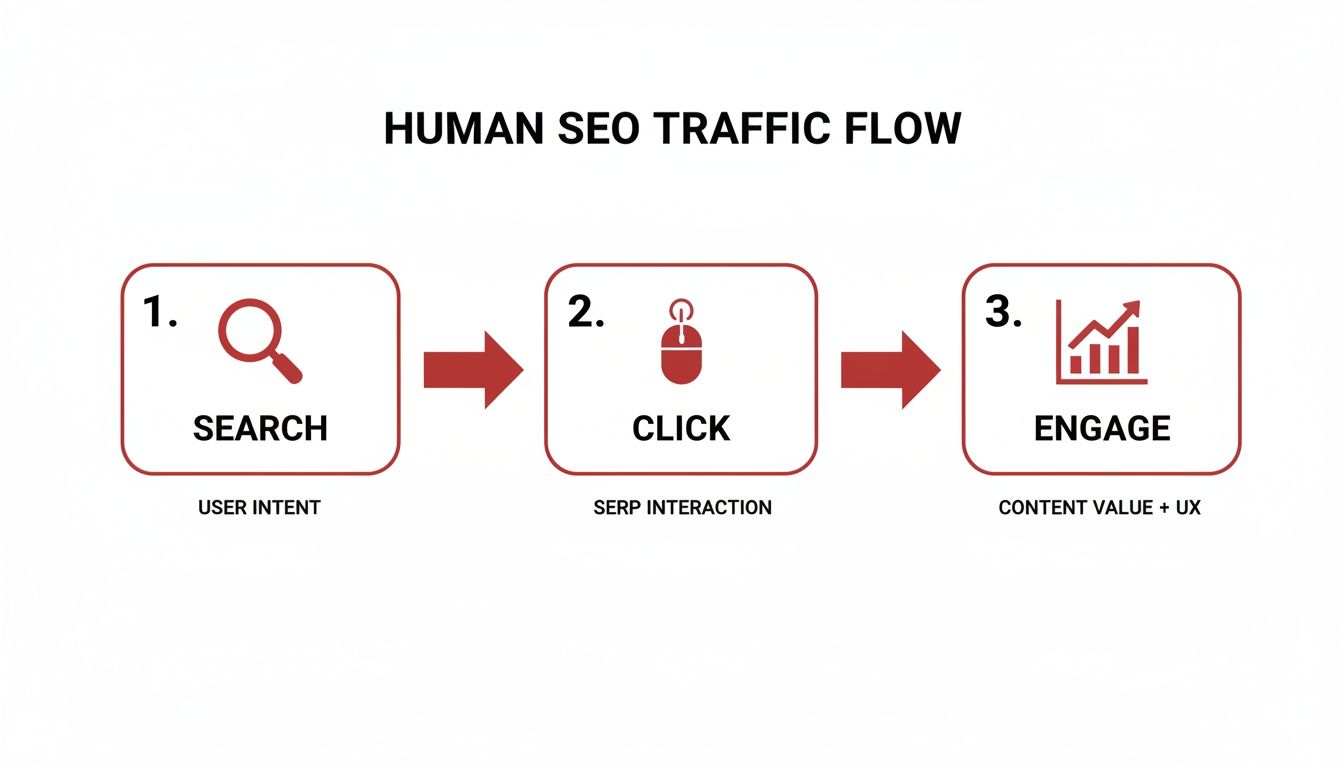
That simple process—search, click, engage—is precisely what separates a quality service from a basic automated traffic bot. It’s about sending authentic signals, not just empty hits.
A Safe Implementation Strategy
Once you’ve found a reputable provider, don't just flip a switch and hope for the best. A "set it and forget it" mindset is asking for trouble. Instead, be methodical, test the waters, and let the data guide your decisions.
- Target Your "Almost-There" Keywords: Start with keywords that are already performing pretty well but are stuck on the bottom half of page one or the top of page two (think positions 4-15). These are your "striking distance" terms that often see the quickest gains from a CTR boost.
- Start with Low Volume: Don't crank the dial to 100 on day one. Begin with a small number of daily clicks, maybe 5-10 per keyword, to create a baseline and see how search engines react.
- Set Realistic Engagement Metrics: Configure your campaigns to have realistic session times and pages-per-visit. A good rule of thumb is to aim for metrics that are slightly better than your site's current organic average, but not so high that they look fake.
- Live in Your Analytics: Keep a close eye on Google Search Console. You're looking for two things: an increase in click-through rate for your targeted queries and, ultimately, an improvement in your average keyword positions. This data is your proof that it’s working.
By following this careful, data-driven strategy, you can use SEO traffic services to get that competitive advantage safely and effectively.
How to Measure Your Campaign's Success
So, you’ve pulled the trigger on an SEO traffic service. It’s easy to get caught up in the excitement, but that feeling won't last long if you aren't sure how to tell if it's actually working. Without the right metrics, you’re just throwing money at a problem and hoping for the best.
To truly understand the value you're getting, you need to know exactly what to look for and when. Success isn’t a single number; it's a story told through a handful of key performance indicators (KPIs) that show how targeted clicks are creating real SEO momentum.
The Key Numbers That Tell the Real Story
To get a complete picture, you'll need to look at how your rankings, clicks, and user engagement are all working together. The four KPIs below are your most reliable indicators of a successful campaign.
Your main dashboards for keeping score will be Google Search Console and Google Analytics.
- Keyword Ranking Improvements: This is the most straightforward sign of success. Are you moving up in the search results for your target keywords? Tracking your average position is the clearest way to see if you’re climbing toward page one.
- Organic Click-Through Rate (CTR): Keep a close eye on your CTR in Google Search Console. A clear lift in CTR for the keywords you’re focused on is often the very first signal that the service is having a positive effect.
- Overall Organic Traffic Growth: As your rankings climb and more people click on your links, you should naturally see a rise in the total number of organic visitors coming to your site. You'll track this in Google Analytics.
- Engagement Metrics: Don't just focus on getting people to the site; make sure they're the right people. Dive into Google Analytics and look at dwell time (also called average session duration) and bounce rate. If dwell time is up and bounce rate is down, it’s a great sign the traffic is high-quality and genuinely interested in your content.
Monitoring these numbers moves you from guesswork to a data-driven strategy, giving you undeniable proof of your progress.
A Realistic Progress Timeline
Results from an SEO traffic campaign don't happen overnight, but they do follow a fairly predictable pattern. The user behavior signals you're sending take time to register and influence Google's algorithms.
Think of the first few weeks as laying the foundation and collecting data. The real, visible impact on your rankings comes later, once Google has had time to process the new patterns of user interest.
Here’s a realistic timeline you can use to gauge your own campaign’s performance:
- Weeks 1-2: The campaign is live, and you'll start seeing the initial click data flow into your analytics. This phase is all about establishing a baseline and confirming that everything is being tracked correctly.
- Weeks 3-4: You should start to see a measurable increase in your organic CTR for your target keywords in Google Search Console. This is the first solid piece of evidence that the campaign is successfully influencing user signals.
- Weeks 5-8: This is when things get exciting. Fueled by a consistently higher CTR, you should begin to see your target keywords making noticeable jumps up the search rankings.
This simple framework helps you set realistic expectations and gives you clear milestones to watch for. By patiently tracking these KPIs against this timeline, you can confidently measure the return on your investment.
Common Questions About SEO Traffic Services
It's completely normal to have questions before diving into SEO traffic services. You’re right to be cautious. So let's cut through the noise and tackle the most common concerns head-on, so you can make a smart decision for your business.
Are These Services Safe for My Website?
This is the most important question, and the answer comes down to one thing: the source of the traffic.
If a service uses low-quality, automated bots running from obvious data center IPs, it's a massive red flag. Search engines can spot this a mile away, and it's a fast track to getting penalized. It’s simply not worth the risk.
A legitimate service, on the other hand, operates on a totally different level. A platform like ClickSEO, for instance, uses a distributed network of real devices, each with its own residential or mobile IP. This means the clicks and visits look exactly like genuine, organic user activity. To Google, it's indistinguishable from someone finding and clicking your link on their own.
How Is This Different from Buying Cheap Website Traffic?
This is a fantastic question because the two are worlds apart. Buying cheap, generic traffic is like paying a crowd of random people to wander aimlessly through your store. You get a spike in foot traffic, but none of them are interested in what you sell, and your bounce rate goes through the roof. It’s noise, not value.
Strategic SEO traffic is different. It’s not about just sending "visits." The entire point is to simulate the exact behavior you want Google to see—real people searching for your most important keywords and then choosing your website from the results. The goal isn't just to get clicks; it's to send a powerful signal that your page is the best answer for that search.
Cheap traffic buys you empty pageviews. A strategic traffic service helps you prove to Google that your result is the one searchers prefer.
When Will I See Ranking Improvements?
SEO is always a marathon, not a sprint, but you'll get feedback from this kind of campaign faster than you might think. You can typically see the initial impact on your click-through rate (CTR) data right inside Google Search Console within the first few weeks.
For those positive signals to bubble up and translate into real ranking gains, you need a little patience. Most campaigns start to show measurable upward movement in the search results within 30-60 days. The search algorithms need that time to collect the engagement data, process it, and reward your page with the visibility it's earned.
Can I Target Traffic from Specific Countries?
Absolutely. In fact, if a service can't do this, you should walk away.
Professional platforms like ClickSEO give you precise control over geotargeting. You can set up your campaign to send clicks from specific countries, or even get as granular as targeting individual cities. This is incredibly powerful for a local business trying to dominate its hometown or an online store focusing on specific international markets.
Ready to push your best content to the top of Google? ClickSEO gives you the tools to safely and effectively boost your CTR and send the right user signals. Start your free trial today and watch your rankings climb.