
Buy Click Traffic Smartly: Avoid Penalties & Boost SEO

Some pages are easy to diagnose. They rank well, get impressions, and convert. Others sit in the most frustrating zone in SEO: visible enough to tease opportunity, weak enough to stay stuck.
That is when the question comes up: should you buy click traffic?
The honest answer is not a clean yes or no. It depends on what kind of traffic you are buying, how you deploy it, and whether your page deserves the lift once users arrive. I have seen bought traffic act like gasoline on an already healthy page. I have also seen it waste budget, distort reporting, and create risk when the traffic source was sloppy.
The practical way to think about buy click traffic is not as a shortcut. It is a risk-managed intervention. You use it when a page already matches search intent, the snippet is competitive, and you need better user signals to help the page move. You avoid it when the page is thin, slow, off-target, or dependent on fake volume.
Why SEOs Are Tempted to Buy Click Traffic
A common scenario looks like this.
You have a landing page that should rank better. The keyword fit is strong. The content is good enough. Internal links are in place. Search Console shows impressions. But the page sits just outside the range where meaningful clicks happen, and progress is slow.

That gap matters because users favor the top result. The temptation to influence click behavior is obvious when you understand how much CTR separates positions. It is also why many SEOs start looking into why SERP clicks impact SEO.
The page two trap
Most site owners do not want “traffic” in the abstract. They want a page that has already earned some relevance to break through.
At this point, buy click traffic enters the conversation. Not as random visits. As an attempt to improve the behavioral picture around a query-page pair that is already close.
The problem is that the market lumps together three very different things:
- Cheap bot traffic that produces visits with no real user intent
- Low-quality human traffic from loose incentives and weak targeting
- Search-behavior traffic designed to resemble genuine discovery and engagement
Those are not interchangeable. One can damage the site’s data and risk profile. Another can create noise. The last one can be useful if the page is already strong.
Why the risk conversation comes first
The scale of fake and automated traffic is the reason experienced operators stay cautious. In 2024, bad bots accounted for 37% of all web traffic, and only 49% of internet traffic came from real humans, according to Fraud Blocker’s click fraud statistics summary. If you buy clicks without verifying where they come from, you can end up paying for activity that does nothing except inflate sessions and create suspicious patterns.
If the vendor talks about “guaranteed volume” before they talk about behavior quality, that is the wrong conversation.
The attraction of buy click traffic is understandable. CTR can influence visibility. Engagement can reinforce relevance. But the only version of this tactic worth considering is the version built around authentic-looking human behavior, tight targeting, and realistic pacing.
Human Clicks vs Bot Traffic Understanding Your Options
Most advice on buy click traffic fails because it treats all purchased visits as one category. They are not.
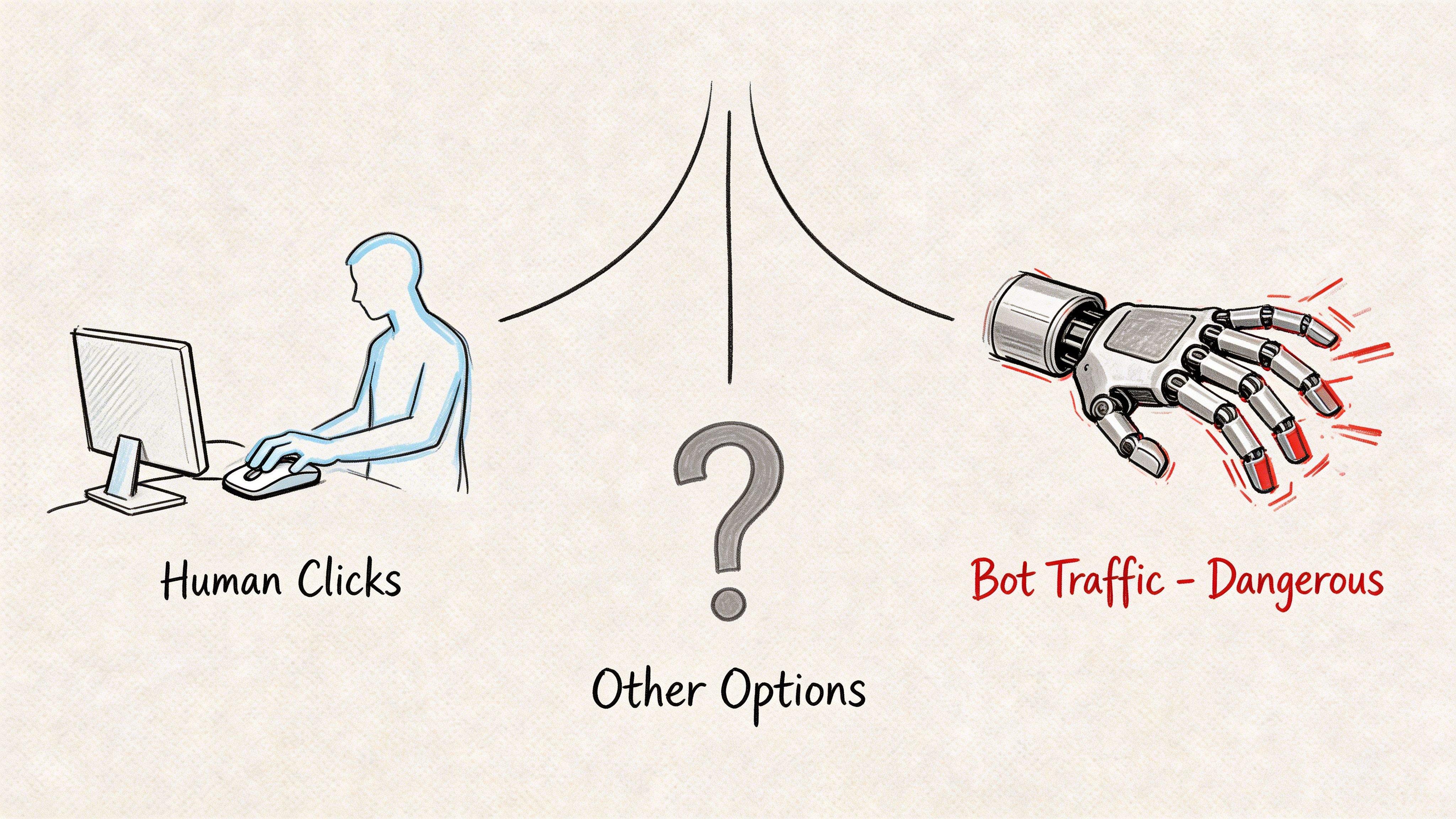
When I assess a traffic source, I sort it into three buckets. That keeps the discussion grounded in outcomes, not marketing language.
Bot traffic
This is the easiest type to buy and the worst type to use.
Bot-driven traffic usually comes from predictable infrastructure, generates shallow sessions, and leaves behind behavior that does not resemble search users. The danger is not just that it fails. It can train you to trust the wrong metrics. Sessions go up, but rankings do not. Sometimes the page looks busier in analytics while business results stay flat.
The search opportunity is large enough to make people chase shortcuts. The top organic Google result gets an average 45.6% CTR, while the second result gets 12.3%, according to RiseOpp’s CTR statistics roundup. That gap explains the appeal of boosting clicks. It does not justify using bots.
For a closer breakdown of why automated traffic creates detectable patterns, this explainer on traffic bot behavior is useful.
Incentivized or low-quality human traffic
This category is more confusing because it involves real people.
The issue is intent. If users click because they are paid to perform a task, pushed through irrelevant offers, or routed from untargeted exchanges, the session may be human but still worthless for SEO. They often bounce fast, ignore page structure, and produce no micro-conversions.
Many campaigns often fail at this stage. The buyer thinks, “At least it’s not bots.” But human does not automatically mean useful. Search engines evaluate behavior in context. If the visit pattern does not fit the query, location, device mix, or engagement profile the page normally attracts, it can create more mismatch than lift.
A quick primer helps here:
Bots mimic access
They can trigger page loads and fake volume, but their sessions often look mechanical.Weak human traffic mimics presence
A person did click, but the visit says little about genuine query satisfaction.Search-aligned human traffic mimics intent
The user path starts with a keyword, lands on the right page, and continues with believable browsing.
Here is a useful walkthrough on the broader traffic quality problem before the next distinction.
Search-aligned human click traffic
This is the only category I consider viable.
The useful version of buy click traffic starts with a SERP action, not a dumped visit. Users should search, find the listing, click through, stay long enough to signal relevance, and visit additional pages when that makes sense. The session should match the site’s normal audience by geography, device type, and intent.
That is very different from “send me 10,000 visitors.”
The mechanics matter:
Entry path matters
Organic-style entry is more credible than direct traffic dumps.Engagement matters
Time on page and second-page views tell a better story than a one-page session.Audience fit matters
A local service page needs local behavior. A SaaS comparison page needs research-oriented behavior.
Good bought click traffic does not try to overpower your existing data. It tries to blend into it.
When it is viable
I consider this tactic only when three things are already true:
- The page satisfies intent.
- The snippet is worth clicking.
- The site can handle and convert the added attention.
If those pieces are missing, buy click traffic just exposes the weakness faster. If they are in place, carefully managed human clicks can help nudge a page that is already close.
How to Vet and Choose a Reputable Traffic Vendor
Most of the risk in buy click traffic is concentrated in vendor selection. If you choose poorly, the campaign is compromised before it starts.
Good vendors tend not to be flashy. They answer operational questions clearly, define what they can control, and avoid unrealistic promises. The bad ones lean on volume, vague language, and miracle outcomes.
What to ask before you buy
I start with basic questions that force the vendor to describe how their traffic works.
Where do the clicks originate
You want to hear about search-led sessions, real devices, and audience controls. You do not want to hear “proprietary network” with no explanation.How do users reach the page
If the answer skips over the search behavior and jumps straight to delivery volume, that is a warning sign.Can I control geography, device mix, and landing page mapping
Granular control matters because traffic that does not match your market is easy to spot in analytics.What engagement can be configured
Session duration, page depth, and path variation should be discussed openly.How do you avoid unnatural traffic spikes
Reliable vendors talk about pacing and smoothing, not bursts.What should I monitor after launch
A serious partner expects you to review Search Console and analytics, not just trust a dashboard.
One practical option in this category is buy organic traffic through services built around search-style human sessions rather than raw visit dumps. The point is not the label. It is whether the vendor can explain the mechanics with enough detail to let you judge risk.
Vendor vetting checklist
| Question for Vendor | Ideal Answer (Green Flag) | Warning Sign (Red Flag) |
|---|---|---|
| What type of traffic do you send? | Human-driven, search-style sessions with configurable targeting and engagement | “Guaranteed real traffic” with no explanation |
| Can I choose keyword to URL alignment? | Yes, with control over landing pages and query targeting | “We send visitors anywhere on your site” |
| How is session behavior handled? | Configurable dwell time, page depth, and realistic browsing patterns | Single-click delivery or no behavior settings |
| Can traffic be paced gradually? | Yes, with controlled daily delivery and traffic smoothing | Instant bulk traffic dumps |
| Do you guarantee rankings? | No. They discuss probabilities, fit, and testing | Yes, they promise ranking outcomes |
| Will this traffic appear in analytics tools? | They explain how visits may appear and what to verify | They avoid measurement details |
| What happens if a segment underperforms? | Pause, adjust, or refine by geo, keyword, or device | “Just increase volume” |
| Do you explain policy risk? | Yes, with clear limitations and use cases | “Zero risk” claims |
Red flags that usually predict failure
Some warning signs are enough for me to walk away.
First, any vendor selling clicks at ultra-cheap mass volume is selling a traffic problem, not a traffic solution. Cheap is not the issue by itself. Lack of believable behavior is.
Second, be careful with ranking guarantees. No one controls the full ranking system. A serious vendor should talk about signal support, not certainty.
Third, watch how they handle questions about analytics. If they cannot explain what “good” traffic should look like once it lands, they are probably not thinking beyond delivery.
If you cannot picture the session in Google Analytics or Search Console before launch, do not buy it.
Green flags that matter more than flashy sales pages
I trust vendors more when they volunteer constraints.
That means they tell you to start with a small page set. They ask about your baseline organic traffic. They care whether your page loads well and whether the title tag already earns clicks. They recommend testing before scaling.
That is how experienced operators behave. They know this tactic works only when the bought clicks fit the page, the query, and the site’s existing pattern.
Designing Your First Click Traffic Campaign
The first mistake most buyers make is treating this like media buying. It is closer to signal calibration. You are not trying to flood a site with sessions. You are trying to support a small set of pages with behavior that looks and acts like legitimate search demand.
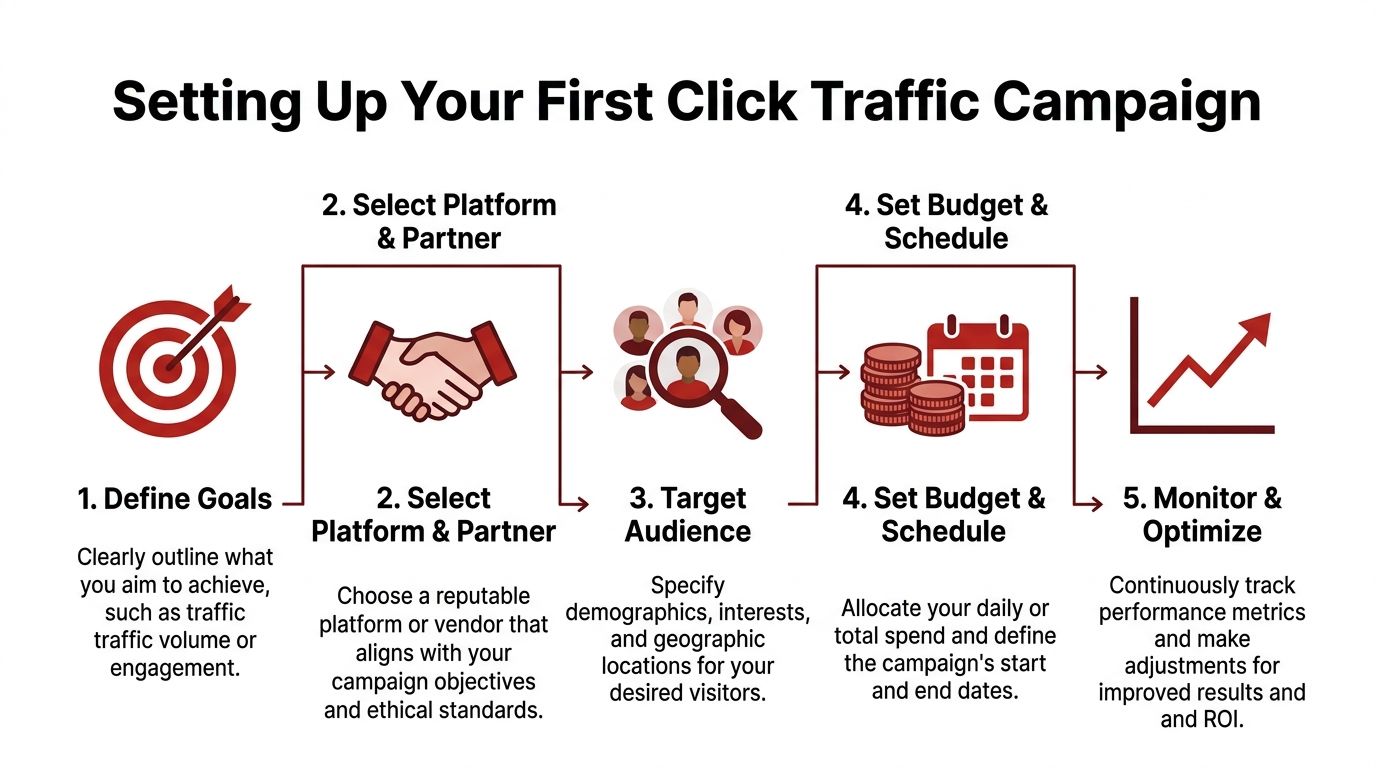
Start with one page type, not the whole site
Pick pages that are already close to earning more visibility.
Good candidates include commercial pages with solid intent match, local landing pages with real service relevance, and comparison pages that already collect impressions. Weak candidates include thin blog posts, pages with poor mobile experience, and URLs that have never shown meaningful query alignment.
The page should already deserve attention. Bought clicks should reinforce that. They should not compensate for a weak asset.
Choose keywords that map cleanly to intent
Do not force a broad keyword set into one page.
The cleanest campaigns target queries where the searcher’s expectation and the page’s offer line up. If the keyword suggests product comparison, the page needs comparison content. If the keyword signals local service intent, the page should clearly serve that geography.
I prefer tighter clusters over broad ambition. A small keyword group gives you clearer readouts in Search Console and makes it easier to see whether the traffic is supporting the intended page.
Pace the campaign like real demand
Here, restraint is important.
Verified guidance on this tactic notes that successful campaigns often see results by adding daily organic clicks with good dwell time and multiple pageviews per session, which can lead to an improvement in perceived CTR in SERP visibility studies. Since no source URL was provided alongside that verified note, I treat it as directional operational guidance rather than something to overstate.
The practical lesson is simple: start modestly.
A sensible campaign has these traits:
Measured daily volume
Enough to matter, not enough to distort the site’s normal behavior.Stable timing
Traffic arrives throughout the day, not in one unnatural burst.Geographic alignment
If you sell in one country or one city, traffic should reflect that.Device realism
Mobile and desktop patterns should match the audience you already attract.
One service that allows this kind of configuration is ClickSEO, which supports setting daily organic clicks, geo-targeting, session length, and page depth around keyword-led visits. Those controls are more important than raw traffic volume.
Build engagement into the session
A click alone is weak. A satisfying session is stronger.
You want the traffic source to support behavior that a real user might exhibit after finding the page in search. That usually means enough time on page to read, a second page view when relevant, and normal interaction with navigation or linked content.
I usually set campaigns around a few principles:
Match the page format
A service page needs a different dwell pattern than a long-form guide.Use natural next clicks
Secondary pages should be obvious, like pricing, features, contact, or related articles.Avoid forced depth
Five or six extra clicks can look worse than one natural follow-up page.
The best session path is the one your real users already tend to take.
Segment before you scale
Do not mix too many variables in the first run.
A better first campaign isolates a small set of URLs, a clean keyword cluster, and a defined geography. That lets you judge whether improved CTR coincides with ranking movement and on-page engagement. If you add too many pages, countries, and intents at once, you lose diagnostic clarity.
A simple campaign design framework helps:
Local business pages
For local SEO, keep geography tight and route users to the most relevant city or service page. Sessions should reflect local research behavior, not national browsing patterns.
Ecommerce collections or product pages
Target terms with clear purchase or comparison intent. Users should land on pages with strong product relevance and obvious next actions such as category exploration or product detail clicks.
SaaS landing pages
Map keywords to evaluation-stage pages, not just homepage traffic. Trial, demo, feature, and comparison pages usually tell you more than broad branded visits.
Keep a control group
This is one of the most useful habits in practice.
Leave similar pages untouched. If targeted pages improve while comparable pages stay flat, you have a better basis for interpreting the effect. Without a control group, every positive movement is easy to over-credit and every drop is easy to misread.
Measuring Success and Proving ROI
If you buy click traffic and only track sessions, you will learn almost nothing.
The meaningful question is whether the campaign changed the right metrics in the right order. I look for a sequence: stronger query-level CTR, steadier engagement on the target page, ranking improvement for the mapped keywords, and then business outcomes such as leads, checkouts, or assisted conversions.
What to check in Search Console
Search Console is where the first useful signal appears.
Review the targeted queries and pages together. If the campaign is working, you want to see the page earning healthier click behavior on the exact terms it was designed to support. That matters far more than a sitewide traffic bump.
Look at:
Query-page alignment
The intended keywords should correspond to the intended URL.CTR movement on targeted terms
Improvement should show up where the campaign was focused.Position trend
Ranking movement may lag CTR changes, so compare over a sensible window.
What to check in analytics
Analytics tells you whether the post-click experience supports the search signal.
Many campaigns expose themselves at this point. Traffic lands, but users leave fast. That means either the bought traffic was weak or the page did not satisfy the intent the campaign assumed.
The warning from Babylon Traffic’s discussion of bought traffic and page experience is worth taking seriously: pages with sudden CTR spikes and high bounce rates often fail to sustain rankings, which suggests search engines may detect a mismatch between click signals and actual on-page experience.
I focus on:
Session quality
Are users staying, scrolling, and visiting relevant follow-up pages?Micro-conversions
Form starts, button clicks, video plays, and product interactions often show value before revenue does.Page-specific behavior
Sitewide averages can hide whether the target page improved.
Tie the campaign to business math
Bought clicks should eventually answer a commercial question, not just an SEO one.
For teams that already evaluate channel efficiency, it helps to frame performance alongside Return on Ad Spend (ROAS) thinking. Even if this is not paid media in the classic sense, the discipline is useful. Compare spend against the incremental revenue, lead value, or assisted conversion lift tied to the targeted pages.
The campaign is working only if stronger SERP behavior turns into stronger business behavior.
What success looks like
A good campaign does not always look dramatic.
Sometimes the best result is a page becoming more stable in rankings, holding improved CTR, and converting better from the traffic it already earns. That is more valuable than a temporary spike followed by a slide.
If the page improves in search but conversion quality drops, the campaign is not finished. It is misaligned.
Navigating the Risks and Platform Policies
Buy click traffic sits in a sensitive area. The tactic itself is not the only issue. The implementation determines most of the risk.
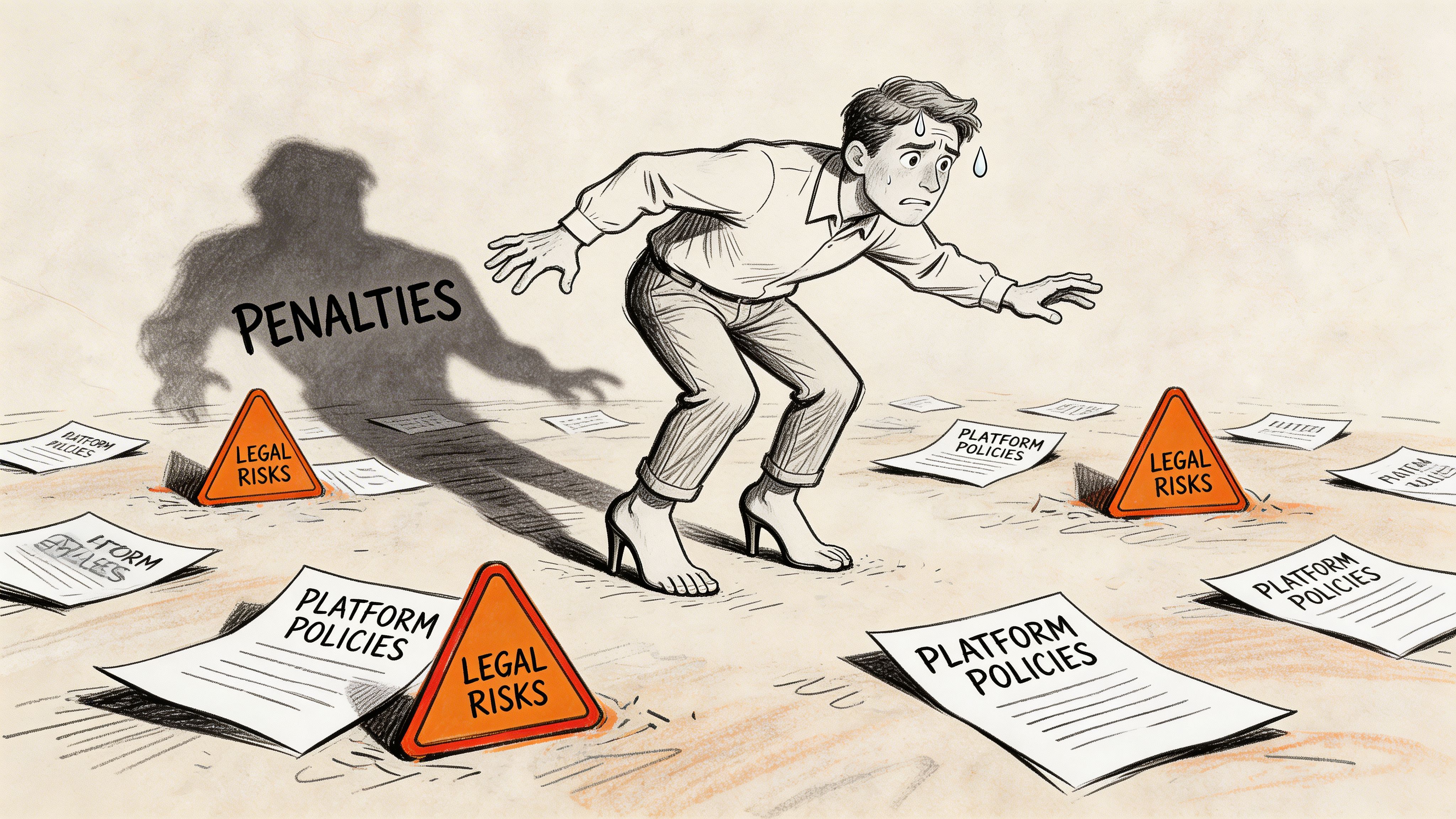
The primary danger
The biggest risk comes from artificial traffic patterns that platforms can classify as manipulation.
That risk increases when buyers use bots, traffic exchanges, or blended schemes that touch paid ad ecosystems. Verified guidance notes that industry news from 2024 to 2025 shows platforms such as Google Ads and Taboola have become more aggressive in detecting and penalizing artificial traffic, as discussed in Taboola’s marketing hub.
That matters because many site owners blur channels. They buy questionable traffic, run ads to the same domain, and assume the signals stay isolated. They often do not.
Practical safeguards
This is the framework I use when someone insists on testing bought clicks.
Keep paid ads separate
Do not mix this tactic with active ad traffic in a way that muddies platform trust.Start small
Small tests reveal quality issues before the pattern becomes expensive or risky.Use realistic pacing
Natural traffic curves matter. Sudden spikes are harder to defend.Match audience and geography
If your users are regional, the campaign should be regional.Document everything
Keep campaign settings, dates, target pages, and observed outcomes.
Why human-powered traffic still needs caution
Human-powered services are safer than bots when they are built around realistic search and browsing behavior. They are not automatically safe.
If the traffic does not fit the page, if the campaign scales too quickly, or if the page experience is weak, the same underlying mismatch appears. Search engines and ad platforms do not only care whether a person clicked. They care whether the pattern makes sense.
For SaaS teams especially, this sits alongside broader growth discipline. If you are working on sustainable acquisition rather than isolated ranking experiments, this guide on Master SEO Strategies for SaaS is a useful complement because it keeps click-focused tactics tied to content, product fit, and compounding search value.
Treat buy click traffic like a controlled test. Not a permanent substitute for better SEO.
The right mindset
This is a calculated gray-area tactic. It is not a foundation.
Use it to support pages that already merit higher engagement. Do not use it to disguise weak content, poor UX, or bad targeting. The safest campaigns are the ones that look like a small acceleration of real demand, not a manufactured event.
Frequently Asked Questions About Buying Click Traffic
Is buy click traffic the same as buying website visitors
No. Raw visitor packages usually optimize for volume. Buy click traffic for SEO should focus on search-style entry, realistic behavior, and page-query fit. Those are different products even if vendors market them similarly.
Can bought clicks improve rankings by themselves
Sometimes they can help a page move, but only when the page already deserves to rank better. If the content misses intent or the page experience is poor, extra clicks usually do not hold.
How long should a test run
Long enough to compare pre-test and in-test behavior in Search Console and analytics. A test should not be judged after a day or two. You need enough time to see whether CTR changes are followed by engagement stability and ranking movement.
Which pages should never be tested
Avoid pages with poor mobile usability, slow loading, weak content, or no clear query mapping. Also avoid pages tied too closely to active paid traffic if platform policy risk is a concern.
What is the clearest sign that the traffic is low quality
The clearest sign is mismatch. The visits show up, but they do not behave like your existing audience. Bounce patterns look wrong, secondary page paths make no sense, and targeted queries do not improve in a clean way.
Should agencies offer this to clients
Only with explicit disclosure, tight controls, and a clear explanation that this is a testable support tactic, not a guaranteed ranking service. If a client expects certainty, this is the wrong offer.
If you want to test buy click traffic without defaulting to cheap bot volume, ClickSEO is one option built around keyword-led human search sessions, configurable geography, and controllable engagement settings. Use it the same way you should use any service in this category: start with a narrow page set, monitor Search Console and analytics closely, and scale only if the traffic improves both rankings and real on-site behavior.