
Why You Must Not Buy Fake Traffic
Let's cut right to the chase: buying fake traffic is one of the worst mistakes you can make for your website. It’s an incredibly tempting shortcut, promising a flood of instant visitors. But the reality is a digital train wreck.
Imagine you’ve just opened a beautiful new restaurant. To make it look popular, you fill every seat with mannequins. The room looks packed from the outside, but inside? No one is eating, no one is talking, and certainly, no one is coming back tomorrow or telling their friends. That’s exactly what you’re doing to your website when you buy traffic.
The Tempting Lie of Fake Traffic
The urge to buy fake traffic usually comes from a good place—you want to see your numbers climb. When you've just launched a site or you're fighting to get noticed, the promise of thousands of visitors for a handful of dollars can feel like a lifeline. These vendors are masters at selling the dream of instant popularity.
But it's a hollow promise. The "visitors" they send are nothing more than ghosts in the machine. They're either bots running on a script or workers in a click farm paid pennies to mindlessly open and close browser tabs. They will never read your blog, buy your product, or become a genuine fan of your brand.
The Promise vs The Reality
So, what are these vendors actually selling? They're selling a lie, and the gap between what they promise and what you get is where the real damage happens. This isn't just a harmless fib; it's a decision that can actively sabotage your business from the inside out.
The core problem is that you are paying for data that lies. Every bot visit corrupts your analytics, making it impossible to understand how real users behave and what they truly want from your site.
To really drive this home, let’s compare the shiny marketing claims with the cold, hard truth.
Fake Traffic: The Promise vs The Reality
This table breaks down the advertised fantasy of buying traffic against the destructive reality for your website.
| Advertised Promise | Actual Reality |
|---|---|
| Instant Website Visitors | Useless bot clicks that provide zero value or engagement. |
| Improved SEO Rankings | Google penalties and a drop in search visibility due to unnatural traffic patterns. |
| Increased Brand Awareness | Damaged reputation and eroded trust with search engines and real users. |
| "Affordable" Marketing Boost | A complete waste of money that also pollutes your valuable analytics data. |
At the end of the day, those inflated visitor numbers are just a vanity metric. They look good for a moment, but they mean absolutely nothing. Real, lasting success is built on authentic human connection—something a bot can never, ever provide.
Choosing to build your audience the right way isn't just the safer option; it's the only path to a sustainable business. That initial high from seeing your traffic spike will quickly sour once you're staring at the real-world consequences: a penalized website, tainted data, and a hole in your budget.
What Is Fake Traffic, Really?
When you see an offer to buy fake traffic, what are you actually getting? It’s certainly not a stream of interested visitors ready to become customers. What you're buying is an illusion—a digital counterfeit designed to trick analytics and, ultimately, trick you.
I like to compare it to counterfeit money. A shoddy fake bill is easy to spot and completely worthless. A really good forgery might pass a quick inspection, but the moment it hits the bank, it's flagged, and you're the one left in trouble. Fake traffic works the exact same way, just with varying levels of digital sophistication.
The Three Main Flavors of Fake Traffic
Not all bogus traffic is made the same. Digging into the different types shows you precisely why taking this "shortcut" is such a gamble. The tech behind it ranges from laughably simple to scarily advanced, which makes spotting it a real cat-and-mouse game.
Here are the three main culprits you'll run into:
- Simple Script Bots: This is the most basic, common type. Think of them as simple programs that do one thing: visit a URL from a server or a network of hacked computers. They don't do anything else. They just land and leave, which is why they create a "visit" with a bounce rate that's close to 100%.
- Sophisticated AI Bots: This is your high-tech forgery. These bots use AI to act like real people—they'll move the mouse around, scroll down the page, and might even click on a few internal links. Their whole purpose is to look legitimate enough to fool basic detection systems.
- Human Click Farms: These operations use real people, often in low-wage countries, who are paid to manually click on websites all day long. Even though a human is behind the click, this traffic is just as worthless as a bot's because there's absolutely zero genuine interest in your brand, content, or products.
This cycle shows you exactly what happens when you buy fake traffic—it’s a loop of empty promises that leads to a damaged reputation.

The diagram really gets to the heart of the deception. You're sold on the idea of fast growth, but all you get are hollow numbers that actively poison your business data.
The Rise of Smarter Bots
This problem is getting worse, and fast. In 2026, bad bots made up a shocking 37% of all internet traffic. That’s a huge leap from 32% back in 2024. This growth is being powered by easily accessible AI tools that let anyone create bots that can copy human behavior with unnerving accuracy.
The most dangerous thing about modern fake traffic is its ability to blend in. An advanced bot might stay on your site for two minutes and visit three pages, generating data that looks completely real but is 100% artificial.
To get a handle on this, you need to understand concepts like what is click fraud and how it directly messes with your traffic reports. This isn't just about vanity metrics; it's about actively corrupting the data you rely on, which can get you slapped with serious penalties from platforms like Google Ads.
Whether it’s a simple script, an AI bot, or a human in a click farm, the result is identical: you pay for worthless activity that puts your entire website at risk. If you want to go deeper on the technical side, our guide on the modern https://www.clickseo.io/blog/traffic-bot breaks it down even further.
The Hidden Costs and SEO Dangers
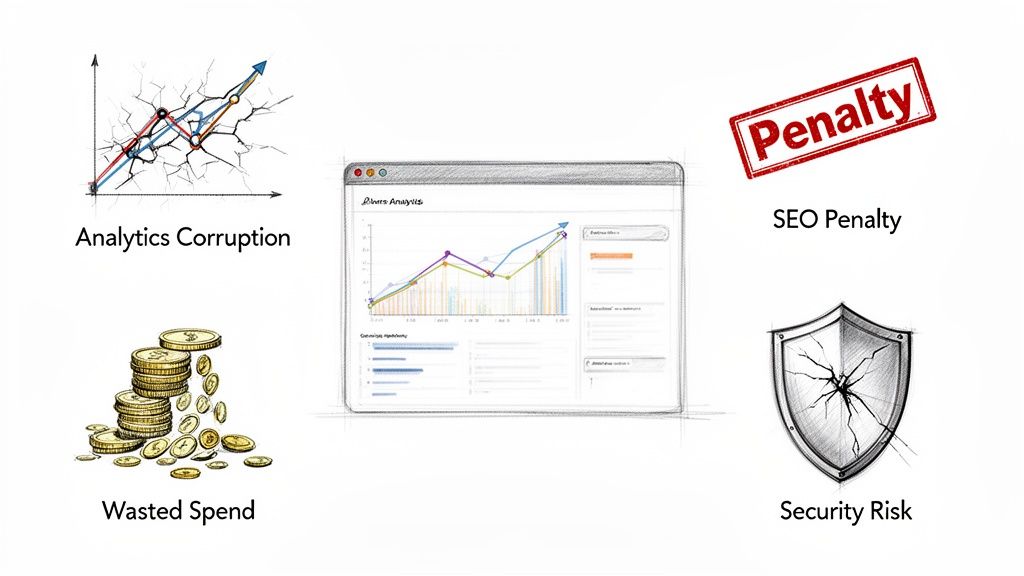
When you buy fake traffic, the price you pay upfront is just the beginning. The real damage isn't measured in dollars but in the chaos it unleashes on your data, your rankings, and even your website's security. This isn't some harmless shortcut; it's a digital infection that quietly spreads through every part of your online business.
Think of your analytics platform as your business's command center. It’s how you understand what customers want, where they're coming from, and how they behave on your site. Fake traffic is like flooding that command center with static, drowning out the actual signals from real people and making it impossible to know what's truly going on.
The fallout from this decision creates a domino effect of problems, each one a major threat to your brand's future.
Analytics Corruption: The Data You Can No Longer Trust
The first and most immediate casualty of fake traffic is your data. It becomes completely corrupted. Every bot that hits your site registers as a session, a user, and a pageview, turning your analytics into a funhouse mirror that distorts every metric you depend on.
Just imagine you're running an e-commerce store. You see a huge spike in visitors from a new campaign and, thinking you've struck gold, you double down on your ad spend. But what if 95% of those "visitors" were bots? You've just thrown a pile of money away based on a complete fabrication.
This leads to a whole cascade of terrible business choices:
- Misguided Marketing Spend: You end up pouring cash into channels that look like they're performing brilliantly but are really just attracting more bots.
- Poor Product Decisions: You might see high traffic to a specific product page and order more inventory, only to find out no real person was ever interested.
- Flawed Content Strategy: You could start creating content based on topics that bots are programmed to visit, completely missing what your human audience actually wants.
When your data is corrupted, you are flying blind. Every decision, from marketing to inventory, is based on a foundation of lies, making strategic failure almost inevitable.
SEO Penalties and Ranking Plummets
Google has spent years training its algorithms to spot artificial engagement. They are designed to reward websites that real people find useful and, just as importantly, to penalize sites trying to cheat the system. Buying fake traffic is like waving a giant red flag right in Google’s face.
Think about the signals you're sending:
- An unnatural, massive surge in traffic from a single, low-quality source.
- A 100% bounce rate because bots land on a page and leave instantly.
- An average session duration of zero seconds.
- Thousands upon thousands of "visitors" with zero conversions, sign-ups, or any other meaningful action.
These patterns practically scream "manipulation." Google’s reaction can be anything from an algorithmic devaluation—where your pages just quietly lose their ranking power—to a full-blown manual action penalty that boots your site from search results entirely. Clawing your way back from a penalty like that is a long, painful ordeal that can take months, assuming you can recover at all.
Wasted Resources and Financial Drain
The financial bleeding doesn't stop with what you paid the fake traffic vendor. You're also burning through money on server resources and bandwidth just to serve pages to mindless bots. And if you're running pay-per-click ads, it gets even worse. Fake traffic can generate fraudulent clicks on your own ad campaigns (a practice known as click fraud), draining your budget with zero possibility of a return.
Security Vulnerabilities: A Gateway for Attacks
Perhaps the most frightening risk is that bot traffic often acts as a Trojan horse for much more sinister activities. The networks used to generate fake visits are often the same ones used for credential stuffing, account takeover (ATO) attacks, and distributed denial-of-service (DDoS) attacks. You’re essentially rolling out the welcome mat for criminals.
This isn't a small-time problem. During the 2026 holiday shopping season, cybercriminals made at least $17.2 million just from selling stolen accounts—a black market fueled by bot-driven fraud. For an e-commerce site, this fake influx doesn't just mess with your conversion rates; it puts your real customers' accounts at risk.
When you buy fake traffic, you're not just getting empty stats. You may be inviting a full-blown security breach. You can get more details on these emerging threats and how they impact businesses by exploring recent holiday bot attack trends.
How to Detect Fake Traffic in Your Analytics
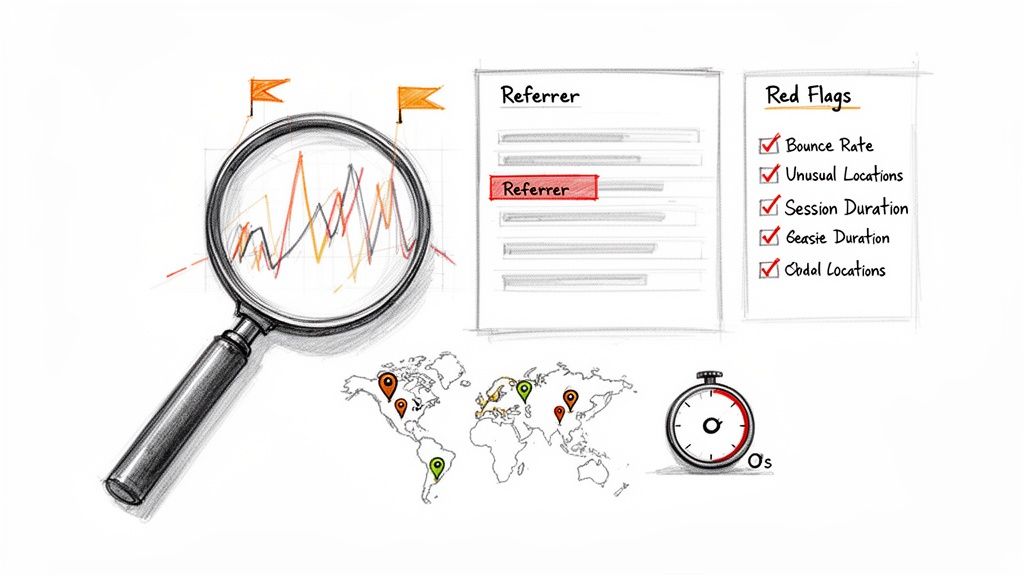
If your website's data just feels off, you’re probably right. The good news is that fake traffic, no matter how clever, almost always leaves a trail. Think of yourself as a digital detective—learning to spot these digital breadcrumbs in your analytics is the first step toward getting your real story back.
You don't need a degree in data science to find the clues. By knowing exactly where to look in Google Analytics 4 (GA4), you can quickly see the patterns that scream "bot." These patterns are often just too perfect or far too chaotic to be human.
Pinpointing Suspicious Traffic Sources
Your first stop should always be the Traffic acquisition report in GA4. Healthy traffic is a nice, balanced mix of sources: organic search, social media, direct visits, and referrals from sites you actually know. Fake traffic, on the other hand, usually sticks out like a sore thumb.
Keep an eye out for a sudden, massive wave of traffic from a single, odd-looking referral domain you don’t recognize. Another huge red flag is a sky-high percentage of Direct traffic, especially if it doesn't line up with any email campaigns or brand-building efforts you're running. Bots often go straight to a URL, completely bypassing the normal ways people find a website.
Analyzing On-Site Behavior Patterns
Once you've flagged a suspicious source, it’s time to dig into its behavior. This is where you’ll find the most damning evidence. Real people browse, they read, and they click around. Bots, even the more sophisticated ones, tend to follow rigid, unnatural scripts that are surprisingly easy to spot.
Here are a few dead giveaways:
- A Near-100% Bounce Rate: If visitors from one source land on a page and leave immediately without a single click or scroll, it’s a strong sign of junk traffic.
- Zero-Second Session Durations: Real visitors spend at least a few seconds on your site. Sessions that last for 0 seconds are almost always automated pings.
- Identical User Journeys: See hundreds of "users" taking the exact same path? For example, visiting the same three pages in the same order every time? That’s not a coincidence; it's a script at work.
The most reliable way to spot fake traffic is to look for extremes. A bounce rate of 100% or an average engagement time of 0 seconds from any single traffic source is not a natural human pattern.
Using Our Red Flag Checklist
To make your audit a little easier, we've put together a checklist to help you spot suspicious activity in GA4. Use this table to cross-reference the metrics that matter with the tell-tale signs of fake traffic.
Red Flags for Fake Traffic in Google Analytics 4
Use this checklist to identify suspicious traffic patterns that may indicate the presence of bots or other forms of fake traffic.
| Metric to Check | Suspicious Pattern to Look For | Where to Find It in GA4 |
|---|---|---|
| Session source / medium | A huge percentage of traffic from one unknown referral or a disproportionate amount of Direct traffic. | Reports > Acquisition > Traffic acquisition |
| Engagement rate | An engagement rate near 0% (or a bounce rate near 100%) from a specific source. | Reports > Acquisition > Traffic acquisition |
| Average engagement time | An average engagement time of 0 or 1 second from a specific country or traffic source. | Reports > Engagement > Pages and screens |
| Geographic Location | Sudden, massive spikes from countries unrelated to your target market (e.g., thousands of visits from a country where you don't do business). | Reports > Demographics > Demographic details (select Country) |
For a deeper dive into what qualifies as worthless engagement, our guide on a deeper look at fake web traffic can provide more context.
By checking these metrics regularly, you can protect your analytics from being polluted. The goal isn't just to spot the problem, but to understand it. That way, you can stop wasting resources and focus on attracting the real visitors who actually matter to your business.
Safe Alternatives for Real SEO Growth
So, you’ve seen how to spot the digital ghosts in your analytics. The good news is that the path forward is much clearer. To get real, sustainable growth, you have to stop chasing shortcuts and start attracting actual, engaged people to your site. It’s time to shift your focus from buying empty numbers to earning the kind of valuable interactions that search engines are built to reward.
It really boils down to one thing: instead of trying to fool Google, give it exactly what it’s looking for. Search engines want to promote websites that give users a great experience. They measure this with engagement signals—things like click-through rate (CTR), how long people stick around (dwell time), and whether they click through to other pages on your site.
Building Authentic Engagement Signals
The most direct way to show Google your site has value is by improving its organic click-through rate. A high CTR sends a simple, powerful message: when people see your page in the search results, they find it more interesting and relevant than the other options. It’s a direct stamp of approval from real users.
But how can you improve these signals without turning to shady tactics? The answer lies in focusing on two things: creating fantastic content that people genuinely want to click and making sure that content gets the engagement it needs to prove its worth. This is where a white-hat approach to CTR optimization can completely change the game.
Unlike services that use bots to buy fake traffic, a legitimate strategy uses real people to create genuine engagement. This is the critical difference between fighting against Google’s rules and working in harmony with them.
Introducing ClickSEO: A Risk-Aware Solution
This is exactly the role a service like ClickSEO was designed to fill. Think of it as the antidote to all the bot-driven noise, prioritizing quality engagement over junk quantity. ClickSEO taps into a huge network of real human users, each with a unique 4G or Wi-Fi IP address, who perform actual searches for your target keywords.
Here’s a look at how it works behind the scenes:
- Real Searches: A real person opens Google and types in your keyword.
- Authentic Clicks: They scroll through the results, find your website, and click on your link.
- Genuine Engagement: They then spend time on your site, browse different pages, and interact with the content just as any organic visitor would.
This process generates the precise user behavior signals that Google's algorithm is designed to find and reward. It’s not about fabricating traffic; it’s about amplifying the positive signals your quality content already earns.
This type of service gives you a dashboard where you can fine-tune how these real users interact with your site. You can set things like daily clicks, the average session length, and even which specific pages you want them to visit, giving you granular control over the engagement signals you’re building.
Let's face it, the internet is swimming in automated activity. A recent report showed that for the first time in a decade, bot traffic accounted for 51% of all internet activity, with malicious "bad bots" making up a staggering 37% of that. This flood of fake interactions makes it incredibly difficult for marketers to trust their data and for search engines to separate the good from the bad.
In an environment like this, services that can deliver clean, human-driven signals offer a serious competitive edge. It's all about focusing on authentic growth, whether that's through CTR optimization or other specialized techniques like Podcast SEO for your audio content.
The goal isn't just to get more clicks, but to get the right kind of clicks. Clicks from real, unique users send a powerful message to Google that your page is the best answer for a specific query.
By using a tool like ClickSEO, you can strategically lift your CTR and other key engagement metrics without any of the risks that come with buying fake traffic. It’s a targeted, data-driven way to help your best content climb the rankings for good. If you're ready for a safe and effective approach, you can buy organic traffic that’s driven by real people, ensuring you’re always building on the right side of Google.
Alright, let's get practical. You understand the dangers of fake traffic, but what should you actually do right now to protect your site and get back on a healthy growth track?
Instead of chasing empty numbers, it's time to focus your energy on building a site that real people genuinely want to visit. This isn't about some massive, complicated overhaul. It's about taking a few smart, decisive steps to clean house and build a solid foundation for the future.
Here's your a simple checklist to get started.
Your Immediate 5-Step Checklist
Think of this as digital triage. Your goal is to stop the bleeding, clean the wound, and then focus on real, long-term health.
Play Detective in Your Analytics: Your first job is to open up Google Analytics and look for the tell-tale signs we talked about. Hunt for those red flags: 100% bounce rates, session durations of zero seconds, or sudden traffic surges from oddball locations. This is your diagnosis.
Pull the Plug on Bad Sources: If you're currently paying for any traffic service and your audit reveals these kinds of patterns, stop. Immediately. You're not just wasting your budget; you are actively paying someone to poison your site's reputation with Google.
Clean Up Your Data: Once you've identified persistent bot traffic or spammy referrals, it's time to take out the trash. Use GA4 filters or your server's .htaccess file to block the worst offenders. Getting this junk out of your reports is the only way you'll be able to trust your analytics again.
Get Back to Basics: Now, redirect that money and effort toward strategies that actually work. This means doubling down on creating genuinely helpful content, building a rock-solid technical SEO foundation, and promoting your work where your real audience spends their time.
The most powerful shift you can make is from buying volume to earning value. One real visitor who converts is worth more than a million bots who do nothing.
A Smarter Path Forward
Finally, once your site is clean, you can consider legitimate ways to improve the engagement signals Google cares about. This is where a careful, strategic approach comes in.
- Consider White-Hat CTR Optimization: A service like ClickSEO, which uses a network of real people to find and interact with your site in search results, can be a safe and powerful tool. This approach sends exactly the right signals—higher click-through rates, longer dwell times—from real user activity, helping your best content earn better rankings without the risk of bot-driven penalties.
By following this plan, you’re not just dodging a penalty. You're building a stronger, more resilient business on a foundation of real human connection.
Common Questions About Buying Website Traffic
It's natural to have questions when you're trying to grow your site's traffic. When you see offers promising thousands of visitors for a few dollars, it's tempting to wonder if it's a legitimate shortcut. Let's clear up some of the most common questions people have about buying fake traffic.
Can Google Really Detect All Fake Traffic?
It's the million-dollar question: can you actually get away with it? While a super-advanced AI bot might slip past Google's defenses for a day or two, they can't hide forever. Google is a master of pattern recognition.
A single fake visit is just a blip on the radar. But when you have thousands of "visitors" all acting the same way—bouncing instantly, staying for the exact same amount of time, never clicking anything, and never converting—it paints a very obvious picture. You're betting against a system that's designed to spot these unnatural patterns. It's really not a matter of if you'll be caught, but when.
Is Manipulating CTR Always a Black-Hat Tactic?
Not at all. The difference between a "black hat" and "white hat" strategy comes down to one thing: the method. Using bots to mindlessly click your link thousands of times is a clear violation of Google's guidelines and a fast pass to a penalty.
On the other hand, a service like ClickSEO operates within a 'risk-aware' framework. It uses real people on unique home IP addresses who perform real searches and interact with your site. This sends the positive user engagement signals Google wants to see. The key is authentic human behavior versus mindless automation.
How Long Does It Take to Recover from a Penalty?
Honestly, this is a mess you don't want to have to clean up. The recovery time really depends on the penalty you get slapped with. For a manual action, you'll have to find and stop the fake traffic source, clean up any damage, and then file a reconsideration request. That whole process can take weeks, or even months, with no guarantee of success.
An algorithmic penalty is even worse because there's no one to plead your case to. You just have to fix the problem and wait—sometimes for a very long time—for Google's crawlers to come back and hopefully see that things have changed. It's far, far easier to just avoid fake traffic in the first place.
What Should I Budget for Authentic Traffic Generation?
The smart move is to shift your mindset from buying cheap volume to investing in real value. That $50 you might spend on 100,000 worthless bot visits is much better spent on strategies that attract genuine customers.
Think about putting that budget toward creating great content, running a small, targeted ad campaign, or using a legitimate CTR optimization service. The goal isn't just to get clicks; it's to get the right clicks from people who are actually interested in what you have to offer.
Ready to improve your rankings with real engagement? ClickSEO uses a network of real, human users to safely improve your CTR and boost your visibility on Google. Get started with a free trial today at ClickSEO.io.