Buy SEO Traffic Safely in 2026
When you hear the phrase "buy SEO traffic," it’s easy to picture something shady—like paying a back-alley character for a guaranteed #1 spot on Google. But that's not what we're talking about here.
In reality, buying SEO traffic is a strategy for generating authentic user activity on your site to influence positive ranking signals. It's not about paying Google directly, but about creating the kind of engagement that Google’s algorithm is designed to reward.
What It Really Means to Buy SEO Traffic
Let's face it: getting noticed on Google is tough. An eye-watering 90% of online pages receive absolutely no organic traffic from search. With competition that fierce, marketers are always looking for an edge, which is where the idea of buying SEO traffic comes in.
But there's a lot of confusion around the topic, and for good reason. It’s often lumped in with risky, black-hat tactics that can get your site penalized.
So, what does this actually mean in practice? When you buy SEO traffic, you are paying for visitors to come to your website. The all-important difference is the quality of those visitors. Think of it like a new restaurant. You could fill the tables with mannequins (bots) to look busy, but that won't create a real buzz or attract actual customers. Or, you could invite a crowd of real people to come in, enjoy a meal, and create a lively atmosphere that naturally draws in others walking by.
A Quick Look at Purchasable SEO Traffic
Not all paid traffic is created equal. Understanding the source and quality is the first step in making a smart decision. This table breaks down the most common types you'll encounter.
| Traffic Type | Source | Quality & Risk | Best For |
|---|---|---|---|
| Bot Traffic | Automated scripts and software | Very Low Quality & High Risk. Easily detected by Google and can lead to penalties. | Nothing. Avoid at all costs. |
| PPC Traffic | Ads on search engines (e.g., Google Ads) | High Quality & Low Risk. Real users with intent, but doesn't directly influence organic rankings. | Immediate, targeted traffic and lead generation. |
| Social Media Ads | Paid promotions on platforms like Facebook, Instagram, etc. | Variable Quality & Low Risk. Real users, but their intent may be passive (browsing, not searching). | Brand awareness and driving traffic from specific demographics. |
| SEO Engagement Traffic | Real human users directed from a network | High Quality & Low Risk (with a reputable provider). Mimics natural user behavior. | Boosting organic CTR and engagement signals for SEO. |
Ultimately, your goal is to attract real humans who send positive signals to search engines, not just inflate your visitor count with worthless hits.
Good Traffic vs. Bad Traffic
The success—and safety—of buying traffic comes down entirely to its source. Low-quality bot traffic is our "mannequin" in the restaurant. It might look like activity in a superficial report, but it adds zero value and can trigger Google's spam filters. On the other hand, high-quality, human-powered traffic is our "lively crowd"—it simulates genuine interest and sends all the right signals.
This flowchart shows exactly what we're aiming for: real user engagement, not bot-driven noise.
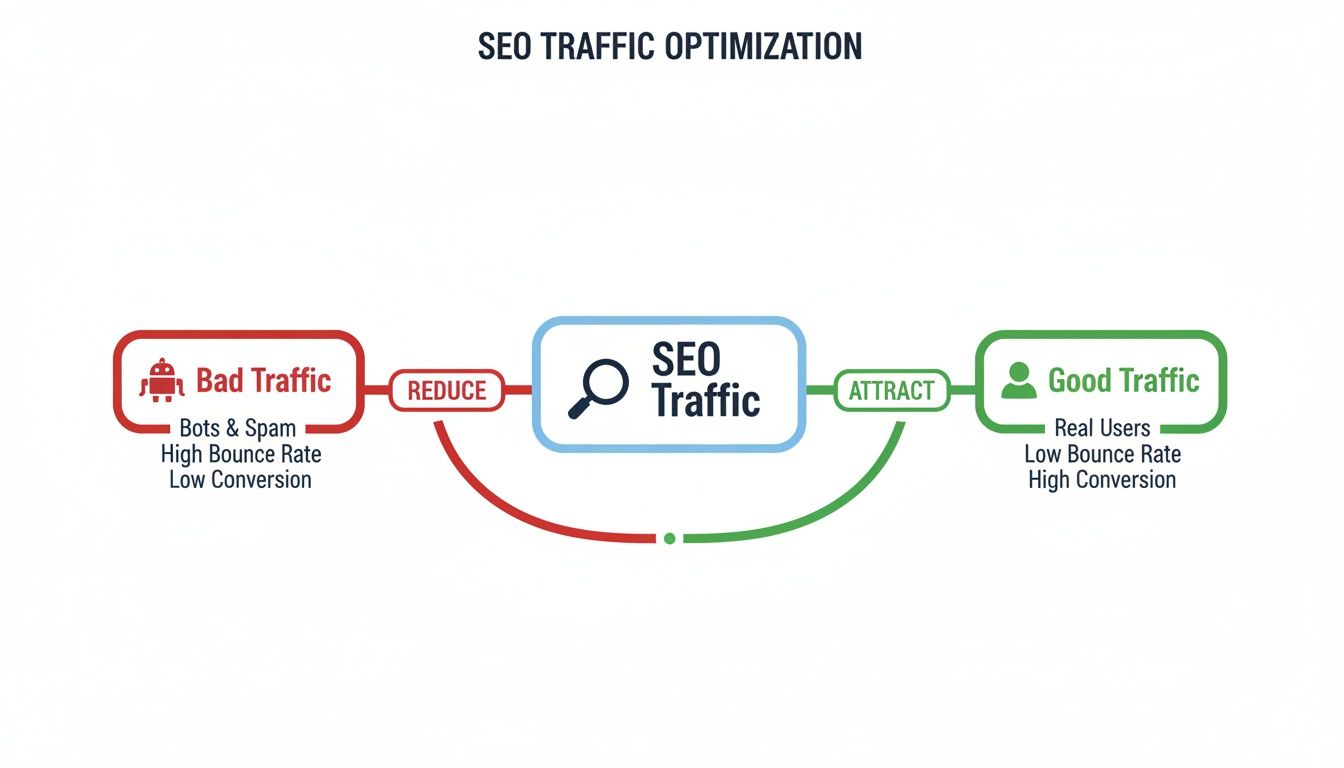
The key is separating the automated, high-risk bots from the authentic, beneficial human visitors. That's the foundation of a safe and effective strategy.
Legitimate services are built to generate clicks from real people who are instructed to perform a sequence of actions, such as:
- Searching for your target keyword on Google.
- Scrolling through the results to find and click your website.
- Staying on your page for a meaningful amount of time (dwell time).
- Sometimes, even navigating to a second or third page on your site.
This behavior perfectly mirrors how a genuinely interested user would act, signaling to Google that your page is a valuable and relevant answer to their query. Bot traffic does the opposite, creating instant bounces and other unnatural patterns that scream "low-quality." Understanding this distinction is the first and most crucial step to finding a good provider and avoiding a very costly mistake.
The Risks and Rewards of Buying Website Traffic
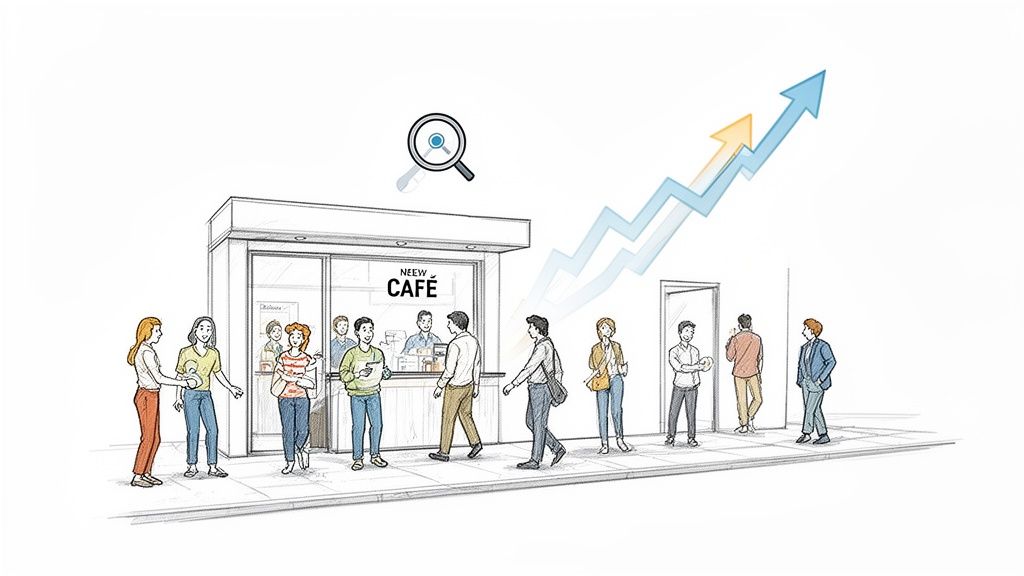
Let's be honest: buying SEO traffic feels like a high-stakes gamble. Get it right, and you could see some impressive gains. Get it wrong, and you risk doing serious, long-term damage to your site. Knowing the difference is everything.
The appeal is obvious, especially if you're just starting out. It can take months of painstaking work to get enough organic visitors to know if your site design, content, or user flow is even working. A good traffic provider can shorten that feedback loop dramatically, giving you real data to work with from day one.
If you have an established site, you know the frustration of hitting a ranking ceiling. Sometimes, you're stuck on page two, and no amount of on-page SEO seems to move the needle. This is where buying traffic can help by directly improving the user engagement signals Google cares about, like your click-through rate (CTR) and how long visitors stick around.
The High Cost of Cheap Traffic
But there's a dark side to this strategy, and it almost always starts with a deal that looks too good to be true. The web is full of vendors selling tens of thousands of visitors for a few bucks. This is the tell-tale sign of low-quality bot traffic, and falling for it can be a catastrophe for your business.
A Cautionary Tale: We’ve seen this happen time and again. An e-commerce store, hungry for quick results, bought a "50,000 visitors for $50" package. In a matter of weeks, their analytics were completely useless, their bounce rate shot up to over 98%, and their hard-won keyword rankings took a nosedive. Google’s algorithm easily spotted the fake activity and penalized the site, wiping out years of legitimate SEO.
Cheap, automated bots don't just burn through your budget with zero chance of a sale—they actively poison your site's reputation with search engines. These scripts create behavioral patterns that scream "low-value page," sending a powerful negative signal to Google.
Recognizing the Dangers
The consequences of using a shady traffic service are severe. Here’s what you’re up against:
- Serious Google Penalties: Your site could get hit with a penalty that makes it practically invisible in search results, killing your organic traffic overnight.
- Polluted Analytics Data: When your data is filled with bot traffic, you can't trust any of it. It becomes impossible to understand how real customers behave, derailing your entire marketing strategy.
- Zero ROI: It’s simple: bots don’t buy things. They don’t fill out contact forms or subscribe to newsletters. It's a guaranteed way to get absolutely nothing for your money.
Ultimately, your success or failure boils down to the provider's methods. You have to be able to tell the difference between a service that uses a network of real people to generate authentic user signals and an automated traffic bot that just sends empty, harmful clicks. Knowing how to spot the fakes is the key to running a safe and effective campaign.
The Smart Way to Influence Your SEO Rankings
Once you understand just how dangerous bot traffic is, it's easy to see why a different approach is needed. The answer isn’t to give up on buying traffic entirely, but to get smarter about it. This is where a modern, much safer method comes into play: using real people to improve your Click-Through Rate (CTR).
Instead of relying on cheap, automated scripts that Google can spot a mile away, this strategy uses a network of actual humans. These individuals, on their own unique devices and IP addresses, search for your keywords, find your site in the search results, and interact with it just like a genuine visitor would.
What Does Real Human Engagement Look Like?
Think about how you use Google. You type in a search, scan the results, and click on the one with the most compelling title. Once you're on the site, you probably spend a few minutes reading the content, maybe click a link to another page, and generally explore what it has to offer.
That’s exactly the behavior a human-powered service recreates. This sends a flood of positive signals directly to Google’s algorithm.
- Higher Click-Through Rate (CTR): When more people click your link from the search results, it tells Google your page is a great match for that specific keyword.
- Longer Dwell Time: People sticking around on your site is a strong indicator that your content is valuable and answers their question.
- Lower Bounce Rate: A visitor who clicks through to other pages on your site signals a high-quality user experience and deep engagement.
Simply put, you're using a network of real people to show Google that your page is a valuable and engaging result for searchers. This method directly improves the user behavior signals that are becoming more and more critical for ranking high.
This is a completely different world from the instant, toxic bounces you get from bots. Human-powered engagement methodically builds a strong case for your site’s relevance and authority, one real visit at a time. If you want to dive deeper into what separates safe services from risky ones, you can explore our detailed guide on SEO traffic services.
The Numbers Don't Lie: Why CTR Is a Game-Changer
The search results page is a fierce battleground where every single spot counts. With Google dominating 82.24% of the global search market, the difference between the top positions is staggering. The #1 spot enjoys an average CTR of 39.8%, but that number is more than cut in half to just 18.7% for the #2 position. This massive drop-off is exactly what platforms like ClickSEO were designed to overcome.
By simulating the entire search journey—from typing a keyword and clicking the result to browsing your pages—you can systematically improve the engagement signals Google rewards. Case studies consistently show that a well-executed campaign can deliver real, measurable ranking improvements in as little as 30-60 days.
This is how you buy SEO traffic in a way that works with search engine goals, not against them. With features like geo-targeting and the ability to customize how long users stay on your site, you can give your rankings a controlled, natural-looking boost. It's the key to breaking through stubborn plateaus and achieving sustainable growth, turning what was once a risky gamble into a calculated investment.
How to Choose a Safe SEO Traffic Provider
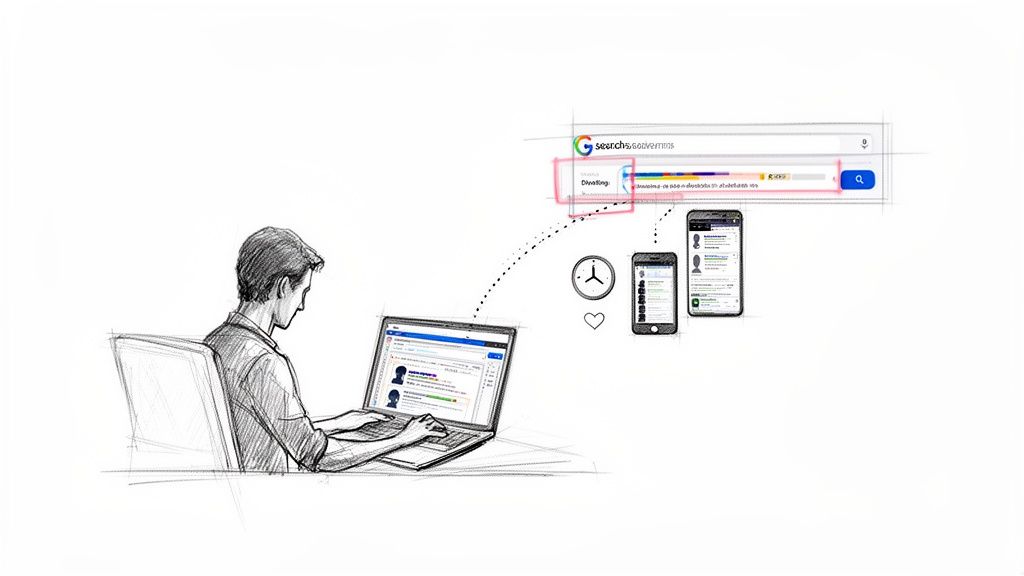
When you decide to buy SEO traffic, you’re stepping into a market where the line between a valuable partner and a harmful scam can be razor-thin. Your first job is to tell the difference. Not all providers are the same, and it's on you to separate the legitimate services from those selling snake oil.
Start by demanding total transparency. Ask them point-blank: are your clicks generated by real humans or automated bots? Any hemming and hawing is an immediate red flag. A provider worth their salt will be proud to show you how their human-powered network works.
To back up their words, ask for case studies with real-world results. You want to see proof—things like improved keyword rankings, higher click-through rates in Google Search Console, and better on-page engagement. If they can’t show you the proof, it probably doesn't exist.
Your Vetting Checklist
As you talk to potential providers, run them through this quick checklist. A trustworthy service should be able to tick every single box without hesitation.
- Human-Powered Network: They must confirm all clicks come from real people using their own unique devices and IP addresses, not from a bot farm.
- Analytics Visibility: The traffic has to be 100% visible in both your Google Analytics and Google Search Console. If they claim it’s “hidden” or “special,” just walk away.
- Customization Options: You should be able to control key variables like geo-targeting, daily click volume, session duration, and the number of pages a visitor views.
- No Unrealistic Guarantees: Anyone promising “guaranteed #1 rankings” is selling a fantasy. It’s a classic scam tactic because organic rankings are impossible to guarantee.
Knowing what to ask before buying an SEO retainer will help you make a much more informed decision and spot a reliable partner.
The Final Test
Never commit your entire budget upfront. Instead, treat it like a test drive. Start with a small pilot project on a handful of keywords for 30-60 days. This is the best way to measure the actual impact on your analytics and rankings with minimal risk.
With 58% of SEO professionals reporting that competition is soaring due to AI, choosing the right growth partner is more important than ever. The rise of AI search is changing the game, and a single misstep can seriously damage your hard-won visibility. You can find more details in these fast-moving SEO statistics.
This measured approach protects your budget and helps you find a provider that can actually deliver results. For a deeper dive, you can learn more about what is SEO safe traffic in our dedicated guide.
How to Measure the True Impact of Your Campaign
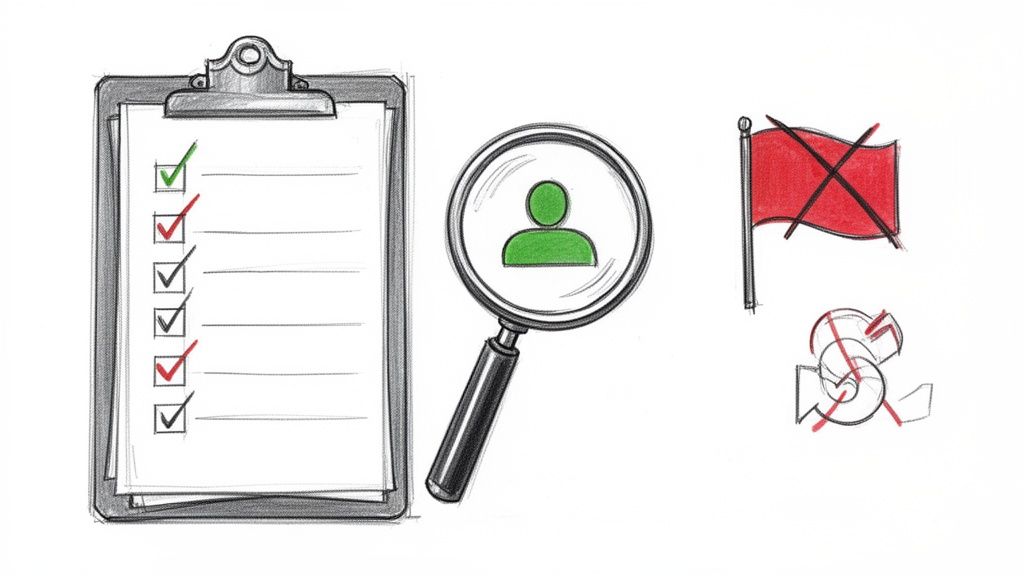
There’s an old saying: if you can’t measure it, you can’t manage it. When you buy SEO traffic, just seeing more visitors on your site isn’t the real win. The actual goal is to achieve real, measurable improvements in your search engine performance. To see if your investment is actually working, you have to look past those surface-level traffic numbers and dig into the key performance indicators (KPIs) that Google's algorithm truly values.
Your two best friends for this job are Google Search Console and Google Analytics. These tools give you a direct window into how users are behaving on your site and how that behavior is influencing your rankings. If you ignore them, you’re essentially flying blind, with no real way to prove your campaign is paying off.
Key Performance Indicators to Watch
Forget about celebrating simple traffic spikes for a moment. Instead, your focus should be on the core engagement metrics that show your campaign is adding genuine value. Positive movement in these areas is what tells you that future ranking gains are on the horizon.
- Organic Click-Through Rate (CTR): You’ll find this in Google Search Console for your target keywords. A rising CTR is a huge thumbs-up to Google, signaling that your page title and description are compelling searchers to click.
- Average Ranking Position: Also in GSC, keep an eye on this for your main keywords over a 30-90 day period. As engagement improves, you should see a slow but steady climb up the search results page.
- Average Session Duration: This Google Analytics metric shows how long people are sticking around. Longer sessions tell Google that your content is interesting and does a good job of answering the searcher's query.
- Bounce Rate: A high bounce rate means people are landing on your page and leaving without clicking anything else. A successful campaign will lower this number, proving your content is relevant and encourages further exploration.
When you buy SEO traffic, you're not just buying clicks; you're investing in a chance to improve these vital signals. The global SEO market is set to explode from $83.98 billion in 2026 to nearly $148.86 billion by 2030, with 92% of marketers actively working on their search presence. That massive spend highlights just how crucial this is, especially when you realize that organic results still get 94% of all clicks.
A Before and After Snapshot
Let’s paint a picture. Before your campaign, your page for "best running shoes" is languishing on the second page of Google, stuck at position 12. It has a dismal 1.5% CTR, an 85% bounce rate, and people only stay for about 35 seconds.
After a 60-day campaign focused on driving authentic user engagement, you check your analytics again. Your page is now at position 7 with a healthy 4.5% CTR. Even better, your bounce rate has dropped to 60%, and the average session is now over 90 seconds.
This is what success looks like in the real world. You’ve sent a clear message to Google: people who search for your keyword love your page. As you measure the impact of your own campaigns, getting familiar with 50 B2B SEO Statistics for 2026 Traffic, Conversion, and ROI can provide helpful benchmarks and industry context.
Frequently Asked Questions About Buying SEO Traffic
If you're thinking about buying SEO traffic, you probably have a lot of questions—and maybe a little skepticism. That’s smart. You should be cautious. Let's cut through the noise and give you some straight answers to the most common questions we hear.
Is Buying SEO Traffic Against Google's Guidelines?
This is the big one, and the answer isn't a simple yes or no. It really boils down to how the traffic is generated.
Google is absolutely clear on one point: using bots or any automated software to fake clicks is strictly against their rules. It's a blatant attempt to game the system, and if you get caught, your site could be hit with a penalty that makes it practically disappear from search results.
But what about traffic from real people? This is where things get interesting. Services like ClickSEO use actual, unique human users to find your site in search results and interact with it. The goal isn't to trick Google, but to improve genuine user engagement signals—like click-through rates and the amount of time people spend on your page. These are the very metrics Google looks at to decide if your content is valuable.
The real test is genuine human behavior. If the traffic looks and acts like an interested person exploring your site, it sends all the right signals. If it’s a bot that clicks and leaves immediately, Google sees that as a huge red flag.
To stay on the right side of Google, always work with providers who deliver authentic engagement from real people.
How Much Does Quality SEO Traffic Cost?
In this corner of the internet, you almost always get what you pay for. If you come across a service promising thousands of visitors for a few bucks, run the other way. That's a tell-tale sign of bot traffic that will poison your SEO, not help it.
Real, human-driven traffic costs more because it’s an investment in real people's time and a sophisticated platform to manage them. The price is usually based on a few key things:
- Number of Clicks: The total volume of visits you’re aiming for.
- Geo-Targeting: Targeting a specific city is different from targeting an entire country.
- Session Duration: You'll pay more for a user who sticks around for several minutes than for one who just clicks.
- Pages Per Visit: Campaigns where users visit multiple pages on your site are more complex and cost a bit more.
Yes, this is a bigger investment than a cheap bot package. But you're paying for sustainable ranking growth driven by authentic user signals, not a meaningless, temporary spike in your analytics report.
How Long Does It Take to See Ranking Results?
Buying SEO traffic is a long-term play, not an instant win. Think of it like watering a plant. You won't see it grow overnight. It takes time for search engines to collect the new engagement data, process what it means, and re-evaluate where your page belongs in the rankings.
With a consistent campaign using high-quality human traffic, most sites start to see positive keyword movement within 30 to 90 days.
But you can spot early signs of success much sooner. Keep an eye on your analytics for these green shoots, which can show up in just a few weeks:
- A higher organic CTR in your Google Search Console reports.
- Longer average session durations in Google Analytics.
- A noticeable drop in your page’s bounce rate.
Remember, a short, one-off campaign probably won't deliver lasting results. The key is consistency. You need to show Google over time that your page is a go-to resource that real people find valuable.
Ready to see how authentic user engagement can break your ranking plateau? ClickSEO provides real, human-powered clicks that improve your CTR and send the positive signals Google loves. Start your journey to the first page with a risk-free trial today.
Learn more and get started at https://clickseo.io.