Buy Traffic SEO: Boost Rankings & Avoid Penalties 2026
When you hear someone mention "buying traffic for SEO," your mind probably jumps straight to sketchy, automated bots and the risk of a Google penalty. I get it. But the reality of what works in 2026 is far more sophisticated. It’s less about brute force and more about sending the right signals with authentic user engagement.
What It Really Means to Buy Traffic for SEO

Let’s reframe what we’re talking about. Modern, effective "traffic buying" isn't about flooding your server with millions of fake hits from a bot farm. That’s a fast track to nowhere. Instead, it’s a strategic play to influence the very user behavior metrics that search engines like Google rely on to gauge content quality.
I like to use a restaurant analogy. Imagine you open a brilliant new place, but it's hidden on a side street. You could just wait for people to wander by, which could take months. Or, you could invite a handful of influential food critics to come have a great meal. Their positive reviews and word-of-mouth create a buzz that draws in a natural, organic crowd.
In SEO, that "buzz" comes from user engagement signals. When a service helps you generate these signals ethically, you're essentially showing Google that real people find your content to be a fantastic answer to their search.
The Two Sides of Bought Traffic
This is where things get critical. The phrase "buy traffic for SEO" is an umbrella term for two completely different worlds. Understanding the difference is the most important thing you can do to protect your site and actually see positive results.
Risky Bot Traffic: This is the dark alley of the traffic world. It’s all about using automated scripts to generate thousands of cheap, useless visits. These bots have zero real user intent. They hit your page and bounce instantly, leaving no footprint of genuine interaction. Google’s algorithms are incredibly good at sniffing this out, and the consequences can range from your site being ignored to a full-blown penalty.
White-Hat Engagement Signals: This is the strategic, legitimate approach we’re focused on. It involves a network of real human users, each on their own unique residential or mobile IP address, performing targeted searches. They find your page in the search results, click on it, and then act like a real visitor would—they spend time on the page, maybe click to another article, and signal to Google that your content delivered on the promise of the search query. Done right, this traffic is indistinguishable from your best organic visitors. You can find a deeper dive into this method in our guide on how to buy organic traffic.
A Comparison of SEO Traffic Generation Methods
To make the distinction crystal clear, let's put these methods next to each other. Pay close attention to how the primary goal shifts from simply inflating numbers to influencing authentic, meaningful user behavior metrics.
A Comparison of SEO Traffic Generation Methods
| Traffic Type | Method & Purpose | Risk Level | Primary Goal |
|---|---|---|---|
| White-Hat CTR Optimization | Real human users click on your SERP link and browse your site to simulate genuine interest. | Low | Improve CTR, Dwell Time, and reduce Bounce Rate. |
| PPC Advertising | Paying for clicks from search engines or social media platforms like Google Ads or Facebook Ads. | Low | Generate immediate, targeted traffic and leads. |
| Automated Bot Traffic | Software scripts generate high volumes of fake, non-human visits with zero engagement. | High | Inflate visitor counts with worthless traffic. |
As you can see, the only method designed specifically to improve your organic rankings through user signals is the white-hat approach. The others serve different purposes entirely—one for immediate lead generation and the other for, well, not much of anything useful.
How User Behavior Shapes Your Google Rankings
At its heart, Google is a massive user satisfaction engine. Its entire goal is to serve up the most relevant and helpful answer for any given search. To figure out which page is "best," Google doesn't just scan your keywords; it watches how real people interact with your site. It treats their behavior as direct feedback on your page's quality.
This is the exact reason a smart approach to buying traffic works. It's not about some black-hat trick. It's about giving Google the evidence it needs to see that your content is exactly what searchers are looking for.
Think of the search results page as a giant, ongoing election. Every time someone scrolls past the top results and deliberately clicks on your link, they're casting a vote for you. When they land on your page and stick around, maybe even click to another article, they’re confirming that their vote was a good one. These actions send powerful signals to Google, suggesting your page is a better answer than the ones ranked above it. Get enough of these "votes," and Google starts to believe you deserve a promotion.
The Key Signals Google Is Watching
Google's algorithm is complex, but it pays special attention to a handful of user engagement signals. If you want to see why carefully boosting these signals can move the needle on your rankings, you need to understand what they are and how they connect.
Click-Through Rate (CTR): This is simply the percentage of searchers who see your page in the results and choose to click on it. A high CTR for your ranking position is a huge tell for Google; it says your title and meta description are hitting the mark and grabbing attention.
Dwell Time & Session Duration: These two are closely related. Dwell time is how long a visitor stays on your page after arriving from a search. A long dwell time says, "This content is good. It's answering my question." Session duration is the total time they spend on your entire site during that visit. If they explore other pages, it shows a deep level of interest in what you have to offer.
Bounce Rate: This is the percentage of people who land on a page and leave without doing anything else—no clicks, no scrolling, nothing. A high bounce rate can be a red flag, often signaling a mismatch between what the user expected and what your page delivered.
These metrics all feed into one another. Improving your CTR, the crucial first step in this chain, is something we cover in depth in our guide on what click-through rate is and why it matters.
How This Actually Influences Your Rank
Let's get practical. Imagine your page is stuck at position #8 for a valuable keyword. The pages above you naturally get more clicks just by being higher up. But what if your content is actually better?
This is where a targeted traffic campaign comes in. By sending real, human users to search for that keyword and click on your #8 result, you start changing the story Google sees.
If your page at position #8 suddenly starts getting a CTR that's more typical for a result in the top 3, it sends a shockwave through the algorithm. Google's system essentially flags it as an anomaly, asking, "Why are so many people choosing this lower-ranked result? Maybe it belongs higher up."
This is the moment things start to shift. By showing Google what authentic user interest looks like, you’re giving it the data it needs to re-evaluate your position. Of course, the click is just the beginning. The traffic has to behave naturally on your site—reading the content and maybe clicking around—to prove that the initial interest was genuine.
Don't forget that other elements on your page influence this behavior, too. Building social proof, for example, is a powerful way to encourage visitors to stay and engage. A simple strategy is to use a Google review widget to boost trust, which sends its own subtle signals to Google about your site's authority. When you show Google that users genuinely prefer your content, you're working with its main goal, not against it.
The Blueprint for Safe White-Hat CTR Campaigns
Knowing that user signals matter is one thing. Actually putting that knowledge to work without getting penalized is a whole different ball game. This is where we move from theory to a battle-tested blueprint. A successful, white-hat campaign to buy traffic for SEO is built on a single, non-negotiable idea: authenticity. It has to look and feel exactly like a real person who’s genuinely interested in your content. Anything less is just asking for trouble.
The real secret—the massive difference between a safe approach and risky black-hat bots—is the source of the clicks. Shady services use automated scripts that run from a handful of servers in a data center. Google can spot that pattern a mile away. A legitimate, white-hat service, on the other hand, taps into a vast network of real people using their own devices, on their own residential and mobile IP addresses. That distinction is everything.
This whole process is about showing search engines that real people click on your result and, more importantly, like what they find.
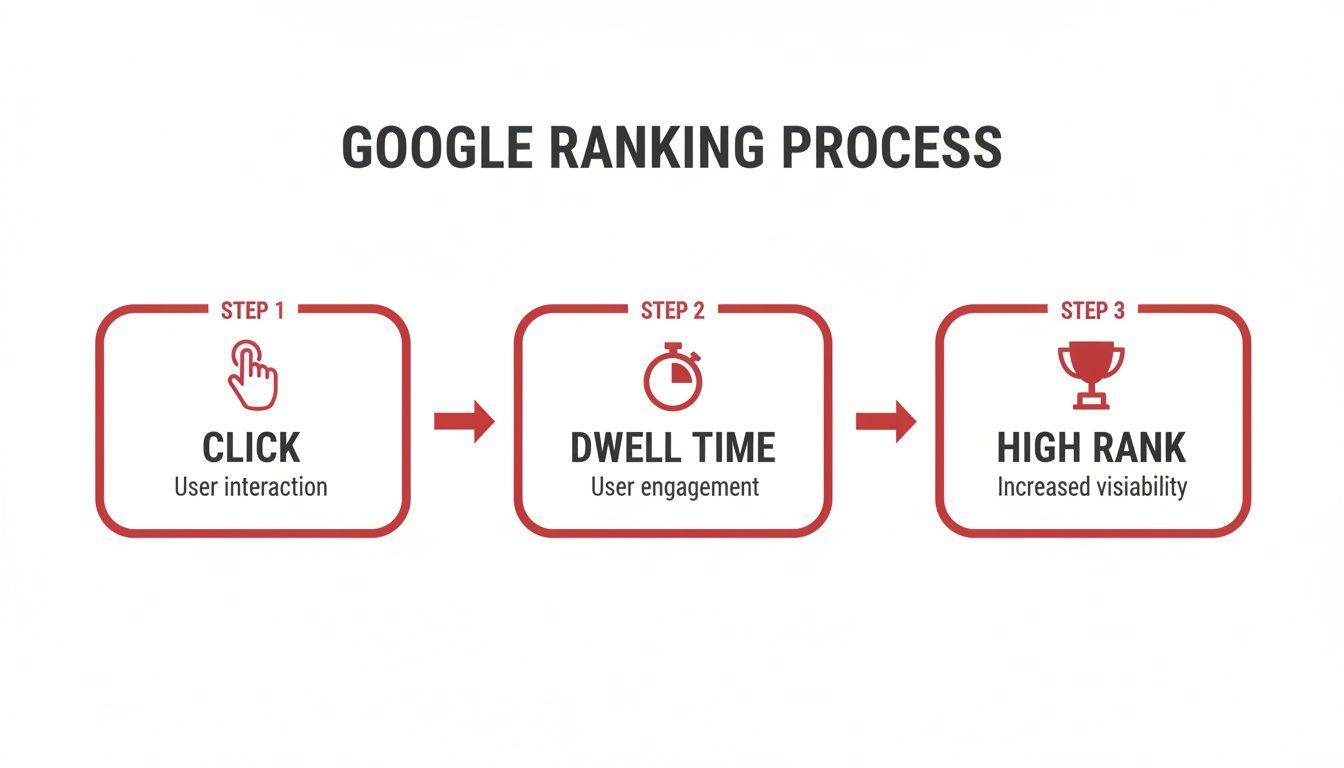
When you get right down to it, a high click-through rate followed by a good long stay on your site tells Google you're a top-tier result.
The Mechanics of an Authentic User Journey
So, what does this "authentic journey" actually look like in practice? It’s far more than just a quick click. A trustworthy service will orchestrate a sequence of events that mirrors how a genuinely interested person would behave.
The Search: A real person picks up their own phone or sits at their computer, opens a browser, and types your target keyword into Google. This isn't a direct visit; it's a true organic search, which is exactly the signal you want to send.
SERP Interaction: They don't just magically land on your site. They do what we all do: scroll through the search results page (SERP), looking for the right link. This natural scrolling behavior is a crucial piece of the puzzle.
The Click: They find your listing and click on it. This is the moment that directly boosts your page’s click-through rate (CTR) for that keyword, screaming relevance to Google.
On-Site Engagement: They’ve landed, but they don't bounce right off. They stick around for a specific amount of time, what we call dwell time. And just as importantly, they'll navigate to other pages on your website, which drives down your bounce rate and increases the total session duration.
Following these steps creates a narrative for the algorithm—a story of a user who searched, found a great answer, and stayed to learn more. It looks completely natural because it mimics a natural process.
Key Takeaway: The point of a white-hat campaign isn’t just to get traffic. It's to generate believable user engagement signals—high CTR, long dwell times, and multi-page sessions—that convince search engines your content is the best answer to a user's question.
Crucial Features for a Safe Campaign
To keep your campaign safe and get the results you want, you need granular control. The service you choose must let you fine-tune how the traffic behaves. These aren’t nice-to-haves; they are essentials for mimicking real user patterns and staying off Google’s radar.
Precise Geo-Targeting: You absolutely must be able to target clicks from specific countries, states, or even cities. If you're a dentist in Dallas, traffic from France is worse than useless—it’s a huge red flag. The clicks have to come from where your customers are.
Natural Click Patterns: Real people don't search in perfectly uniform patterns. A good service will add a bit of randomness to the daily click volume, making it look like natural ebbs and flows in interest, not a robot sending 50 clicks every day like clockwork.
Customizable Session Times: You need to be able to set how long visitors stick around. A 10-minute session on a simple "contact us" page looks suspicious, but it's perfect for a 3,000-word ultimate guide. Your session times should match your content.
This level of precision is a game-changer for local businesses. Think about it: with 46% of searches having local intent and "near me" searches hitting 800 million per month in the U.S. alone, being able to simulate local interest for a Google Business Profile is a powerful, and safe, way to climb the local pack rankings. As the SEO industry keeps growing, having these sharp tools in your belt gives you a massive leg up, as highlighted in Ahrefs’ research on the booming B2B SEO market.
By sticking to these core principles—real human clickers, a perfectly simulated user journey, and detailed campaign controls—you can run a CTR optimization campaign that safely and powerfully moves the needle on your rankings.
How to Plan and Launch Your First Campaign
Alright, let's get tactical. Moving from the "what" to the "how" is where things get interesting. Launching your first CTR campaign isn't some dark art, but it does demand a smart, deliberate plan. This isn't about just blasting traffic at a URL and crossing your fingers; it's about being a careful puppet master, setting clear goals, and knowing precisely what success looks like.
The whole game is about making your campaign signals look utterly natural to search engines. If you get this right, you’re basically sending Google a very convincing story that real users love your page and it deserves to rank higher.
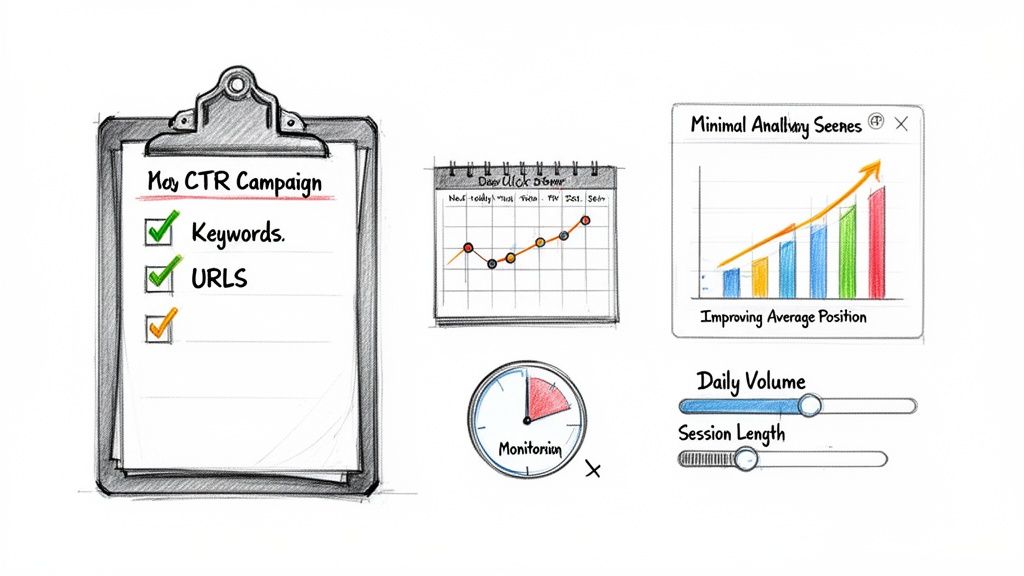
Selecting Your Targets: Keywords and URLs
So, where do you point this thing? Your biggest wins from a buy traffic seo strategy will come from targeting pages already knocking on the door of page one. Think about those keywords that are just agonizingly stuck on the second or third page of Google.
Those are your golden tickets.
Trying to boost a page from position #45 with CTR manipulation alone is a fool's errand. But a page sitting at position #12 for a juicy keyword? That's the sweet spot. It's already proven its relevance to Google; it just needs a final nudge—a vote of confidence from "users"—to break into the top 10.
Your best friend here is Google Search Console. Dive into your performance report and look for queries with a boatload of impressions but a disappointingly low CTR. That data is screaming at you: "People see us, but they aren't clicking!" You’re about to fix that.
Setting Realistic Campaign Parameters
Once you've picked your targets, it's time to dial in the settings. Getting this wrong is the fastest way to get your site flagged. You have to think like a real user. Forget a brute-force attack; we're going for surgical precision.
Here are the dials you absolutely must get right:
- Daily Click Volume: Start small. Seriously. Sending 500 clicks overnight to a page that typically gets 10 is like setting off a flare gun in a library. Begin with a trickle, maybe 5-10 clicks a day, and watch what happens before you even think about turning up the volume.
- Session Duration: This needs to match your content. If you're sending traffic to a 3,000-word deep dive, a 5-8 minute session looks plausible. If it’s a simple contact page, 1-2 minutes is far more believable.
- Geo-Targeting: This is completely non-negotiable. If you're a plumber in Dallas, you need clicks from the Dallas-Fort Worth area. Clicks from India or Brazil are worse than useless; they’re a giant red flag telling Google something is very, very wrong.
By carefully tuning these settings, you aren't just sending traffic; you're crafting a believable narrative of authentic user interest. This control is what separates a safe, effective CTR strategy from a reckless gamble.
Tracking Success and Measuring ROI
How do you know if any of this is actually working? Don't rely on gut feelings. Your source of truth is Google Search Console. It's the scoreboard for your campaign.
Keep a close eye on these three metrics in GSC for your targeted keywords:
- Average Position: This is the big one. Your rank for the keyword you're targeting should be on a steady upward trend.
- Impressions: As your rank climbs, more people will see your result in the SERPs, so your impressions should naturally rise too.
- Click-Through Rate (CTR): This is the metric you're directly manipulating, so it should show an immediate jump.
Given that a staggering 96.98% of all clicks are divvied up among the results on page one, even a small bump in position can open the floodgates to more organic traffic. This is especially critical in 2026, where the average CTR for the #1 spot has dipped below 30% for many queries, making each click you earn that much more precious. For a deeper look at these trends, check out the latest data analysis on SEO traffic.
It's one thing to talk about the theory behind click-through rate (CTR) optimization, but seeing the real-world impact is what truly builds confidence. This is where abstract strategies turn into tangible business growth. Let's move past the hypotheticals and look at what a smart, well-executed SEO traffic campaign can actually deliver.
These examples reflect common situations where businesses we’ve worked with used user behavior signals to smash through ranking plateaus and finally start capturing the organic traffic they deserved.
The E-commerce Product Stuck on Page Two
A classic case we see all the time is an online store selling something like high-end "ergonomic office chairs." They’ve done everything right—the product page has stunning images, persuasive copy, and fantastic reviews. The only problem? It's been stranded at position #11 on Google for months, which is practically invisible to most searchers.
- The Problem: Their visibility was terrible, leading to a dismal CTR of less than 1%. Even with a superior product, they were losing sales every day to the competition on page one.
- The Campaign: We helped them launch a targeted campaign to break onto the first page. The setup was simple: aim for 15-20 clicks per day on their main keyword, with a session duration of 3-4 minutes to signal high engagement, all coming from their primary shipping regions.
- The Result: In just 60 days, that page jumped from #11 all the way to #4. Organic traffic to the page more than tripled, and the resulting sales delivered a clear, positive return on their investment.
The Local Business in a Hyper-Competitive Market
Now, think about a local law firm specializing in "personal injury law" in a massive, crowded market like Los Angeles. They were fighting tooth and nail for visibility in the Google Local Pack but were consistently buried below the fold.
Their main goal was to prove their local relevance to Google. The campaign was highly specific, using mobile IP addresses from particular LA zip codes to search for their target keywords. The clicks went first to their Google Business Profile listing and then clicked through to their website.
This approach sends an undeniable message to Google: "People in this exact area are searching for this service, and they are choosing this firm." It's a powerful local signal that traditional SEO often struggles to replicate.
Within only 45 days, the firm saw a huge lift in their Local Pack rankings. More importantly, this led directly to more calls and contact form submissions from qualified potential clients in their immediate service area.
The SaaS Company Fighting for a High-Value Keyword
Finally, let’s look at a B2B SaaS company aiming to rank for the incredibly competitive term "project management software for small teams." Their in-depth comparison page was languishing at position #9, getting almost no clicks.
The big challenge here is the rise of zero-click searches. As of late 2024, over 58% of Google queries result in no click at all, thanks to AI Overviews and rich snippets answering questions directly on the SERP. To win, the SaaS company had to prove their result was the one worth clicking on.
Their campaign was designed to reflect genuine user research, emphasizing a longer session duration of 6-8 minutes. A key part of the process was confirming the ranking changes weren't just a fluke. By applying proper methods for testing statistical significance, they could confidently tie the improvements directly to the campaign. The page climbed from #9 to #5, effectively doubling their organic CTR and driving a significant increase in demo sign-ups.
To give you a clearer picture of what these outcomes can look like across different industries, here’s a quick summary of typical results.
Campaign Outcome Snapshot
| Business Type | Starting Rank | Campaign Duration | Ending Rank | Organic CTR Lift |
|---|---|---|---|---|
| E-commerce Store | #11 | 60 Days | #4 | +210% |
| Local Law Firm | #8 (Local Pack) | 45 Days | #2 (Local Pack) | +180% |
| SaaS Company | #9 | 75 Days | #5 | +115% |
| Affiliate Blog | #14 | 90 Days | #6 | +250% |
These examples show that whether you're selling a product, a local service, or a software subscription, a well-planned campaign can deliver impressive results. To learn more about the different options available, check out our deep dive on professional SEO traffic services.
Don't Buy Traffic in a Vacuum: Pair It with Core SEO
Thinking you can just buy traffic for SEO and watch your rankings soar is one of the fastest ways to waste your money. It's a common trap. A far smarter approach is to see this kind of traffic not as a magic fix, but as a powerful booster for the solid SEO work you should already be doing.
Think of it like this: your on-page SEO, great content, and technical fundamentals are the carefully built campfire. A targeted traffic campaign is the gasoline you pour on top. You need the fire first for the gasoline to have any real impact.
First, Your On-Page Snippet Has to Earn the Click
Before you even think about driving traffic, you have to win the battle on the search results page itself. A traffic campaign gets more eyeballs on your listing, but your title and meta description are what have to convince a real person to actually click.
- Irresistible Titles: Your title tag is your one shot to grab a searcher's attention. It needs to combine your keyword with a hook—something that promises value, creates urgency, or asks a question they can't help but want answered.
- A Compelling Pitch: The meta description is your 160-character ad. It has to back up the title's promise and give someone a clear reason why your page is the best result for them, right now.
When you nail this, you create a powerful cycle. The traffic campaign increases your impression count, and your killer snippet converts those impressions into clicks at a higher rate. This is the kind of natural-looking engagement Google loves to see.
Then, Your Site Has to Keep Them There
Getting the click is only half the job. If a visitor lands on your page and immediately hits the back button because it's slow or the content is junk, you've just told Google your page isn't a good result. That's a negative signal that can completely undo any benefit from the initial click.
A great CTR campaign shows Google that people want to see your page. A fast, well-structured site with excellent content confirms their decision was the right one. That synergy is the secret to making rankings stick.
This is where your fundamental SEO practices become absolutely critical:
- Page Speed: Your site has to feel fast. A user who has to wait is a user who will bounce, and that's a signal you can't afford to send.
- Content Quality: The page must deliver on what your title promised. It needs to be genuinely helpful, easy to read, and valuable enough to make someone want to stick around.
For niche site owners and affiliate marketers, this is a massive opportunity. We know that 94% of SERP clicks go to organic results, but what’s shocking is that an estimated 66% of pages have zero backlinks, leaving them invisible. A well-run traffic campaign can bridge that gap by sending real human signals—higher CTR, longer session times, lower bounce rates—that tell Google your high-quality content deserves to be seen. You can dig into more data like this in Ahrefs' breakdown of B2B SEO statistics.
Ultimately, buying traffic doesn't replace good SEO; it supercharges it. When your on-page, technical, and content foundations are rock solid, every single click you send to your site works overtime to prove its value to the search engines.
Common Questions About Buying SEO Traffic
Diving into the world of buying traffic for SEO can feel a little like walking a tightrope, so it's only natural to have a few questions. It’s a powerful strategy, but you have to know the rules of the game. Let's clear up some of the most common concerns.
The first question on everyone's mind is always about safety. "Is buying traffic actually safe for my website?" The short answer is: it depends entirely on the kind of traffic you're buying. Cheap, low-quality bot traffic hitting your site from a data center? Absolutely not safe. That's an open invitation for a Google penalty.
But that's not what we're talking about here. Reputable, white-hat services use a network of real people on real devices. Think of it this way: the bad approach is like filling a restaurant with cardboard cutouts. The manager will spot it a mile away. The right approach is like hiring a crowd of actors to come in, order food, and have a great time—it looks and feels completely real because, for all intents and purposes, it is.
How Long Until I See Results?
Okay, so if it's done right, it's safe. The next logical question is, "How long will it take to see a difference?" While every campaign is unique, you can generally expect to see the needle start moving within 30 to 60 days.
Of course, several things can influence that timeline:
- Your Starting Point: Pushing a keyword from page two (#12) to page one (#7) is often much faster than trying to climb from page five (#50) to page two.
- Keyword Difficulty: If you're targeting a hyper-competitive term, you'll need more patience. The SERPs for these keywords are just tougher to crack.
- Campaign Pacing: This isn't about brute force. A slow and steady stream of high-engagement clicks is far more believable—and effective—than a sudden, unnatural spike in traffic.
The goal is to demonstrate a credible, sustained increase in user interest over time. It's a marathon, not a sprint.
Can Google Penalize This?
This brings us to the biggest fear of all: the dreaded Google penalty. If you're using a black-hat bot service that sends thousands of junk visits from the same IP block, the answer is a hard yes. Google's systems are incredibly sophisticated and designed specifically to sniff out and neutralize that kind of artificial activity.
But when you buy traffic for SEO from a service that simulates authentic user behavior, the risk practically disappears. Why? Because you're giving Google exactly what its algorithm is designed to reward: positive user signals. You're sending real people, on unique residential IPs, who search for your keyword, click your result, and then actually spend time on your page.
Done correctly, it isn't a "trick" at all. You're simply providing verifiable proof that users find your content valuable and relevant for their search query.
Ready to see how ClickSEO can safely boost your rankings? Our platform uses real human clickers to send authentic engagement signals, helping you climb the SERPs without the risk. Start your free trial today and watch your rankings grow.