Click Traffic Buy A Guide to Safer SEO
So, you've poured your heart and soul into creating top-notch content, but it's still languishing on the second or third page of Google. Sound familiar? It’s a frustratingly common problem. You’ve done everything right, yet your pages are invisible, buried under the competition.
The hard truth is that great content alone isn't always enough. This is where you might consider a strategy to click traffic buy—and no, I'm not talking about risky, automated bots. I'm talking about using real, human-powered visits to show search engines that your content is worth a closer look.
Why User Signals Are Your Secret SEO Weapon
Let's get real for a moment. Google's algorithm is smart, but it can't read your content and appreciate its brilliance like a human can. Instead, it relies on user signals—the digital breadcrumbs people leave behind—to judge a page's quality.
When someone searches for a term, clicks your link, and actually stays on your site, it sends a powerful signal to Google. It says, "Hey, this result was a good match!" This is what creates that classic chicken-and-egg dilemma for so many website owners. You need clicks to climb the rankings, but you need to be on the first page to even get those clicks in the first place.
The Metrics That Move the Needle
It all boils down to a few key engagement metrics that tell the story of your page's performance:
- Click-Through Rate (CTR): How many people who see your link in the search results actually click on it.
- Dwell Time: The length of time a visitor spends on your page before heading back to the search results. Longer is better.
- Pages Per Session: After landing on your page, do they explore other parts of your site? This shows deeper interest.
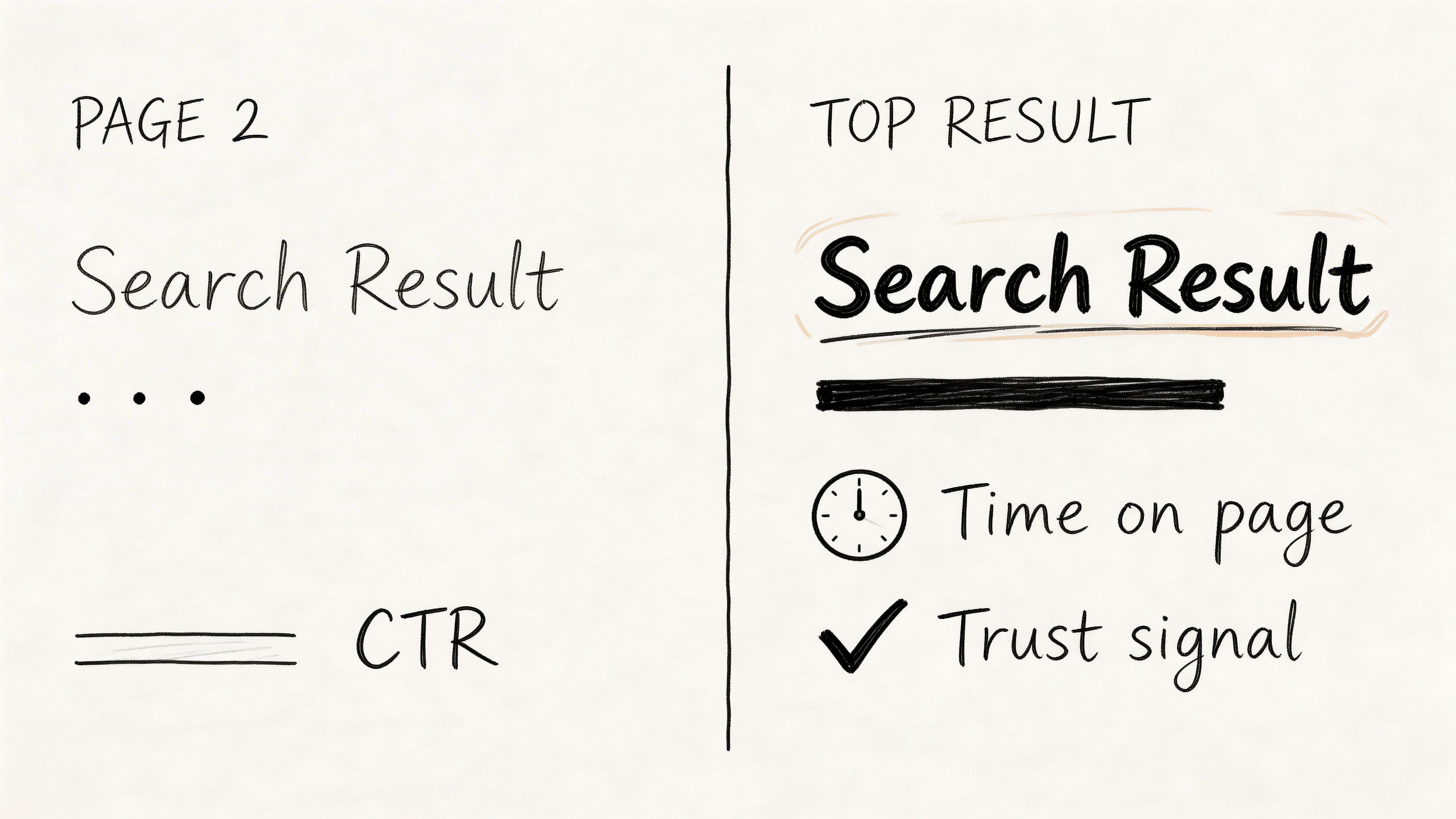
When these signals are weak, even the best content can get stuck in the SERP wasteland. And the difference between the top spot and everything else is staggering.
The #1 organic result on Google gets a massive 45.6% click-through rate (CTR). That number plummets to just 12.3% for the #2 position. This winner-take-all scenario makes it incredibly difficult for pages stuck on the bottom of page one—or worse, page two—to gain any traction.
Proving Your Page Deserves to Rank
This is exactly where strategic, human-powered click traffic comes in. It's not about tricking the system; it's about giving your excellent content the initial push it needs. By sending real, targeted visitors to your site who behave like a genuinely interested audience, you’re providing the algorithm with the positive signals it needs to see.
To help you understand the difference, let’s compare a high-quality service with the automated bots you must avoid.
Human-Powered Clicks vs Automated Bots
| Feature | Legitimate Click Service | Risky Bot Traffic |
|---|---|---|
| Traffic Source | Real human users on genuine devices from residential IPs | Data centers, proxies, or compromised devices |
| User Behavior | Simulates natural engagement (scrolling, clicking, etc.) | Robotic, repetitive actions with no variation |
| Risk Level | Low; mimics authentic user behavior | High; easily detected and can lead to penalties |
| Geo-Targeting | Precise; can target specific cities, states, or countries | Unreliable and often inaccurate |
| Cost | Higher, reflecting the cost of real human time | Extremely cheap, which is a major red flag |
Ultimately, using human-powered clicks is about demonstrating your content's value and earning the rank you've worked so hard for. It's the nudge that can help you break out of the lower-ranking purgatory.
If you’re looking for more ways to improve your site's performance, I highly recommend digging into our guide on boosting search engine optimization.
Finding a Click Traffic Partner You Can Trust
When you decide to buy click traffic, you're doing a lot more than just buying website visits—you're placing a bet on your site's reputation. The provider you choose is the single biggest factor determining whether you build real SEO value or just end up on Google's bad side. I've seen both happen, and believe me, telling a good partner from a risky bot farm is the most important job you have.
The first thing I always look for is total transparency. A legitimate provider won't shy away from explaining exactly how their system works. If you ask about their traffic sources and get a vague, jargon-filled answer, that's a huge red flag. The same goes for unbelievable promises ("guaranteed #1 rankings overnight!") or rock-bottom prices. Real, human-powered traffic has real operational costs, and their pricing will always reflect that.
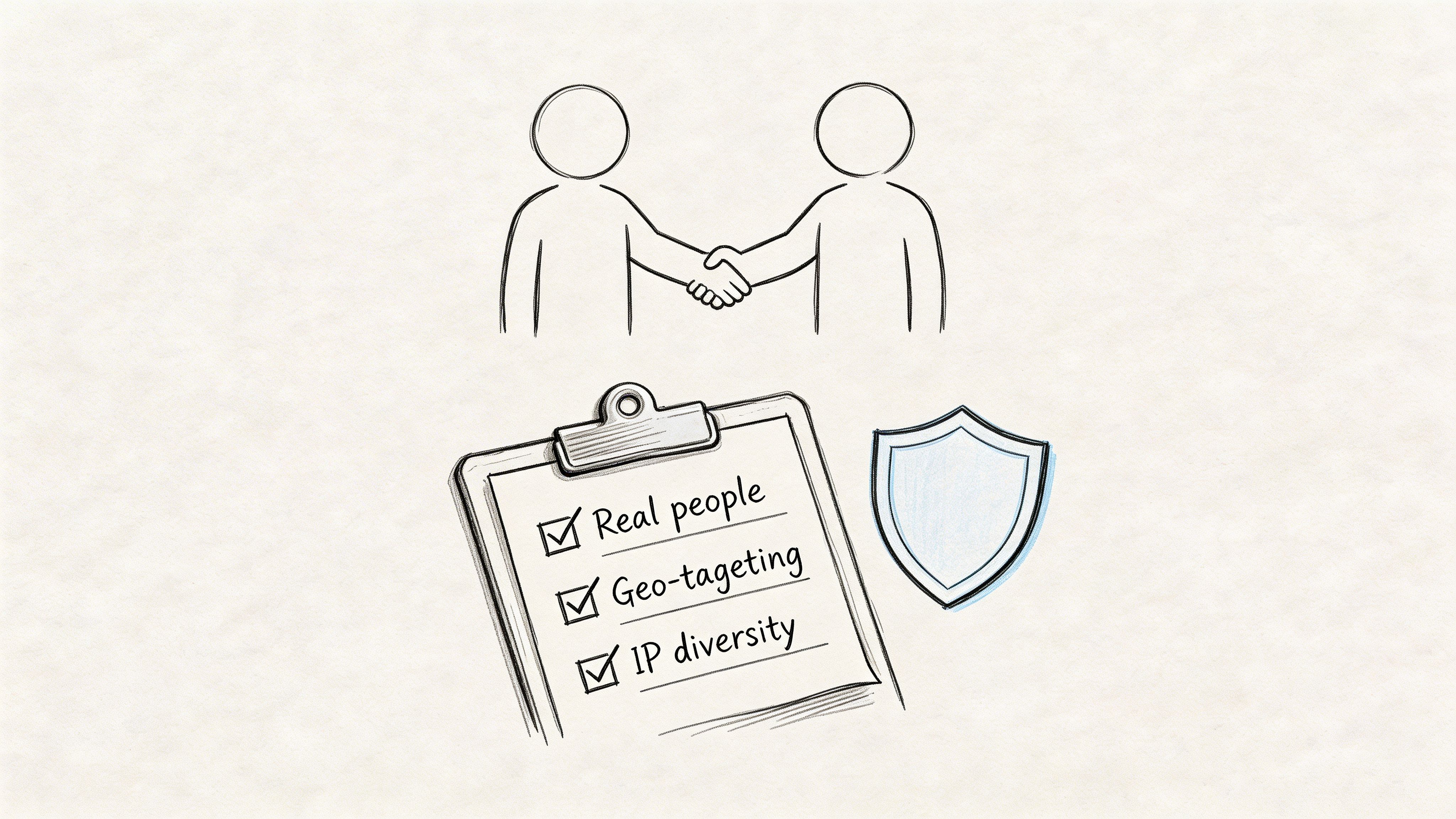
Your Vetting Checklist
Before you even think about signing up, you need to have a list of tough questions ready. Think of it as an interview. Their answers will tell you everything you need to know about the quality and safety of their traffic.
Here are the questions I personally ask every single time:
- Are your clicks from 100% real human users? This is a simple yes or no question, and "yes" is the only acceptable answer. Follow up by asking how they recruit and verify their user network.
- What does your IP network look like? You're listening for words like "diverse," "residential," and "mobile." They should be able to explain how they filter out cheap data center or VPN IPs, which are an instant giveaway to search engines.
- What campaign controls do I get? A good service gives you the keys. You need to be able to set daily click volumes, control session durations, and create paths where users visit multiple pages.
- How specific can my geo-targeting be? This is critical for local SEO. If you run a dental practice in Dallas, clicks from Miami or Mumbai are completely useless. Can they target down to the country, state, or even city level?
A trustworthy partner will be happy to answer all of this. They’re proud of the authentic engagement they provide. If you get defensive or evasive answers, it’s a clear sign to end the conversation and move on.
It's About Engagement, Not Just Clicks
At the end of the day, raw traffic numbers are a vanity metric. What really moves the needle are positive engagement signals—proof that real people are interacting with and valuing your content. Our guide on how to buy organic traffic safely and effectively goes into much more detail on this.
For example, imagine you run an e-commerce site. A valuable click isn't just someone landing on a product page and leaving. It's a visitor who clicks from the product page to your "About Us" section and then checks your "Shipping Policy." That multi-step journey signals genuine interest, and it's the kind of sophisticated campaign a quality partner will help you build.
Alright, let's get into the weeds. You've vetted your vendor and you're ready to start sending traffic. This is the part where the rubber meets the road, but don't let it intimidate you. Setting up your first engagement campaign is all about one thing: looking natural.
The goal isn't just to buy clicks. It's to build a believable story for search engines, one that shows people are genuinely interested in what you have to say. And that story always starts with your keyword.
Dialing in Your Daily Clicks
Here’s the first rule of thumb: don't send a tidal wave of traffic to a keyword that only gets a trickle of searches. A massive, sudden spike on a low-volume keyword screams "I'm buying traffic!" to Google. You want to be a gentle, rising tide instead.
Let’s say you’re targeting a keyword with a monthly search volume (MSV) of about 1,000. A good, conservative place to start is with 10-15 daily clicks. This is enough to get noticed and send positive signals, but it's subtle enough to blend in with the natural ebb and flow of real-world search traffic.
Crafting Believable User Behavior
Getting a visitor to your page is only half the battle. What they do after they arrive is what really matters. A visitor who shows up and immediately bounces is worse than no visitor at all—it's a direct signal to search engines that your page isn't a good answer to their query.
This is where you need to get specific about the kind of behavior you want to simulate. Think like a real, curious reader.
Session Duration (Dwell Time): How long does the visitor stick around? For that 1,000 MSV keyword, setting a session duration of 2-3 minutes is a great starting point. It tells the algorithm that the visitor is actually reading your content, not just glancing at it.
Page Depth: Do they click around and explore? You want them to. Setting a page depth of 2-3 means that after landing on your main page, the "user" will then navigate to one or two other pages. Maybe they'll check out your About Us page or a related service page. This is a powerful signal of deep interest.
Expert Tip: Think of your campaign settings as the script for a story. You're telling search engines a believable tale of a user who found your content, loved it, and wanted to learn more about you. Every parameter should support that narrative.
How This Fits Into Your Broader Strategy
It helps to think about this in the context of your wider marketing efforts. Take paid search, for example. Even with an average cost-per-click of $5.26 in some industries, businesses invest heavily because they know it works. A well-run Google Ads campaign can deliver a 200% ROI by putting a brand in front of users at the exact moment they're ready to buy.
While we're aiming for an organic boost, the mindset is the same. We are strategically placing "users" on our site to signal high intent and value. When you blend the precision of a paid search mentality with this kind of organic engagement strategy, you create a powerful, self-reinforcing loop. For a deeper dive into these numbers, you can check out the latest cost-per-click data to see how they break down across different sectors.
To give you a better idea of how to structure your own campaigns, here are some practical starting points for different types of businesses. These are just templates—feel free to adjust them based on your specific keywords and goals.
Example Campaign Settings for Different Goals
| Business Type | Daily Clicks | Geo-Targeting | Session Duration | Page Depth |
|---|---|---|---|---|
| Local Plumber | 10-20 | City/Metro Area | 1-2 minutes | 2 |
| SaaS Company | 20-30 | National | 3-4 minutes | 3 |
| E-commerce Store | 25-50 | National or Global | 2-3 minutes | 4 |
| Niche Blog | 5-15 | National | 4-5 minutes | 2 |
As you can see, a local business might aim for shorter, high-intent visits within a tight geographic area, while a niche blog focuses on longer read times to signal content quality.
By thoughtfully setting your daily clicks, session duration, and page depth, you're doing more than just buying traffic. You're building a sophisticated engagement engine that lays the groundwork for real, lasting ranking improvements.
Staying Safe and Avoiding Google Penalties
When you’re looking to buy click traffic, the first question on your mind should always be about safety. Let's get right into it. Staying on Google’s good side boils down to one thing: understanding the massive difference between strategic, human-driven engagement and the kind of reckless, automated tactics that will get your site flagged in a heartbeat.
The secret is authenticity. A legitimate service like ClickSEO isn't using bots from a server farm. Instead, it relies on a vast, distributed network of actual people. These are real users on unique residential and mobile IPs (4G/Wi-Fi), which means their visits look exactly like the rest of your organic traffic. This approach sidesteps the very digital footprints Google's algorithm is built to sniff out.
The Power of a Gradual Approach
One of the surest ways to get penalized is to create a sudden, unbelievable traffic spike. Just picture it: your page has been getting maybe 5 clicks a day, and then, boom—it gets 500 overnight. That’s a huge red flag for any algorithm.
A safe, smart strategy is always gradual. It’s about building a believable, steady stream of engagement over weeks and months. This slow-burn approach sends consistent, positive signals to Google, essentially teaching the algorithm that your page is naturally gaining authority and relevance. This isn't a gamble; it's a calculated move focused on long-term, sustainable growth.
This visual breaks down how to structure a campaign that prioritizes this natural, step-by-step method.
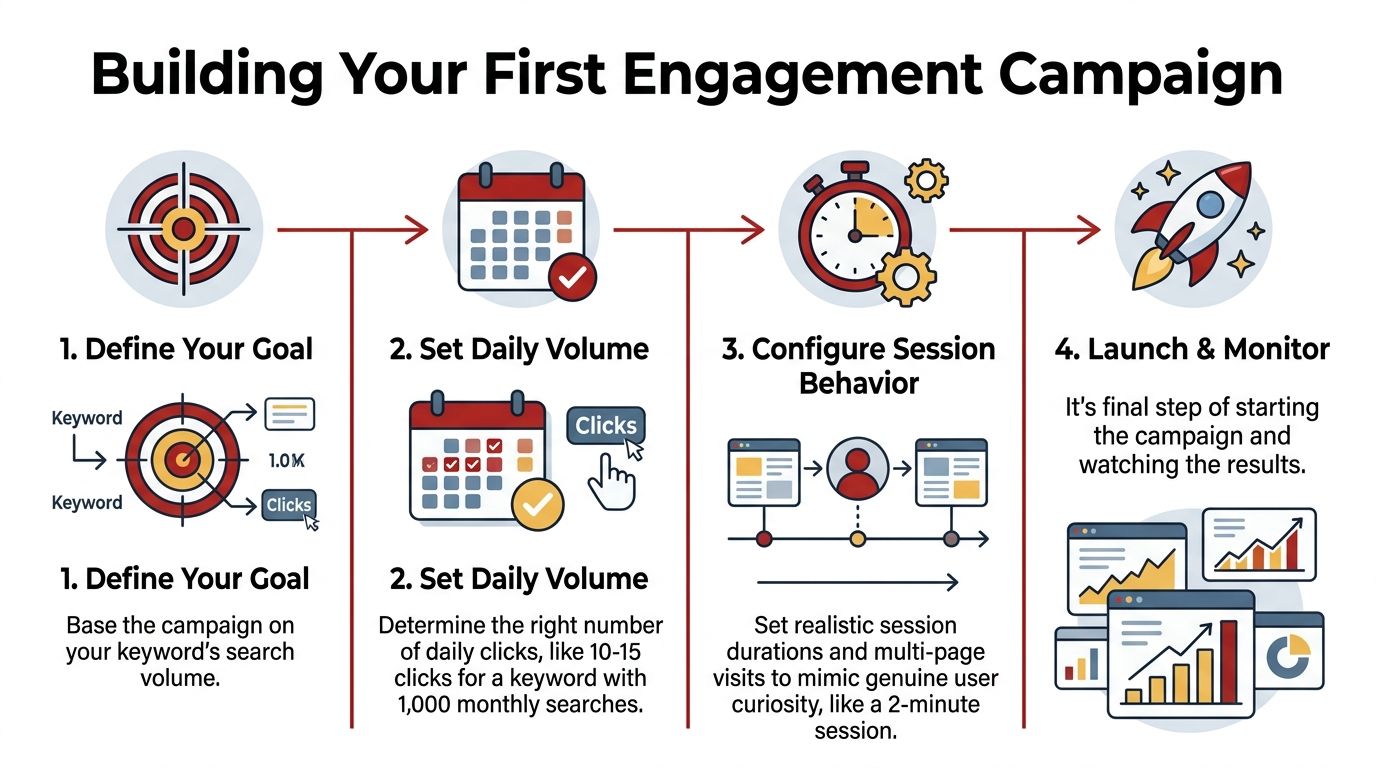
As you can see, a safe campaign starts with defining goals based on real data and then configuring user behavior that looks like genuine curiosity, not robotic commands.
Avoiding Fraud and Ensuring Quality
Click fraud is a persistent headache in digital advertising. In fact, a recent report on global invalid traffic from Lunio AI shows that the average invalid traffic (IVT) rate is 8.51%. In some industries, like gaming, it's a shocking 18.49%. Bots and shady competitors are constantly inflating ad costs and muddying analytics for everyone.
This is exactly why a white-hat approach to CTR optimization is so different. By delivering clicks from real people, a service like ClickSEO actively insulates you from these risks. Since every single visit comes from a genuine user, the engagement metrics you're building are authentic and won't set off Google's invalid traffic filters. You can read more about the perils of automation in our guide on why you should never buy bot traffic.
The Takeaway: True safety isn’t about trying not to get caught. It’s about using a method that’s fundamentally invisible because it’s based on real human behavior. The goal is to blend in with your best organic traffic, not stand out for all the wrong reasons.
This principle extends beyond just click traffic. For instance, when you purchase quality backlinks, it's just as crucial to understand the risks and prioritize strategies driven by real human value, not automated shortcuts that could get your site penalized.
Measuring the Impact on Your Rankings
Alright, you’ve pulled the trigger on a click traffic campaign. Now what? Simply buying the traffic is just the beginning; the real work starts with tracking your investment to prove it’s actually moving the needle. You're not just looking for a temporary spike in website visitors. The goal is to see how those clicks translate into better search rankings and, down the line, a healthier business.
To get the full picture, you’ll want to get comfortable with two essential, free tools: Google Search Console and Google Analytics. Think of them as a team. Search Console tells you what’s happening on Google's turf, while Analytics tells you what happens once visitors land on your site. Together, they provide the data to confirm your campaign is working.
Monitoring Key Metrics in Google Search Console
Google Search Console (GSC) is your window into how Google perceives your website. It’s the first place you should go hunting for evidence that your engagement campaign is making a difference. Don't get overwhelmed by all the data; just zero in on the performance report for the keywords you’re targeting.
Here's what you’re watching for:
- Impressions: This is often the first metric to budge. A lift in impressions means Google is starting to show your page in search results more often. It’s an early breadcrumb trail showing the algorithm is taking notice.
- Average Position: This is the big one. Seeing your rank for a target keyword slowly creep up from position 15 to 12, and then to 9, is the tangible progress you want. It's the ultimate validation.
- Click-Through Rate (CTR): Your campaign is designed to directly influence this. As more users click your result, you send a powerful signal to Google that your page is a great match for that search query.
To get the most out of this data, it helps to understand what SERP tracking entails and how it fits into your larger SEO picture. Context is everything when you're trying to connect the dots.
Validating Engagement in Google Analytics
While GSC shows you the action in the search results, Google Analytics reveals what happens after the click. This is where you separate the good traffic from the bad and confirm your vendor is delivering real, engaged humans. Your focus here should be on your organic traffic segment.
Look for a noticeable increase in Average Session Duration and Pages per Session for your target URLs. These metrics are the proof of genuine engagement. Bots bounce; real users explore.
When you look at your analytics, you should see a story unfolding. Organic visitors arrive from a search, stay on the page for roughly the time you specified in your campaign, and then maybe click around to other pages. That's the behavior of an interested user, and it confirms the traffic quality is legitimate.
Setting Realistic Timelines for Results
Finally, a bit of real-world advice: be patient. SEO has always been a marathon, not a sprint, and using user signals to influence rankings is no exception. You might see some small, positive movement within the first few weeks, but you should really be looking at a 30-60 day timeframe to see significant, stable improvements in your rankings.
That window gives Google's algorithm enough time to gather the data, notice the pattern of positive engagement, and reward your page with a better position. This isn't an overnight trick; it’s a strategy for building sustainable authority. If you monitor the right things and have realistic expectations, you'll be able to confidently measure the true return on your campaign.
Common Questions About Buying Click Traffic
Even if you've got a solid plan, stepping into the world of click traffic for the first time can feel a little uncertain. That’s perfectly normal. Let's walk through some of the questions I hear most often from marketers who are ready to click traffic buy but want to do it right.
The first thing everyone wants to know is, "Is this safe? Am I going to get my site penalized?" The answer is a confident no—if you're working with a provider that sends real human visitors. The real danger lies with automated bots that leave an obvious, repetitive digital footprint. When you have human-powered clicks coming from unique residential IPs, the behavior mimics genuine organic traffic. It becomes completely indistinguishable from your other visitors, effectively neutralizing any risk.
Is This a Good Strategy for Local Businesses?
It's not just good; it can be a game-changer for local SEO. A quality click traffic service gives you incredible control over geo-targeting. Imagine being able to send visitors exclusively from your specific city, county, or service area.
That's a powerful local relevance signal for search engines. For a plumber in Dallas trying to crack the Google Maps pack, having a steady stream of clicks from users in Dallas tells Google that local searchers are finding and engaging with their business. It's a huge competitive edge.
How Do I Know the Traffic Is Actually Real?
This is the most important question you can ask. Any transparent provider will insist that all the traffic they send is 100% visible in your Google Analytics account. You should be able to log in at any time and see the new organic sessions arriving from the exact geographic locations you targeted.
But don't just stop at seeing more sessions. Look for the real proof of human engagement. You should see your average session duration climb and your pages-per-session metric increase. Bots bounce. Real people click around and explore your site.
How Long Until I See Ranking Improvements?
This is a marathon, not a sprint. While you might see some encouraging signs in your analytics pretty quickly, you need to think in terms of weeks and months for tangible ranking shifts.
Most businesses start to see significant, stable improvements within 30 to 60 days. That timeframe gives the algorithm enough consistent data to recognize that your page is a valuable result for its target keywords. You're building genuine authority, not just trying a short-term trick, so a little patience goes a long way.
Ready to see how real human engagement can improve your rankings? ClickSEO provides authentic, targeted clicks from real users to safely boost your user signals and help you climb the SERPs. Start your free trial and take control of your SEO performance today at https://clickseo.io.