
What Is SearchSEO and How Does It Drive Rankings in 2026?
What Is SearchSEO and Why Does It Matter Now?
Simply put, SearchSEO is about making sure that when people see your website in Google’s search results, they actually want to click on it. It’s the art and science of optimizing for user engagement signals—the little clues people leave that tell search engines your result is the one they prefer. This goes beyond old-school SEO by focusing on the human element of search.
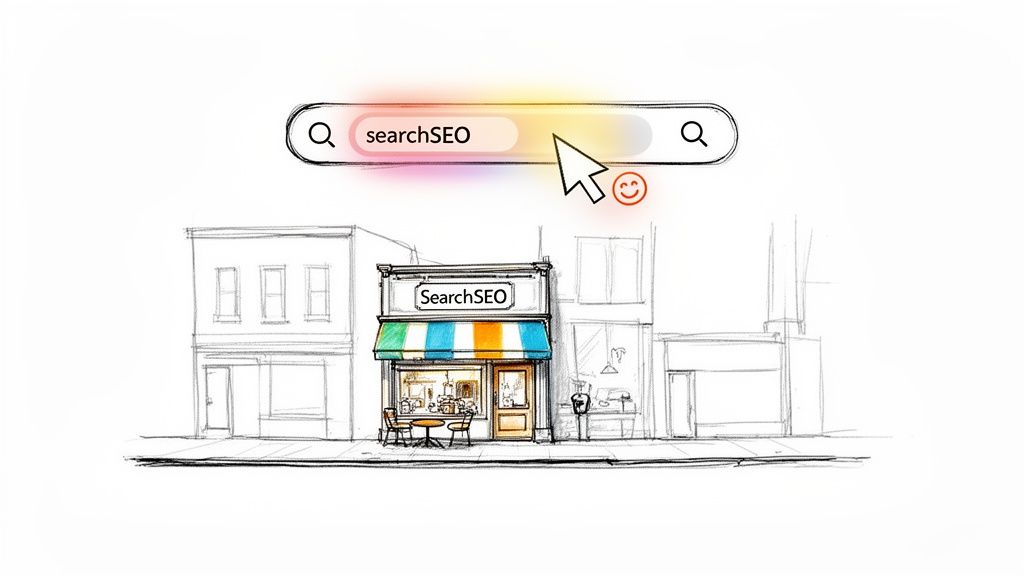
Think of your website as a coffee shop on a jam-packed digital street. Traditional SEO gets your shop listed in the local directory. That’s a good start. But SearchSEO is what makes someone walk past ten other cafes to come into yours. It's the inviting storefront, the smell of fresh coffee, and the friendly barista that seals the deal.
In the world of search, this means mastering the "digital body language" that shows Google your page is the best answer for a given query. It’s not just about showing up; it’s about earning the click and proving you were the right choice.
The Shift From Technical SEO to User Satisfaction
For a long time, SEO was a technical game of keywords, backlinks, and site structure. Those things absolutely still matter—they're the foundation. But search engines have evolved. Google's main job is to give searchers results that genuinely solve their problems, and it uses real user behavior to figure out if it's succeeding.
This is exactly where SearchSEO comes in. It zeroes in on the metrics that act like a direct feedback loop from users to Google, telling the search engine how good your content really is.
- Click-Through Rate (CTR): This is the percentage of people who see your site in the search results and actually click it. A high CTR tells Google your title and description caught their eye and seemed relevant.
- Dwell Time: This measures how long someone stays on your page after they click. A long dwell time is a great sign; it suggests your content is interesting and delivering on its promise.
- Bounce Rate: This is the percentage of visitors who land on your page and then leave without going anywhere else on your site. A low bounce rate means people found what they were looking for and were curious enough to explore more.
Think of search engine algorithms as a massive, real-time focus group. Every click is a vote of confidence. Every time a user hits the "back" button just a few seconds after landing on your page, it's a vote of no-confidence. To win, you have to win over the user.
Why This Matters For Your Business
Ranking high isn't the whole story anymore, especially with AI summaries and zero-click searches becoming more common. Many sites are seeing their traffic drop even while their impressions on Google climb. The way to protect your business is to build brand recognition and user preference. A great place to start understanding this concept on a smaller scale is by learning What is Local SEO Marketing and how it leverages community-level trust.
When you get SearchSEO right, you’re not just appeasing an algorithm. You're creating a genuinely better experience for your users, which builds the trust and authority that lead to sustainable growth. You can dive deeper into the signals that search engines value by reviewing the top SEO ranking factors that are critical today. Ultimately, this approach doesn't just secure higher rankings; it builds a loyal audience that chooses you first.
The Core Components of Modern SearchSEO
To really get a handle on SearchSEO, you have to think about what a search engine is trying to figure out. When someone searches on Google, your page is just one option on a huge menu. How do you get them to pick you?
First, you have to look appealing. Your page title and the little description under it are your storefront. They need to grab a searcher's attention and promise a solution to their problem. When they click, that's the first win. But the job isn't done. What happens after the click is what truly matters.
Earning the Click With CTR
The first major piece of the puzzle is your Click-Through Rate (CTR).
The math is simple: if 100 people see your link in the search results and 5 of them click on it, you have a 5% CTR. But the meaning behind that number is profound. A strong CTR sends a direct message to Google that your "storefront"—your title and description—is compelling and highly relevant to what people are searching for. It's the searcher's way of saying, "That one. That looks like the answer."
Think of it as the first vote of confidence. A consistently low CTR, on the other hand, is a clear sign that your message is falling flat or your competitors are simply doing a better job of catching the searcher's eye.
Keeping Their Attention With Dwell Time
Getting the click is only half the battle. Once a user lands on your page, the clock starts ticking on what might be the most important factor: Dwell Time.
This metric is exactly what it sounds like—how long someone dwells on your page before heading back to the search results. It’s the ultimate test of whether you delivered on the promise your title made.
Consider these two outcomes:
- A user clicks your link, spends four minutes reading your article, and then closes their browser tab. Google sees this "long click" as a huge win. Your content was clearly valuable and answered their question.
- A user clicks, stays for five seconds, and immediately hits the back button. This "short click" (also known as "pogo-sticking") is a massive red flag, telling Google your page was a disappointment.
High dwell time is the ultimate proof of content quality. It tells Google that not only did your result look like the right answer, it was the right answer. This user satisfaction signal is a cornerstone of modern ranking algorithms.
When search engines see long dwell times, they interpret it as a sign of high-quality, engaging content. This feedback loop helps solidify your rankings, proving your page deserves its spot.
The Full Spectrum of User Engagement Signals
While CTR and dwell time are the headliners, they're part of a larger ensemble of user engagement signals. A smart SearchSEO strategy accounts for every clue a user leaves behind. These metrics tell a complete story about the user's experience on your site.
Here’s a breakdown of the most important metrics, what they measure, and why they are so critical for success in today's SearchSEO environment.
Key User Engagement Metrics in SearchSEO
| Metric | What It Measures | Why It's Important for SearchSEO |
|---|---|---|
| Click-Through Rate (CTR) | The percentage of people who see your SERP listing and decide to click it. | This is your first impression. It shows how well your title and description resonate with a searcher's query. |
| Dwell Time | The amount of time a user spends on your page after clicking before returning to the search results. | The strongest indicator of content quality and user satisfaction. It proves you delivered on your promise. |
| Bounce Rate | The percentage of visitors who leave your site after viewing only a single page. | Can signal a poor user experience or content that doesn't encourage further exploration. Context is key here. |
| Pages Per Session | The average number of pages a user visits on your site in a single session. | Reveals if your site is "sticky" and successfully guides users to other relevant content. |
It's crucial to remember that these signals don't exist in a vacuum. For instance, a high CTR followed by a rock-bottom dwell time is a recipe for disaster. It tells Google you're good at writing headlines but bad at delivering value—a classic clickbait scenario. A healthy dwell time, however, validates a good CTR, creating a powerful one-two punch that fuels sustainable rankings.
As search evolves, we're also seeing the lines blur with AI-driven results. Understanding things like ChatGPT ranking factors is becoming increasingly important for staying ahead.
The stakes are only getting higher. The search engine market was valued at a massive USD 223.41 billion in 2024 and is expected to more than double to USD 526.79 billion by 2033, according to market analysis from SkyQuest. In such a competitive arena, mastering these core components isn't just a good idea—it's essential for survival and growth.
How Google Interprets User Behavior Signals
Every Google search is basically a popularity contest. Think of the search results page (SERP) as a lineup of candidates, and your page is one of them. Each click a user makes is a vote, and Google’s own machine-learning systems, like RankBrain, are watching closely, tallying those votes in real time.
But they don't just count clicks. They analyze the behavior that follows the click. This is a direct line of communication between a real person and the search engine, and your website is right in the middle of it. If you want to succeed with a modern searchseo strategy, you have to understand this conversation. It’s not about finding a loophole in the algorithm; it's about proving your page is the best answer through the actions of your visitors.
The Power of the Long Click
Let's play this out. Say your page is sitting at position #4 for a tough keyword. A user scans the results, their eyes skipping right over the top three listings, and they click on yours. That click alone is a good sign. But what they do next is what really matters. They land on your page and actually stick around for a few minutes, reading your content. They found what they were looking for.
In the SEO world, we call this a "long click," and it’s one of the most powerful signals you can send to Google. That user’s behavior just told the search engine two very important things:
- "The title and snippet for result #4 looked more promising than the ones above it."
- "This page answered my question so well that I don't need to go back and check any other results."
You just won a huge vote of confidence. When Google sees a consistent pattern of these long clicks, it takes it as strong evidence that its initial rankings might be off and that your page probably deserves to be higher.
The Danger of Pogo-Sticking
Now for the flip side. A user clicks your result, but the page is a mess—it loads at a snail's pace, the content is confusing, or it just doesn't deliver on what your title promised. After just five seconds, they hit the back button and click on a competitor's link instead.
This is what we call "pogo-sticking," and it is absolutely toxic for your rankings. It's the user's way of telling Google, "Nope, wrong answer. That was a complete waste of time."
When users constantly bounce off your page like this, it’s a massive vote of no-confidence. Google sees this as a clear sign of a low-quality or irrelevant page, and your rankings can tumble, even if all your other traditional SEO work is perfect.
This real-time feedback loop is how Google is constantly fine-tuning its own results. It's always trying to self-correct by observing which pages make users happy. Your job is to keep generating those positive signals (long clicks) and stamp out the negative ones (pogo-sticking). Understanding this dynamic is key, and you can learn more about why SERP clicks directly impact your SEO in our full guide.
This diagram breaks down the relationship between what users do and how Google responds.
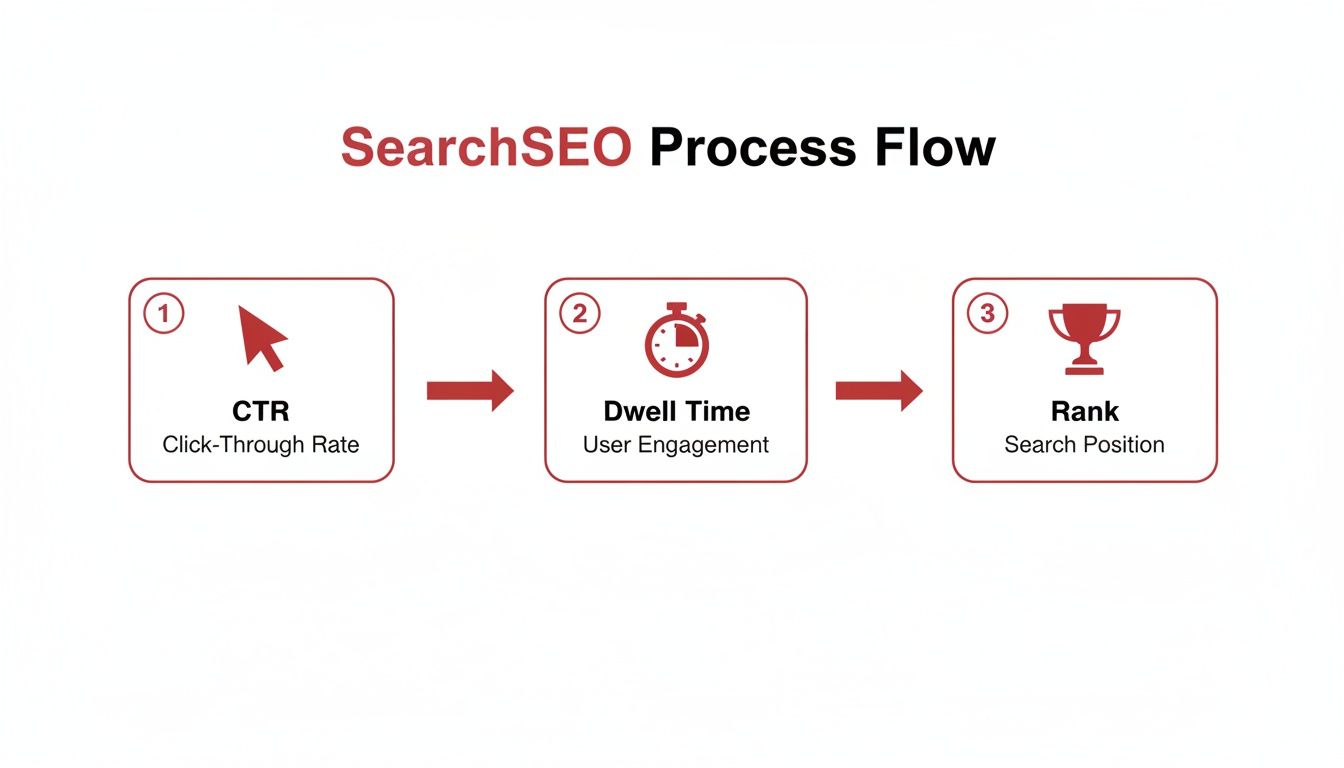
As you can see, a strong click-through rate (CTR) gives you the chance to earn a high dwell time, which is what ultimately signals to Google that your rank should improve.
Your Direct Conversation With the Algorithm
At the end of the day, optimizing for user behavior means you're having a direct conversation with Google’s ranking systems. The old-school SEO stuff—keywords, technical audits, and backlinks—is what gets you a spot on the results page. But it’s what happens after the click that determines whether you win or lose.
Every time you rewrite a headline to be clearer, make your content more engaging, or improve your page speed, you are directly influencing these behavioral signals. You aren't just telling Google your page is relevant; you're proving it with the most honest metric there is: genuine user satisfaction. That’s the core of a smart, long-lasting searchseo strategy.
Practical Strategies to Improve Your SearchSEO Performance
Understanding that Google watches user behavior is one thing. Actually doing something to influence those signals is where the real work begins. Let's move from theory to action. Getting your SearchSEO right really comes down to a two-part mission: first, make your listing in the search results completely irresistible, and second, find ways to boost the positive signals that prove your content is top-notch.
Here are some concrete tactics you can start using today. These will help you win that crucial click and keep users on your page, which sends all the right signals to Google.
Crafting Magnetic Page Titles and Meta Descriptions
Think of your page title and meta description as your one and only sales pitch on the search results page. A dull title is invisible; a great one practically forces a click. Your job is to make your link pop in a crowd of nearly identical blue links.
Forget just cramming keywords in there. Your title needs to be a compelling headline that promises a clear solution or sparks some curiosity.
- Ask a Question: "Is Your Website Leaking Money? Find Out How"
- Promise a Result: "The 5-Step Guide to Doubling Your Organic Traffic"
- Create Curiosity: "The One SEO Mistake That 90% of Businesses Make"
The meta description then has to back up that promise. It's your chance to give a quick preview that reinforces why they need to click. Use punchy, active language and maybe a gentle nudge like "Discover the secrets" or "Learn how to start today."
Think of your search listing as a book cover. It doesn’t matter how brilliant the story is on the inside if the cover is bland and uninspired. Your title and description have to be interesting enough to make someone want to open it up.
Gaining More Real Estate with Structured Data
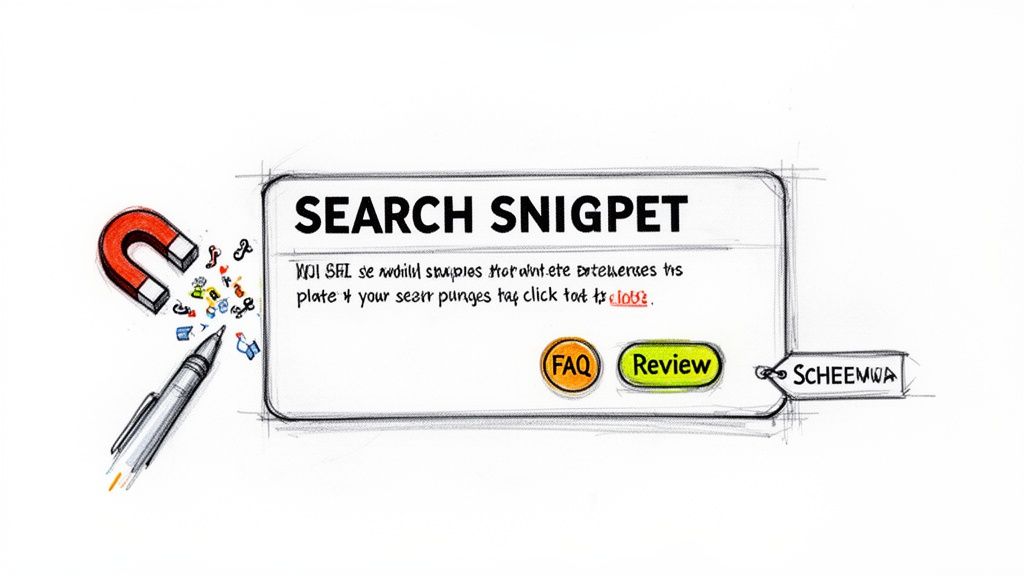
One of the best ways to stand out on the results page is simply to take up more space and provide more value than your competitors. That’s where structured data, also known as schema markup, comes in. By adding this little bit of code to your page, you help Google understand your content on a deeper level, and it often rewards you with "rich snippets."
These suped-up listings can make a huge difference in your visibility and click-through rate.
- FAQ Schema: This adds a dropdown of common questions and answers right under your main link. It instantly provides value and physically pushes competitors further down the page.
- Review Schema: Got good reviews? This schema displays star ratings directly in the search results. An average rating of 4.5 stars builds immediate trust and offers powerful social proof before anyone even clicks.
- How-To Schema: This lays out a step-by-step guide right in the search results, instantly positioning your page as the definitive guide for a specific task.
Using structured data turns a boring old blue link into a feature-packed, attention-grabbing result that’s hard to ignore. As you implement these, you'll find more ways to boost your website's visibility naturally and really separate yourself from the pack.
Amplifying User Signals with CTR Optimization Services
So what happens when you’ve got a fantastic page with a great title and rich snippets, but it’s still stuck on page two, just out of reach of meaningful traffic? This is where a strategic push can make all the difference.
Services like ClickSEO are designed to provide that final nudge to get over a ranking hump. They work by having real people find and click on your website in the search results for your target keywords.
This process essentially mimics authentic user interest. It generates positive behavioral signals—like a higher CTR and more time spent on your site—that show Google your page is a great match for the query. It's a method for confirming your content's quality and proving its relevance to Google.
Consider this: Google’s global market share has consistently hovered between 89-91% for more than a decade, according to recent data on global search engine market share. This means improving your engagement signals on Google gives you a massive return, since you’re optimizing for where nearly all the search activity happens.
The trick is to use these services as an amplifier for your best content, not as a crutch for bad pages. It's a smart way to get Google's attention on a deserving page that’s struggling to get that initial traction, helping it finally earn the visibility and traffic it's built for.
Measuring the Impact of Your SearchSEO Efforts
So, you’ve launched a new searchseo campaign. You've tweaked your titles, refined your meta descriptions, and maybe even used a service to get the ball rolling. But how do you know if any of it is actually working?
Proving the value of your efforts comes down to connecting the dots between your actions, user engagement, and—ultimately—your search rankings. Think of yourself as a data detective. You need to gather the right clues to build a case that your strategy is paying off, and your investigation starts with two key tools: Google Search Console and Google Analytics.
Your First Clues: Google Search Console
Google Search Console (GSC) is your direct line to Google. It gives you a raw, unfiltered look at how users interact with your site right on the search results page, before they even click. This is where you'll find the first signs of success.
Head over to the "Performance" report and zero in on the pages and keywords you're targeting. The metrics you're looking for are:
- Impressions: How many times your page was shown to a searcher.
- Clicks: How many of those people actually clicked on your result.
- Average CTR (Click-Through Rate): The percentage of impressions that turn into clicks. This is your number one indicator for how well your snippet is grabbing attention.
- Average Position: Your site’s average rank for a given query.
When you kick off a searchseo campaign, the first metric you should see move is your CTR. A steadily climbing CTR is the initial proof that your new titles and descriptions are resonating with searchers and enticing them to click.
Connecting the Dots with On-Site Behavior
While GSC shows you what happens on the SERP, Google Analytics tells you the rest of the story: what people do once they land on your website. This is where you confirm that the clicks you’re earning are from people who are genuinely interested in your content.
Here, you’ll want to cross-reference your GSC data with the on-page behavior for those same landing pages. Keep an eye on positive movements in:
- Session Duration: Are people sticking around longer? This signals that your content is valuable and engaging.
- Bounce Rate: A lower bounce rate means users are finding what they expected and aren't hitting the back button immediately.
- User Flow: This report gives you a visual map of the journey users take, showing if they navigate to other pages after landing.
By linking a rising CTR in Search Console with an increased session duration in Analytics, you build a powerful narrative. You can definitively show that not only are more people clicking your result, but they are also highly engaged with the content, sending strong positive signals to Google.
This data-driven story becomes even more critical when you're running geo-targeted campaigns. User behavior isn't the same everywhere. For example, while Google has a staggering 97% market share in India, things look very different in Russia, where the local engine Yandex commands 76.3% of search traffic. These global search engine preferences show why a one-size-fits-all approach to user engagement just doesn't work.
Finally, a word of advice: be patient. Seeing significant, stable ranking improvements from engagement signals isn't an overnight process. It generally takes Google's algorithms 30-90 days to fully process these new user patterns and reward your page accordingly. Keep this timeline in mind to set realistic expectations for yourself, your clients, and your team.
Common Questions About SearchSEO
Whenever we start talking about directly influencing user engagement signals, a few eyebrows go up. It’s a smart reaction—you should be skeptical. This isn't your grandad's SEO, and it’s natural to wonder about the risks and how it all really works.
Let's clear the air and tackle the questions I hear all the time.
Is This Stuff Safe, or Is It Black Hat?
This is the big one, and for good reason. The answer comes down to one thing: how the clicks are being generated. There's a world of difference between shady, automated traffic and genuine human engagement.
The Wrong Way: Cheap, Automated Bots. These are a one-way ticket to trouble. Bot traffic is fast, cheap, and incredibly easy for Google to detect. The bots often come from the same data center IPs and follow robotic, predictable patterns. Using them is like sending a badly forged invitation to a party—the bouncer (Google's algorithm) will spot it a mile away and you won't just be turned away, you'll be blacklisted.
The Right Way: Real Humans, Real Devices. A professional searchseo service is completely different. It relies on a network of real people using their own computers and phones, on their unique home and mobile internet connections. They perform searches just like a real user would: typing a keyword, scrolling through the results, finding your page, clicking, and then actually spending time on it. This activity is practically identical to genuine user interest, making it a much safer way to validate your content's quality.
The goal isn't to trick Google. It's to show Google what it wants to see: that real people are finding your page useful for a specific search. When done correctly, you're simply accelerating the discovery process.
How Many Clicks Will It Take to Rank?
Everyone wants a magic number, but this question is a bit of a trap. Success with searchseo isn't about the total volume of clicks; it's about consistency.
Blasting a page with 1,000 clicks in a single day is a huge red flag. That kind of unnatural spike looks suspicious and is often ignored by Google. It's the digital equivalent of shouting, and it rarely works.
Think of it like building a reputation in a small town. You don't do it by throwing one giant, flashy party. You do it by showing up consistently, being helpful, and becoming a familiar, trusted face over time.
A slow drip of high-quality clicks is far more powerful than a firehose. A strategy that delivers just 5-10 targeted clicks each day over a month or two sends a believable, steady signal that people are repeatedly choosing your page.
This consistent pattern tells the algorithm that your page is a reliable answer for that query. Patience and consistency win this game, not brute force.
Can SearchSEO Fix a Bad Piece of Content?
Let me be blunt: absolutely not.
SearchSEO is an amplifier, not a miracle worker. You can't just slap a great title on a thin, unhelpful article and expect a few clicks to rocket it to the top. It doesn't work that way.
In fact, trying this will actively hurt your rankings. When you send traffic to a page that doesn't deliver, users will hit the back button almost immediately. This "pogo-sticking" is one of the strongest negative signals you can send to Google. You're literally paying to prove to the algorithm that your page is a disappointment.
Engagement optimization should always be the final polish on a well-built machine.
- First, Create A+ Content: Write something genuinely useful that completely solves the searcher's problem.
- Next, Nail Your On-Page SEO: Craft a compelling title and meta description that makes people want to click.
- Finally, Amplify with SearchSEO: Once the page is genuinely great, use a searchseo strategy to confirm its value and accelerate its climb.
At the end of the day, this strategy helps great content get the recognition it deserves. It’s about giving an already-worthy page the push it needs to break through.
Ready to amplify your best content and break through ranking plateaus? ClickSEO provides the strategic, human-powered clicks you need to prove your content's value to Google. Start sending the right signals today by visiting https://clickseo.io.