Build a Powerful Organic Traffic Generator
Let's get one thing straight: you can't just buy an "organic traffic generator" off the shelf. The term itself can be a bit confusing. It's not a single piece of software or a magic button that instantly floods your website with visitors.
Think of it less like a quick fix and more like building a high-performance engine, piece by piece. When all the parts are assembled and tuned correctly, this engine hums along, consistently pulling valuable, free traffic from search engines like Google.
This "engine" is actually a combination of several critical systems working in perfect harmony. Each one has a specific job to do, from attracting people searching for answers to converting them once they land on your site.
The Core Components of Your Traffic Engine
Building this engine isn't about chasing one-off tactics; it's about committing to a holistic strategy where every element supports the others. The most successful sites get this.
- High-Value Content: This is the fuel. We're talking about content that genuinely solves a problem, answers a burning question, or thoroughly entertains your target audience.
- Precision SEO: This is the expert engineering. It covers all the on-page, off-page, and technical details that make sure search engines can find, understand, and rank your amazing content.
- Click-Through Rate (CTR) Optimization: This is your competitive advantage. Even if you rank #1, you still have to convince someone to click your link instead of the nine others on the page. That's where compelling titles and descriptions come in.
And make no mistake, getting this right is worth the effort. The data shows that organic search is responsible for a staggering 57.3% of all trackable website traffic, making it the most dominant channel for online visibility by a long shot.
The core idea is simple: a true organic traffic generator is the result of a deliberate, long-term strategy. It's about building an asset that produces predictable traffic and sustainable growth, turning your website into a reliable source of leads and sales. You can explore our foundational guide on what is organic traffic to deepen your understanding.
The Five Pillars of Your Traffic Engine
Think of your website not as a static brochure, but as a dynamic engine built for one purpose: attracting a steady stream of the right kind of visitors. A truly effective organic traffic generator isn't a single tactic or a quick fix. It’s a complete system where several key parts work together seamlessly.
When all these parts are humming in sync, your site becomes a powerhouse for sustainable growth. But if one piece is missing or broken, the whole engine can stall. Let's break down the five core pillars that make this engine run.
Pillar 1: Foundational Content Strategy
Content is the fuel. Simple as that. Without high-quality, genuinely helpful content, even the most technically perfect website has nothing to offer search engines or, more importantly, your audience. The goal here is to create the best answer to a searcher's question or the best solution for their problem.
This goes way beyond just churning out blog posts. It’s about creating a strategic library of resources that meets people where they are, whether they're just discovering a problem or are ready to make a purchase.
- Solve Real Problems: Your best content will come from identifying your audience's biggest headaches and creating detailed, actionable guides that offer a real solution.
- Answer Specific Questions: Dig into what people are actively searching for. Use this insight to create content that directly answers those queries, making you the go-to resource.
- Build Trust and Authority: Consistently publishing well-researched, in-depth content is how you prove your expertise and become the name people trust in your space.
This is the core of your entire operation. As you can see, your content, SEO efforts, and user engagement (like click-through rate) are the interconnected components that power the whole machine.
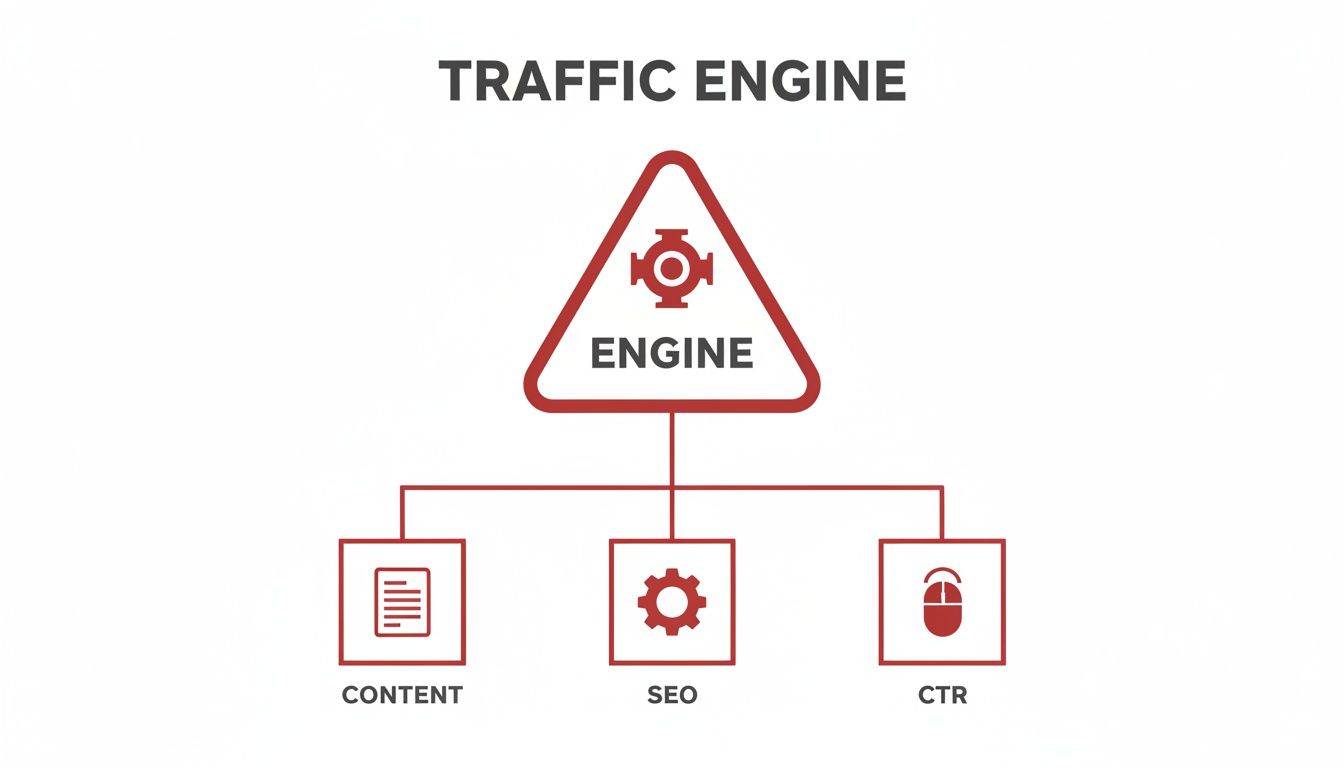
When these elements work together, they create a powerful flywheel effect, driving more and more qualified traffic over time.
Pillar 2: Precision On-Page SEO
Now that you have the fuel (your content), you need to make sure the engine can actually use it. On-page SEO is how you optimize your individual web pages to clearly signal to search engines what they're about. It’s about making your brilliant content understandable to Google's bots.
Think of it like putting clear, accurate labels on every part of your engine. This helps the mechanic—Google—quickly understand what each part does and where it fits. This involves everything from optimizing your title tags and writing persuasive meta descriptions to using headers (H1, H2, H3) to structure your content logically. Good internal linking also plays a huge role in guiding both users and search bots through your site. If you're curious about the different avenues this traffic can come from, explore our guide on examples of organic traffic sources for marketers.
Pillar 3: Flawless Technical SEO
Technical SEO is the very frame and wiring of your engine. It's all the crucial, behind-the-scenes work that allows the rest of your strategy to function properly. If your site is slow, clunky on mobile, or a maze for search engines to crawl, even the world's best content will stall out.
A fast, secure, and easily crawlable website is no longer a luxury; it's a baseline requirement. Google prioritizes sites that offer a great user experience, and that starts with a solid technical foundation.
This means focusing on things like lightning-fast page speed, a flawless mobile experience, a clean site structure, and submitting an XML sitemap to give search engines a clear roadmap to all your important pages.
Pillar 4: Strategic Off-Page Authority
Off-page authority is all about your website's reputation on the wider web. The main way you build this reputation is by earning high-quality backlinks—in other words, getting other respected websites to link to yours. Every one of those links from a credible site is like a vote of confidence.
These "votes" are a powerful signal to search engines that your content is valuable, trustworthy, and worth showing to more people. Building this kind of authority doesn't happen overnight; it’s a long-term play that involves creating content so good that people want to link to it and then doing strategic outreach to get it in front of the right eyes.
Pillar 5: Critical CTR Optimization
Finally, let's talk about the moment of truth. You can have the best content and a #1 ranking, but if no one clicks on your result, it's all for nothing. Click-through rate (CTR) is the percentage of people who see your site in the search results and actually click on it.
Improving your CTR is one of the most powerful levers you can pull. It not only drives more traffic directly but also sends a strong positive signal to Google that your result is the most relevant and appealing one for that query. This is where your page titles and meta descriptions act as your 3-second sales pitch on the search results page. You have to make them count.
To bring it all together, here is a quick overview of how these five pillars form a comprehensive strategy.
| The 5 Pillars of Organic Traffic Generation |
| :--- | :--- | :--- |
| Pillar | Primary Goal | Key Activities |
| Content Strategy | Create valuable, relevant content that solves problems and answers questions for a target audience. | Keyword research, topic clustering, creating guides, blog posts, and case studies. |
| On-Page SEO | Optimize individual pages to be easily understood and ranked by search engines for target keywords. | Title tag optimization, meta descriptions, header tags, internal linking, image alt text. |
| Technical SEO | Ensure the website's foundation is fast, secure, and crawlable for search engines and users. | Site speed optimization, mobile-friendliness, XML sitemaps, fixing crawl errors. |
| Off-Page Authority | Build the website's reputation and trustworthiness across the internet. | Earning high-quality backlinks through outreach, guest posting, and digital PR. |
| CTR Optimization | Maximize the percentage of users who click on your search result over competitors'. | Writing compelling headlines, persuasive meta descriptions, and testing SERP snippets. |
By systematically addressing each of these five areas, you move from just "doing SEO" to building a predictable, scalable organic traffic engine.
Your Step-by-Step SEO Game Plan
Knowing the theory is one thing, but actually putting it all together is where most people get stuck. SEO can feel like a massive, never-ending project. The secret is breaking it down into a manageable, phased approach.
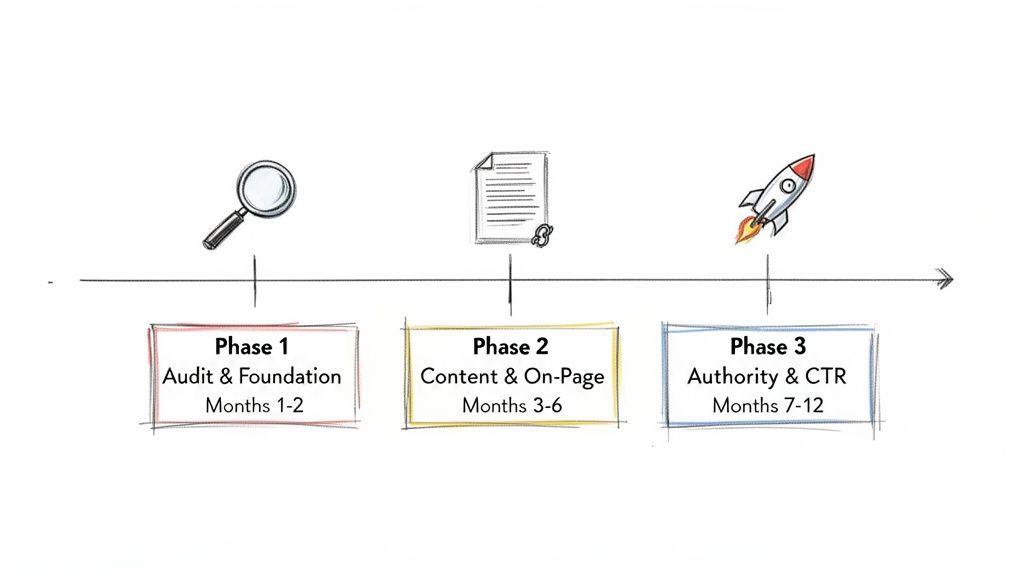
Think of this as a 12-month blueprint for building your digital presence. It’s not about just "doing SEO" for a year; it’s about methodically constructing an asset that brings in predictable, high-quality traffic long after the initial work is done.
Phase 1: Laying the Foundation (Months 1-2)
The first 60 days are all about discovery and planning. You simply can't build a skyscraper on a shaky foundation, and the same goes for your website. This phase is where we find and fix the critical issues holding you back.
The goal here is to get a brutally honest assessment of your starting point. We need to know your site's technical health, what your competitors are doing right, and where the low-hanging fruit is. This groundwork informs every single step that comes next.
Key activities for this phase include:
- A Full-Scale Technical Audit: This isn't optional. Using tools like Google Search Console, we hunt down crawl errors, fix sluggish page speeds, and ensure your site is flawless on mobile. If Google can't crawl and understand your site efficiently, nothing else matters.
- Deep-Dive Keyword Research: We're going way beyond the obvious terms. The real gold is in understanding the questions your audience asks at every stage of their journey, from just browsing to being ready to buy.
- Competitor Reconnaissance: Let's see what the top players are doing. What content is winning them traffic? Where are their backlinks coming from? A thorough analysis almost always reveals strategic gaps we can exploit.
By the end of this phase, you should have a prioritized hit list of technical fixes and a "quick win" list of keywords—terms with decent search volume that your competitors have overlooked. These are your first targets.
Phase 2: Content and Optimization (Months 3-6)
With a solid technical base, it's time to start building the actual structure. This four-month block is all about creating genuinely valuable content and optimizing every page with surgical precision. This is where your organic traffic machine really starts to hum.
I won't lie, this part requires the most elbow grease. But it's also where you'll start to see those first, exciting glimmers of traffic growth. Consistency is everything here.
We'll take the research from Phase 1 and put it into action:
- Build a Content Calendar: We'll map out your content for the next several months. This isn't just a list of topics; it's a strategic plan to ensure a steady drumbeat of new, targeted assets.
- Create Pillar Pages: For your most important core topics, we'll build out massive, comprehensive guides. These "pillar" pages become the authoritative hubs for entire sections of your site.
- Publish Supporting Blog Posts: We'll surround your pillars with a constant stream of articles targeting more specific, long-tail keywords. Every new post links back to its relevant pillar, building a powerful web of topical authority.
- Execute Flawless On-Page SEO: As we publish (and update old content), we'll nail the fundamentals: killer title tags, compelling meta descriptions, logical header structures, and a smart internal linking strategy that guides both users and Google.
To really get an edge in 2026, your strategy has to include essential AI SEO tactics. These tools help you scale high-quality content creation and spot optimization opportunities your competitors will miss.
Phase 3: Authority and Enhancement (Months 7-12)
Now that you have a growing library of fantastic, optimized content, we shift gears. This final phase is all about building your website's authority in the eyes of Google and amplifying the results of all your hard work.
By this point, you'll likely have pages creeping onto the second or third page of the search results. The goal now is to give them the final push they need to hit page one and, most importantly, get the click.
This final strategic push involves two critical activities:
- Strategic Link-Building: We begin a careful, targeted outreach campaign to earn high-quality backlinks to your best content (especially those pillar pages). These external "votes of confidence" are a massive signal to Google that your site is a credible source.
- CTR Enhancement and Testing: We'll identify pages that are ranking well but have a poor click-through rate (CTR). Rewriting their titles and meta descriptions to be more irresistible is often all it takes to double their traffic.
- Accelerating with Engagement Signals: For those crucial keywords stuck just outside the top spots, a tool like ClickSEO can be a real difference-maker. By sending targeted, real-user engagement signals to these pages, you can show Google that users love your content. This helps accelerate ranking tests and validate your optimization efforts in weeks, not months.
Why Click-Through Rate Is Your Secret Weapon
Getting onto the first page of Google feels like a huge win, and it is. But honestly, that’s just the start of the race. Once your page is visible, you have to convince someone to actually click on it. This is where your click-through rate (CTR) comes in, and it's probably the most powerful—and most overlooked—part of a true organic traffic generator.
Think of it this way: the search results page is a packed supermarket aisle. Your title tag and meta description are your packaging. A high ranking gets you prime shelf space, but it's that little snippet of text that makes a searcher reach for your product instead of the nine others right next to it.
The Simple Math Behind a Better CTR
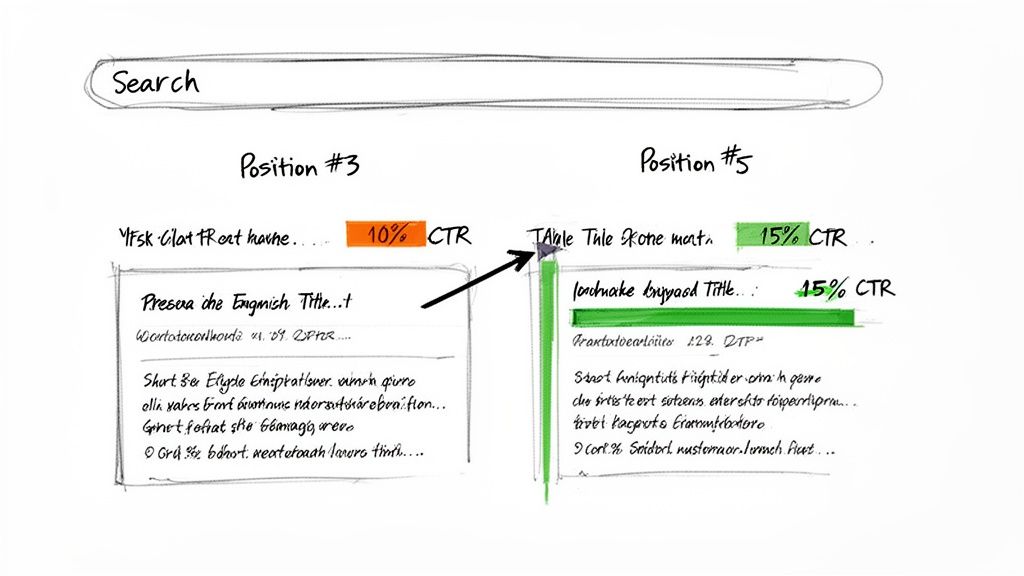
Let's break this down with a real-world example. Say your page ranks in position #5 for a keyword with 1,000 monthly searches. An average CTR for that spot is about 9%, which brings you roughly 90 visitors.
Now, imagine you rewrite your title and description to be far more compelling, and your CTR jumps to 15%. Just like that, you're getting 150 visitors from the exact same ranking. That’s 60 extra visitors every month, without moving up a single spot.
But it gets even better. Google watches user behavior like a hawk. When it sees your result getting a higher-than-average CTR, it sends a clear signal: people find this page more relevant, even compared to the ones ranked above it. This often prompts Google to test your page in a higher position, kicking off a fantastic feedback loop that can boost both your rankings and your traffic. To see the full picture, you can learn more about what is click-through rate and why it matters.
How to Write Snippets That Get the Click
Crafting a snippet that people can't resist clicking is part art, part science. You have to get inside the searcher’s head and give them a compelling reason to choose you. To really master this, it helps to have a solid grasp of what is Click Through Rate and how to actually improve it.
Here are a few tips I've seen work time and time again:
- Use Power Words: Words like "Proven," "Effortless," "Secret," or "Step-by-Step" create intrigue and promise a clear, valuable outcome.
- Include Numbers: Headlines with numbers (e.g., "10 Simple Ways...") work so well because they set a clear expectation for the reader. They’re predictable in the best way.
- Ask a Question: Start a conversation in their head by asking a question they're already thinking, like "Tired of Low Traffic?" It builds an immediate connection.
- Focus on the Benefit: Don't just state what your page is. Explain what the reader will get. Instead of "Guide to SEO," try "Rank #1 With This SEO Guide."
The data on search behavior is incredibly telling. Updated 2025 figures show the #1 spot on Google gets a massive 39.8% CTR. This drops sharply to just 18.7% for position #2 and 10.2% for position #3. It goes to show that even a single jump in rank can nearly double your traffic, which is why CTR is something you can't afford to ignore.
Speeding Up Growth with the Right Signals
Sometimes a page gets stuck. You know the feeling—it's lingering on page two or at the bottom of page one, and waiting for Google to notice your improvements can feel like an eternity. This is where you can be proactive and prove your page's worth much faster.
Services like ClickSEO give you a way to safely accelerate this process. The platform uses a massive network of real human testers from over 170+ countries, all on unique residential IP addresses, to mimic how an authentic user would behave.
Here’s a quick look at how it helps your organic traffic generator:
- Search and Find: A real person types your target keyword into Google.
- Click Your Result: They scroll through the SERP, find your page (even if it's on page two), and click it.
- Engage with Content: They then spend real time on your site, browsing different pages to simulate genuine interest and engagement.
This entire sequence sends strong, positive user signals straight to Google's algorithm. It essentially shows Google that when people search for your keyword, they find your result incredibly relevant. This can slash the time it takes to see ranking improvements, with many users reporting a noticeable lift in just 30-60 days.
How to Measure Success and What to Expect
Let's be honest—this is the part everyone wants to know. You're putting in all this work, so when does the traffic actually start rolling in? Building a true organic traffic generator is a long game, a marathon that rewards patience and consistency. Forget about overnight success; real SEO is about methodically building an asset that pays dividends for years.
Think of it like this: for the first few months, you’re planting seeds and watering them. Most of the critical growth is happening underground where you can't see it. In SEO terms, this is your technical foundation getting solid and Google’s crawlers just beginning to find and understand your new content. You won’t see a sprout right away, but you’re building the root system.
Generally, you’ll start to see tangible traffic growth around the six-month mark. After a full year of consistent effort, that growth really begins to compound.
Defining Realistic Timelines and Outcomes
How fast you see results really depends on the mountain you're trying to climb. A local bakery targeting neighborhood keywords will see movement much faster than a global B2B software company competing against industry giants. Your starting point and the resources you commit play a huge role.
Still, industry data gives us a solid idea of what's achievable with a one-to-two-year commitment. After sustained SEO efforts, it’s not uncommon for e-commerce sites to hit an average of 24,572 monthly sessions with 38% annual growth. B2B SaaS companies often reach 21,410 sessions with an impressive 41% growth rate.
Some sectors are even more explosive. We've seen biotech companies achieve a 108% yearly jump in traffic. This proves that a smart, consistent strategy works, regardless of the industry. You can explore more industry-specific organic traffic benchmarks on First Page Sage to get a feel for what’s possible in your space. The key takeaway is that the early days feel slow, but the long-term payoff is huge.
Key Performance Indicators Beyond Traffic
While more traffic is the goal, it’s a vanity metric if it doesn’t lead to business results. To get the full picture of your SEO health, you need to track the right Key Performance Indicators (KPIs). These are the numbers that tell you what’s working, what isn’t, and where you need to focus next.
Your command center for this will be a combination of Google Search Console and Google Analytics. Here’s what you should be watching like a hawk:
- Keyword Ranking Improvements: Are your most important keywords climbing the search results? A jump from page three to page two might not bring traffic yet, but it’s a powerful sign that Google is taking notice.
- Organic Click-Through Rate (CTR): This number shows how well your headlines and descriptions are doing their job. A rising CTR for a specific page is one of the strongest positive signals you can send to Google.
- Session Duration and Pages Per Session: When people arrive, do they stick around and explore? High engagement is a direct signal to search engines that your content is valuable and matches what the user was looking for.
- Bounce Rate: A high bounce rate can mean your content isn't delivering on the promise of your headline. A decreasing bounce rate is a fantastic sign that your content quality and relevance are improving.
- Goal Completions and Conversions: This is the bottom line. You need to know how many organic visitors are signing up, filling out a form, or making a purchase. This is how you prove the ROI of your SEO efforts.
By tracking these KPIs, you stop just counting visitors and start understanding them. You get a real-time report card on your content's performance, user behavior, and the actual business impact your work is having.
Interpreting the Data to Guide Your Strategy
The data tells a story—if you know how to read it. For example, if Google Search Console shows a page is getting tons of impressions but has a terrible CTR, you know your content is ranking but your title and meta description aren't compelling enough to earn the click. Time for a rewrite.
On the other hand, if a page has a great CTR but a sky-high bounce rate in Google Analytics, it means your headline made a promise that your content didn't keep.
This is where you shift from just reporting data to acting on it. Let's say you spot a group of valuable keywords that have been stubbornly stuck on page two for months. They're on the verge of becoming major traffic drivers. This is the perfect scenario to use a tool like ClickSEO. By sending genuine human engagement signals to those specific URLs, you can help prove their relevance to Google and give them the nudge they need to break onto page one.
This targeted approach lets you test your optimizations and see a measurable lift in as little as 30-60 days, turning those data-driven insights directly into growth.
Frequently Asked Questions
Let's tackle some of the big questions that come up whenever we talk about building a real organic traffic engine. These are the things people ask me all the time, so let's get you some clear, no-nonsense answers.
How Long Does It Really Take to See SEO Results?
Ah, the million-dollar question. The honest-to-goodness answer is, "it depends." I always tell my clients to think of it like planting a tree. For the first few months (1-3), you're not going to see much. You're preparing the soil (technical SEO) and planting the seed (new content), and all the important work is happening underground as the roots take hold.
Then, around the 4-6 month mark, you'll start to see the first sprouts. This is when you'll notice your first keyword ranking improvements and maybe a small, encouraging trickle of new visitors.
But the real, meaningful traffic—the kind that actually impacts your bottom line—typically starts to build and compound after 6-12 months of consistent work. In really competitive spaces, it can take even longer. The key takeaway is that SEO is a long-term investment in a compounding asset, not a switch you can flip for instant results.
What Is the Real Difference Between Building and Buying Traffic?
Here’s a simple way to think about it: building traffic is like earning a great reputation. You put in the work by creating fantastic content, making your site a joy to use, and building real authority. In return, you earn a steady flow of high-quality visitors who are genuinely interested in what you have to say. This is the bedrock of a sustainable business.
Buying traffic, on the other hand, is like renting an audience. You pay platforms like Google or Facebook to send people your way immediately. It’s a fantastic tool for short-term campaigns or testing a new offer, but the second you stop paying, the traffic disappears.
A key insight is that building traffic through SEO has a much higher long-term ROI. A well-ranked article can bring in free, targeted traffic for years, whereas an ad campaign's value vanishes once the budget is spent.
Is Using a CTR Service Like ClickSEO Safe?
This is a perfectly valid question, and the answer comes down to one thing: how the user signals are created. The old-school, black-hat traffic bots are incredibly risky. They use cheap datacenter IPs and predictable, robotic scripts that Google’s algorithms can spot a mile away. Using them is a fast track to getting penalized.
However, a modern service like ClickSEO is in a completely different league. It works by coordinating a massive network of real human testers on unique residential 4G and Wi-Fi IPs from over 170+ countries.
These aren't bots; they are real people who perform actual searches, find your website in the search results, and browse it just like a regular visitor would. Because the engagement signals come from real humans on real devices, they are indistinguishable from your ideal target audience. This makes it a perfectly safe, white-hat way to confirm your on-page optimizations are working and speed up your ranking tests.