
SparkTraffic Review 2026: The Risks vs Rewards for SEO
Most advice about sparktraffic starts from the wrong premise. It asks whether the visits look human enough. That is not the key question in 2026.
The key question is whether simulated engagement can create durable SEO value without corrupting your data, exposing your site to risk, or distracting you from channels that bring revenue. On that standard, tools like sparktraffic deserve a much harder review than they typically get.
I have seen too many site owners chase traffic volume when what they needed was qualified demand, stronger pages, and better click appeal in search. Inflated sessions can make a dashboard feel alive. They can also make decision-making worse.
SparkTraffic sits right in the middle of that tension. It is popular because it promises control. You can shape visits, geography, device type, timing, and behavioral patterns. For agencies under pressure, affiliates trying to lift weak properties, and store owners tired of slow growth, that offer is easy to understand.
The problem is that search engines do not reward the appearance of interest forever. They reward evidence that users found what they wanted.
The Allure of Instant Website Traffic
Traffic hunger makes smart marketers do dumb things.
A site launches. Rankings stall. Paid acquisition gets expensive. Organic growth moves slower than the founder wants. At that point, “more visitors” starts sounding like a strategy even when it is only a metric.
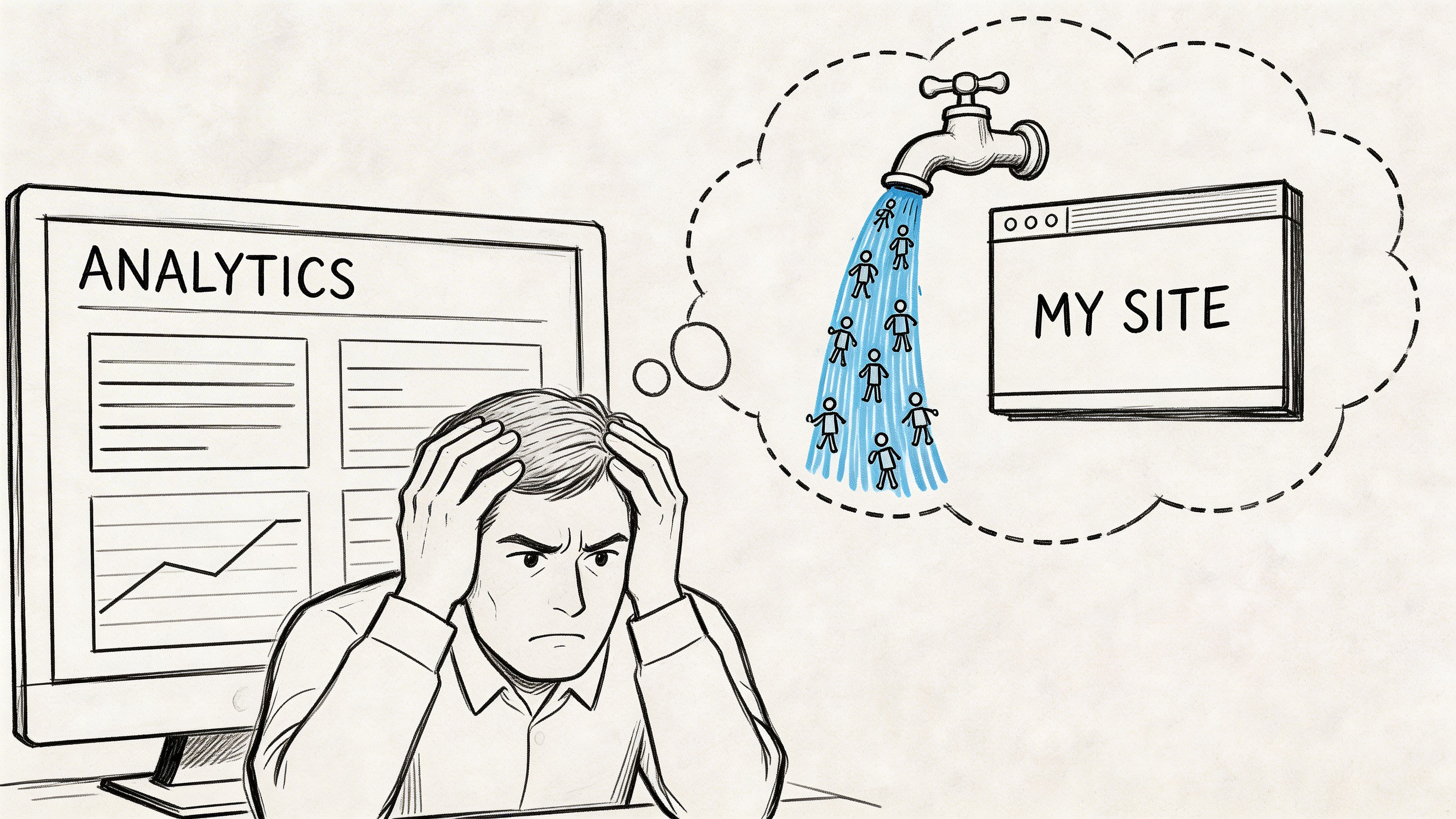
SparkTraffic has obvious market pull. According to Similarweb’s February 2026 view of sparktraffic.com, the site recorded 111.4K total visits in the last month, up 20.05% month over month, with a 41.09% bounce rate and 1 minute 55 seconds average session duration. Those numbers tell you one thing clearly: a lot of marketers are at least curious enough to evaluate the product.
Why the offer lands so well
SparkTraffic sells relief from the slowest parts of SEO.
It appeals to people facing familiar frustrations:
- Agencies under retention pressure: Clients want movement before content, links, and technical fixes have time to compound.
- Store owners chasing social proof: A quiet analytics panel can make a business feel stuck even when product-market fit is the bigger issue.
- Affiliate publishers testing weak niches: Some want traffic to make a property look more active while they figure out whether the site has any real upside.
That emotional pull matters because many traffic tools are bought in moments of impatience, not after rigorous channel analysis.
The hidden trade-off
Not all sessions are equal. A visit only matters if it helps with one of three things: better rankings, better conversions, or better decisions.
Bot-driven traffic can interfere with all three.
It may improve surface metrics inside analytics. It does not automatically create the kinds of interactions that support long-term search visibility. Worse, it can muddy the signals you rely on to judge landing pages, offers, and user intent.
Key takeaway: The attraction of sparktraffic is not mysterious. It offers speed, control, and visible activity. The risk is that those benefits mostly live at the reporting layer, not the business layer.
That is why sparktraffic deserves evaluation as an operational choice, not just as a traffic product.
What Is SparkTraffic and Who Uses It
SparkTraffic is a traffic generation platform built for people who want to send controlled visits to a website without waiting for search, social, partnerships, or ads to produce them naturally.
The offer is simple on the surface. You choose the kind of traffic pattern you want, launch a campaign, and watch visits appear in your reporting stack.
What the platform sells
SparkTraffic positions itself as a scalable system rather than a one-off blast service. According to Craig Campbell’s SparkTraffic overview, its plans range from basic packages up to $499 per month for 2,000 daily visits, with controls for geo-specific sourcing, device targeting, and time-of-day delivery across 170+ countries.
That matters because the product is not just selling raw visits. It is selling the idea that you can shape those visits to resemble the kind of audience behavior you wish you already had.
A buyer can tune inputs like:
| Feature | What it is meant to help with |
|---|---|
| Geo targeting | Making traffic appear relevant to a country or local market |
| Device targeting | Matching user sessions to mobile or desktop expectations |
| Time scheduling | Avoiding perfectly flat traffic patterns |
| Visit volume controls | Creating a steady stream instead of sporadic spikes |
Who tends to buy it
Different users buy sparktraffic for different reasons, but the motivations usually fall into a few buckets.
Agencies trying to show movement
Some agencies use traffic tools when a client expects visible momentum before foundational SEO work has had time to mature. SparkTraffic looks attractive because it gives the operator knobs to turn.
The problem is that visible activity and search progress are not the same thing.
E-commerce teams trying to improve engagement metrics
Store owners often worry about bounce rate, short sessions, and low page depth. A tool that promises configurable traffic patterns sounds like a shortcut to healthier engagement.
That can backfire if the injected sessions do not represent buying intent. A cleaner metric with no commercial value still leaves the store with the same revenue problem.
Affiliate marketers and niche publishers
This group often cares about optics, testing, and short-term SERP experiments. SparkTraffic can look useful for making smaller properties appear active, especially where real audience acquisition is slow or expensive.
That is also the group most likely to get hurt by polluted data. If your edge comes from knowing which pages deserve investment, synthetic traffic can blur the answer.
The core appeal
SparkTraffic solves a psychological problem before it solves a marketing one. It reduces the discomfort of low traffic.
That does not make it worthless. Controlled traffic can be useful for some narrow operational tests. But if the goal is organic growth that survives scrutiny, then the buyer needs to be brutally honest about what the platform delivers.
Unpacking the SparkTraffic Methodology
SparkTraffic’s marketing language often points toward realism. The mechanics point toward simulation.
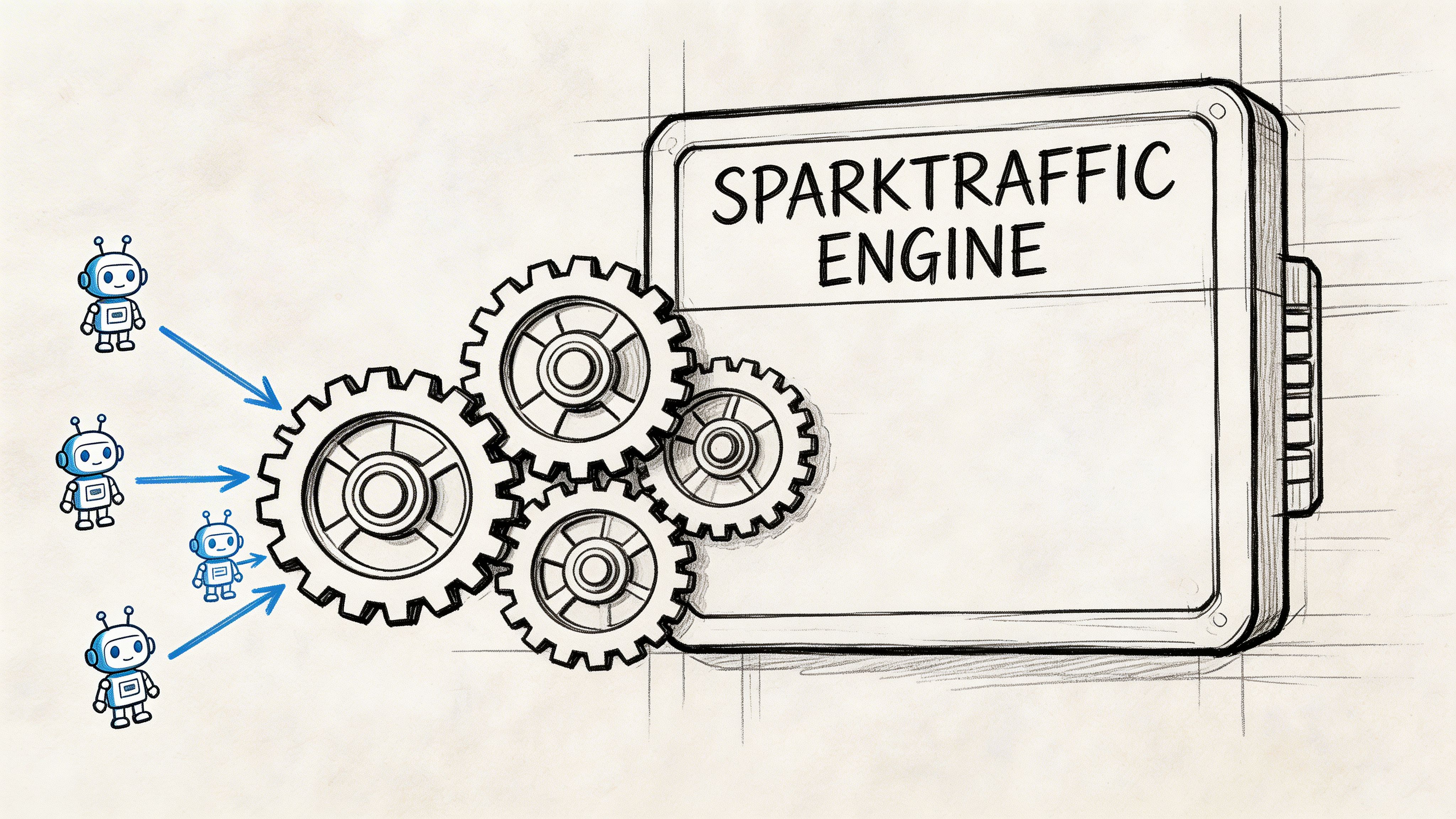
According to SparkTraffic’s explanation of traffic bots, the platform uses lightweight bot scripts that emulate human-like navigation. Those behaviors include scrolling, internal link clicks, and variable session depths up to 11 pages, backed by rotating residential proxies and diverse IP fingerprints. It also offers city-level geotargeting on advanced plans.
What this looks like in practice
Think of sparktraffic as a behavioral scripting engine.
It does not need a real person to become interested in your product, compare options, hesitate on pricing, or return later after seeing your brand elsewhere. It only needs to create a plausible pattern of on-site actions.
That distinction is everything.
A real visitor arrives with context. They searched for something, wanted something, or recognized your brand from another touchpoint. A scripted visitor performs gestures associated with interest, but there is no underlying intent behind the gesture.
Animatronic applause versus a real audience
The best analogy is a theater.
An engaged audience laughs at different moments, misses some cues, checks the program, whispers to a friend, and leaves with opinions. Their behavior is uneven because it comes from actual attention.
Animatronics can clap on cue, turn their heads, and make the room sound lively. From a distance, the theater seems full of approval. Up close, nobody is reacting to the performance.
That is the gap between simulated traffic and genuine users.
Why operators find the method attractive
From a tactical standpoint, sparktraffic gives the buyer a high degree of control:
- Behavioral variation: Sessions can include more than a single page load.
- Location control: Traffic can be pushed toward selected countries and more granular areas.
- Pattern shaping: Delivery can be timed to fit a more natural daily curve.
- Analytics visibility: Visits are intended to show up in standard reporting environments.
Those settings are exactly why many buyers underestimate the underlying issue. The more realistic the scripting looks, the easier it is to confuse detectability with legitimacy.
Practical tip: If your traffic source needs to imitate curiosity rather than capture real curiosity, treat it as synthetic input, not growth.
There is also a broader product category problem here. Discussions around tools like traffic bots and engagement simulation often get stuck on sophistication, as if better mimicry automatically makes the tactic safer. It does not. More convincing scripts can still fail the deeper test of genuine user satisfaction.
What sparktraffic can and cannot create
SparkTraffic can create sessions. It can shape browsing patterns. It can alter what analytics appears to say about behavior.
It cannot create:
- authentic commercial intent
- genuine post-click satisfaction
- word of mouth
- repeat demand rooted in product value
- the messy, inconsistent decision patterns real buyers produce
That does not mean every use is pointless. It means the tool should be judged as an artificial traffic simulator, not as a source of audience development.
Once you classify it correctly, the SEO concerns become much easier to understand.
Assessing the SEO Legitimacy and Safety Concerns
The biggest mistake people make with sparktraffic is treating SEO risk as a binary issue. Either Google catches it, or it does not. That is too simplistic.
The deeper risk is that automated traffic can fail even before any explicit penalty enters the picture. It can fail because it sends the wrong quality of signals, distorts your measurement environment, and trains your team to optimize for appearances instead of outcomes.

The stated risk is already serious
SparkTraffic’s own commercial framing leaves room for concern. On its buy-organic-traffic page, the unresolved issue is plain: there is a risk of detection and potential Google penalties for bot-like human traffic, especially as Google’s 2025 to 2026 updates prioritize genuine engagement signals. That same framing contrasts SparkTraffic’s bot reliance with competitors that emphasize human clickers.
If a product category starts from “we simulate human behavior well enough to avoid detection,” that alone should tell you where the strategic weakness lives.
Why 2026 makes this harder, not easier
Modern search systems do not need a single obvious bot fingerprint to distrust a traffic source.
They can evaluate consistency across patterns that are difficult to fake at scale:
- Intent alignment: Did the visit likely originate from a real search need?
- Behavioral coherence: Do click paths resemble how actual users in that context behave?
- Cross-signal validation: Do on-site actions align with what appears in search, discovery, and broader site performance?
- Quality persistence: Do engagement patterns hold over time in ways that suggest real satisfaction rather than mechanical repetition?
A bot script can imitate scrolling. It cannot manufacture human motive.
The problem with vanity metrics
SparkTraffic can make dashboards look healthier. That is exactly why it can be dangerous.
An SEO team might see stronger session depth and conclude a page experience improved. A store owner might see calmer bounce metrics and think merchandising is working. An affiliate publisher might assume a content cluster has traction.
But if those signals came from simulated visitors, the conclusion is false.
That creates three downstream problems:
| Problem | What happens |
|---|---|
| Reporting distortion | Teams misread what content or landing pages work |
| Strategic drift | Budget and effort move toward pages that only perform under synthetic traffic |
| Risk concentration | The site depends on a tactic that may stop helping or start harming at any time |
Human behavior is messy for a reason
Real users abandon pages abruptly. They pogo back to search. They open tabs and never return. They compare competitors. They convert late. They revisit branded searches after seeing you elsewhere.
That messiness is not a bug. It is evidence of a real market.
Bot traffic tends to smooth behavior into patterns a buyer wants to see. That is useful for simulation. It is weak evidence for SEO legitimacy.
For marketers considering automated visits, this is the important distinction explored in why buying bot traffic creates search risk. The issue is not whether a visit can be logged. The issue is whether the visit stands up as credible user activity when search systems evaluate quality.
Key takeaway: A traffic source can be visible in analytics and still be useless for SEO. Visibility is not validation.
Can sparktraffic ever be used safely
For ranking purposes, I would not treat sparktraffic as a sustainable tactic.
For isolated non-SEO testing, a marketer might argue for limited operational use, but that requires strict separation from performance analysis and no confusion about business impact. Many teams are not disciplined enough to maintain that separation over time.
The practical problem is that once synthetic sessions enter the same environment as your real traffic, they start contaminating decision quality. Even without a manual action, that can set your SEO program back.
That is why the safety conversation should not stop at “will I get caught?” The better question is “what am I teaching my team to trust?”
Automated Bots vs Human-Powered CTR Services
Not all traffic manipulation products work the same way.
Lumping every CTR service, visit simulator, and engagement platform into one bucket leads to bad decisions. The relevant comparison is not “paid traffic versus organic traffic.” It is automated behavior versus real human action.
The core dividing line
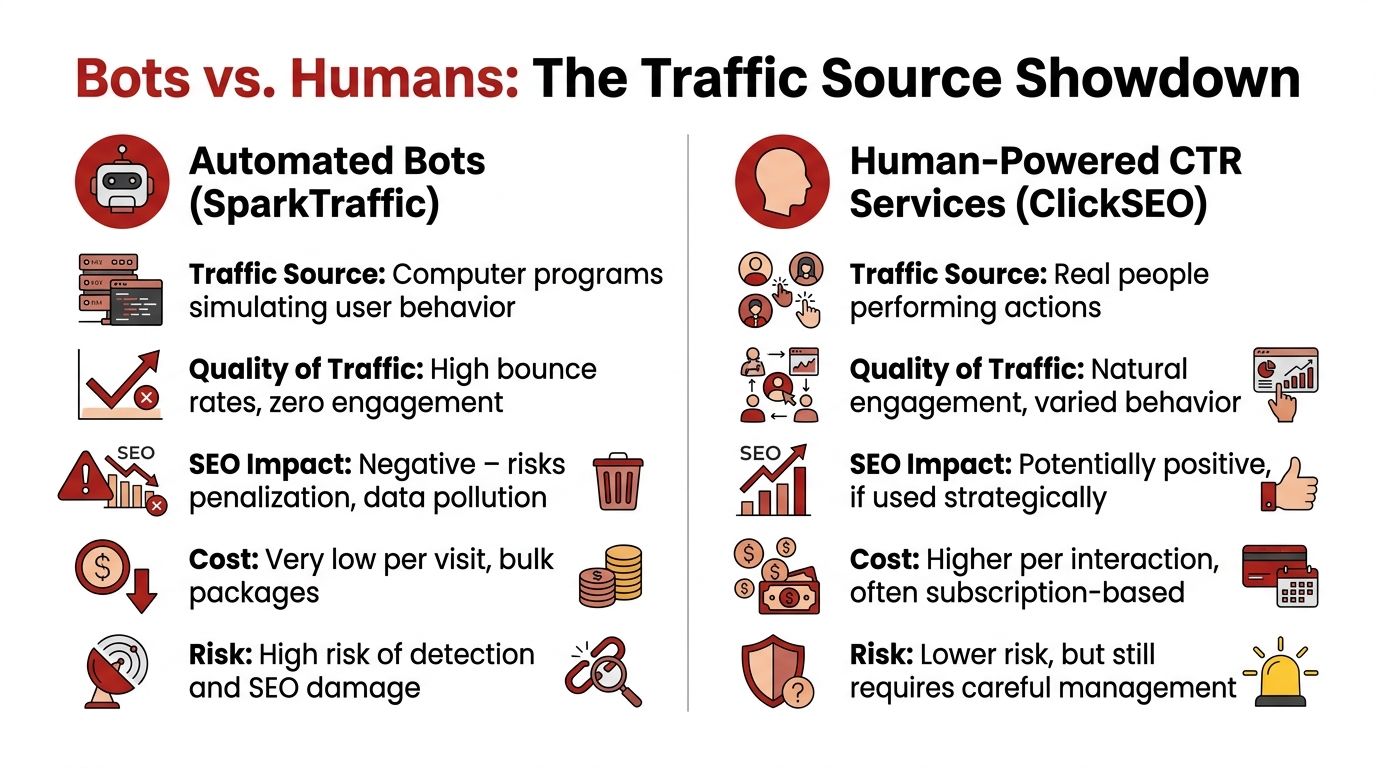
SparkTraffic sits on the automated side. Its value proposition depends on scripts, proxies, and programmable navigation patterns.
Human-powered CTR services operate differently. They rely on actual people completing tasks, which means the traffic tends to carry more natural variability, less behavioral uniformity, and a lower mismatch between recorded engagement and plausible user activity.
This distinction is useful beyond SEO. The team at Uxia has a strong breakdown of synthetic users vs human users, and it maps well to this debate. Synthetic behavior is excellent for controlled simulation. Human behavior is harder to standardize, but it is far closer to the conditions businesses need to understand.
Side-by-side evaluation
| Criterion | Automated bots like sparktraffic | Human-powered CTR services |
|---|---|---|
| Traffic source | Scripted visits | Real people taking actions |
| Behavioral pattern | Configurable and repeatable | Naturally inconsistent |
| IP environment | Proxy-based masking and rotation | Real user connections and devices |
| Data quality | Can pollute analytics interpretation | Still requires caution, but closer to real behavior |
| SEO risk profile | Higher because intent is simulated | Lower than bots, though not risk-free |
| Commercial value | Weak unless used for narrow non-revenue testing | Better chance of reflecting genuine engagement patterns |
What works better long term
If a marketer insists on using CTR-focused services, human-powered systems are the more defensible option.
Not because they are magical. Not because they bypass every search concern. They are closer to the kind of activity search engines are trying to reward in the first place.
Human users:
- arrive with more behavioral variation
- produce less mechanical interaction patterns
- can generate signals that look less manufactured
- align better with the idea of search results being chosen by people, not scripts
Bot systems try to imitate these qualities from the outside in. Human systems start with an actual person and then structure the task around that reality.
Where sparktraffic still wins
It is cheaper at the per-visit level and easier to scale mechanically.
For some buyers, that is enough. They want visible traffic, not trustworthy traffic. If the goal is to show movement on a chart or create a stream of sessions for a superficial purpose, automation is the low-friction choice.
That same efficiency is what makes the tactic brittle. Scale comes from repeatability. Detection risk and low analytical value also come from repeatability.
Rule of thumb: If the main advantage of a traffic source is that software can produce more of it cheaply, assume the quality ceiling is low.
The practical judgment
Human-powered CTR services are not the same as pure white-hat SEO. They still require restraint and context.
But compared directly against sparktraffic’s scripted methodology, they are closer to credible user behavior and further from synthetic traffic inflation. For teams concerned with long-term rankings, brand trust, and clean data, that difference matters more than the price gap.
Practical Recommendations for Marketers and Agencies
Most buyers should not use sparktraffic for SEO campaigns. The reasons vary by business model.
The unresolved analytics issue is central. SparkTraffic’s own traffic-checking framing leaves a major gap: it guarantees visibility in Google Analytics, but does not provide clear detail on how automated traffic blends with real organic traffic in a world shaped by AI Overviews and zero-click behavior. If you cannot cleanly interpret what your traffic means, you cannot manage ROI with confidence.
For SEO agencies
Client trust is the first thing on the line.
If you inject automated visits into a client property, you risk creating short-term reporting improvements that are impossible to defend under scrutiny. The account may look more active while actual lead quality, rankings, and revenue stay flat.
Agencies should avoid any workflow where synthetic traffic touches core reporting without explicit separation.
Use this filter:
- If the client expects ranking gains: Do not use bot traffic.
- If the client expects cleaner analytics: Do not use bot traffic.
- If the client expects durable growth: Invest in content, technical fixes, internal linking, and search click improvement instead.
For e-commerce operators
SparkTraffic does not solve buyer intent.
A store needs shoppers who compare products, evaluate trust, consider shipping, and decide whether the offer is worth their money. Simulated sessions can make your analytics panel more active, but they do not create product demand.
What should a store owner do instead?
A better path is to work through proven fundamentals like search intent mapping, collection page optimization, merchant trust elements, and category-level content. If you need a practical roadmap, this guide on how to increase organic traffic is a useful resource because it focuses on compounding channels rather than synthetic visits.
For affiliate marketers
Affiliate sites live or die on signal clarity.
You need to know which pages deserve updates, which keywords bring buying intent, and which offers produce actual earnings. Automated traffic muddies that judgment. It can also create compliance headaches if a network reviews your traffic quality and sees patterns that do not align with genuine user acquisition.
Affiliate publishers should protect three things above all:
- Clean attribution: Know where clicks and outcomes really came from.
- Offer integrity: Do not send traffic you would be embarrassed to explain to a partner.
- Testing discipline: Separate SEO experiments from vanity metric inflation.
For local businesses
A local business does not need synthetic visitors from a dashboard perspective. It needs real discovery and real inquiries.
That usually means strengthening service pages, local relevance, review acquisition, and branded search demand. If you are considering paid engagement-style traffic, at least compare it against options built around more credible search behavior, such as services discussed in resources about buying organic traffic.
Practical advice: Before paying for any traffic source, ask one question: “Will this help me make a better business decision next month?” If the answer is no, the traffic is probably cosmetic.
A simpler rule for everyone
If your success metric is rankings, revenue, or qualified leads, treat sparktraffic with extreme caution.
If your success metric is “my analytics chart looks busier,” then it may do exactly what you paid for. That is just not the same as marketing progress.
The Final Verdict on Automated Traffic for SEO
SparkTraffic is not difficult to understand. It is an advanced attempt to make visits look more natural through control, scripting, and delivery settings.
That is also why it falls short as a long-term SEO strategy.
The attraction is real. You get speed. You get volume. You get sessions that show up in analytics. For teams under pressure, those benefits can feel like relief.
The cost is also real. You introduce synthetic behavior into your measurement environment. You risk optimizing around false positives. You move away from what search engines want, which is evidence that users chose a result, found it useful, and behaved like real people with real intent.
The hardest truth in SEO is that authentic demand cannot be faked into existence for long.
Automated traffic can decorate a dashboard. It cannot replace product-market fit, stronger pages, better snippets, sound internal linking, and content that deserves attention. It cannot produce the uneven, credible engagement patterns that come from real users trying to solve real problems.
My verdict is straightforward. SparkTraffic may have narrow use as a synthetic traffic simulator, but it is a poor foundation for sustainable SEO. The closer your business gets to revenue accountability, client reporting, or long-term search growth, the less acceptable that trade-off becomes.
If you care about rankings that last, invest in channels and tactics rooted in real human behavior. That path is slower. It is also the one that compounds.
If you want a safer alternative to bot-driven traffic, ClickSEO focuses on real organic clicks and human engagement patterns rather than automated visit simulation. For businesses trying to improve CTR without poisoning analytics or leaning on scripted behavior, it is the more credible direction to evaluate.