A Guide to Driving Targeted Traffic That Actually Converts
Let's get one thing straight: not all website traffic is created equal. Targeted traffic is the lifeblood of any successful online business. These are the visitors who land on your site already looking for exactly what you offer—your products, your expertise, your solutions. It's the difference between shouting into a random crowd and having an engaged conversation with a room full of people who genuinely want to hear from you.
Why Targeted Traffic Is Your Most Valuable Asset
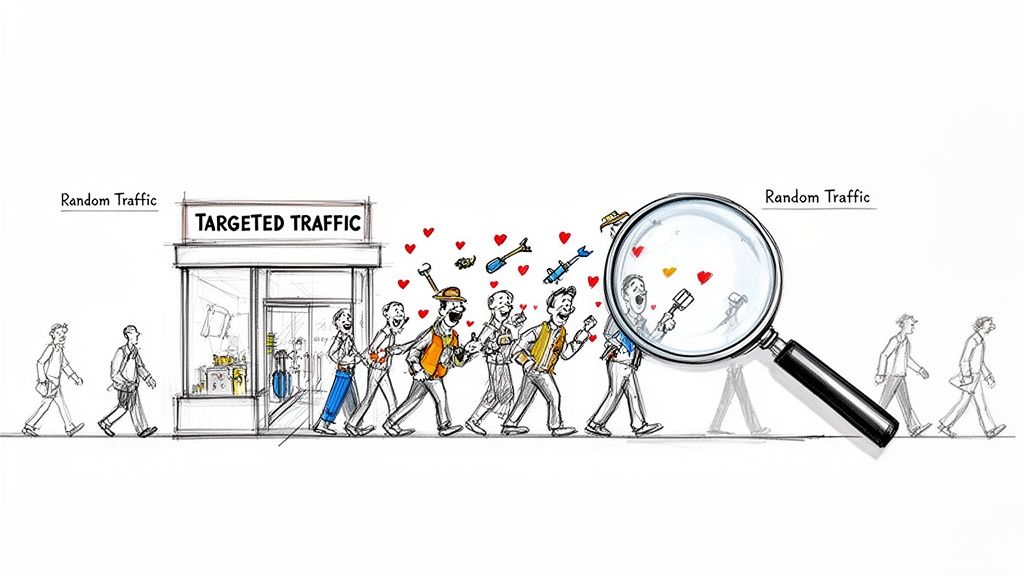
Imagine you own a specialty shop that sells rare, vintage model train parts. If your marketing floods the store with thousands of people searching for fast fashion, you’ll have a packed house but an empty cash register. That’s non-targeted traffic—all volume, no value.
Now, picture this: just 50 people walk in, but they’re all passionate model train hobbyists. The store is quieter, but every single conversation is rich and meaningful. Sales are practically a given. That, in a nutshell, is the power of targeted traffic. The goal isn't just getting more visitors; it's about attracting the right ones.
The Smart Shift: From More Traffic to Better Traffic
For years, the mantra was "more traffic is always better." That mindset is not only outdated, it's expensive. In today's market, smart businesses know that quality trumps quantity every time. Bringing in visitors who have a real interest in your brand is what actually moves the needle, because they're the ones who are ready to act.
This focus on quality has a ripple effect across your entire business and even your search engine performance. The benefits are clear:
- Sky-High Conversion Rates: When someone arrives with a specific problem or desire, they're far more likely to make a purchase, sign up, or fill out a form. The friction is gone.
- Sticky Engagement: Targeted users don't just bounce. They stick around, view more pages, and spend more time on your site because they’ve found what they were looking for.
- A Massive SEO Boost: Search engines like Google are smart. They see high engagement as a powerful vote of confidence in your site's relevance and quality. This creates a fantastic feedback loop, pushing your rankings higher.
The Undeniable Business Case for Quality Clicks
Chasing targeted traffic isn't just a marketing trick; it's a core business strategy. It ensures every dollar of your marketing budget works harder by reaching people who have the potential to become loyal, paying customers. And with global ad spend projected to hit a staggering $1.27 trillion in 2026—an 8.1% jump from 2025—you can't afford to waste a cent. In such a competitive space, precision is your greatest advantage.
The bottom line is simple: Better traffic is everything. Every irrelevant click can burn through your ad spend and muddy your analytics, while every high-intent visitor strengthens your brand and improves your search authority.
Ultimately, building a foundation on the right audience is the only path to sustainable growth. While many types of traffic can play a role, it's crucial to understand their distinct functions. You can dive deeper into how organic traffic serves as the backbone of a long-term strategy, but recognizing this difference is the first real step toward building a more profitable online presence.
Comparing Channels for Acquiring Targeted Traffic
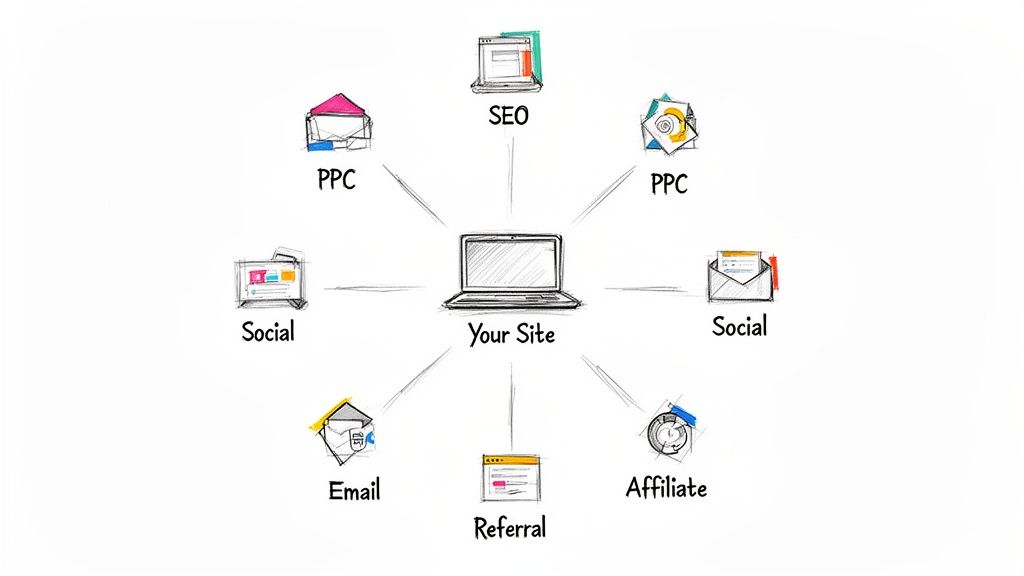
Think of it this way: attracting the right customers is a bit like fishing. You wouldn't use the same bait to catch a tiny minnow and a giant marlin. In the world of digital marketing, your channels are your bait and tackle. Each one is designed to attract a specific type of visitor.
The reality is that not all website traffic is created equal. Every channel offers a different way to connect with people, each with its own costs, timelines, and targeting methods. Getting a handle on these differences is the first step toward building a strategy that brings in clicks that actually convert.
To help you decide where to focus your efforts, we've put together a comparative overview of the main digital marketing channels. This table highlights their core targeting methods, typical costs, and where they shine the brightest.
Traffic Acquisition Channel Comparison
| Channel | Primary Targeting Method | Typical Cost | Best For |
|---|---|---|---|
| Organic Search (SEO) | User Intent (Keywords) | Time & Resource Investment | Long-term, sustainable growth and building brand authority. |
| Paid Search (PPC) | User Intent (Keywords), Demographics | Pay-Per-Click | Immediate traffic, testing offers, and lead generation. |
| Social Media | Demographics, Interests, Behavior | Varies (Free to High CPC) | Brand awareness, community building, and visual product discovery. |
| Referral | Contextual Recommendation | Relationship Building | High-quality traffic from trusted third-party sources. |
| Email Marketing | Owned Audience Segmentation | Low to Medium (Platform Costs) | Nurturing leads and driving repeat business from your warmest audience. |
| Affiliate Marketing | Partner Audience | Commission-Based (Pay-Per-Sale) | Low-risk, performance-based sales and market expansion. |
Each of these channels plays a unique role, and the most successful strategies often blend several of them. Let's dig a little deeper into what makes each one tick.
Organic Search and SEO
When it comes to building a foundation for lasting growth, organic search is king. People who turn to Google aren't just window shopping; they have a real problem to solve or a question that needs answering. They are actively looking for you. The entire practice of Search Engine Optimization (SEO) is built around capturing this high-intent audience.
While SEO demands a significant investment of time and resources upfront, the payoff is immense. A page that ranks well can become a reliable source of "free" traffic for months, or even years. The whole process starts with effective keyword research strategies to figure out exactly what your ideal customers are searching for, so you can create content that meets them head-on.
- Pros: Attracts high-intent visitors, builds long-term brand authority, seen as highly credible by users, and delivers exceptional ROI over time.
- Cons: Results take time (often 3-6+ months), requires consistent effort, and can be impacted by sudden search engine algorithm updates.
Paid Search and PPC
If SEO is the marathon, Paid Search—or Pay-Per-Click (PPC)—is the sprint. Platforms like Google Ads let you buy your way to the top of the search results for your most important keywords, putting your site in front of potential customers instantly. Just as the name implies, you only pay when someone actually clicks your ad.
The level of control here is phenomenal. You can zero in on users based on the exact phrases they type, where they live, the device they're on, and even their general demographic profile. This makes PPC perfect for generating traffic fast, A/B testing a new offer, or promoting a sale. But remember, it's a pay-to-play game. As soon as you turn off the budget, the traffic vanishes.
Key Insight: Don't think of PPC and SEO as rivals; they're partners. PPC gives you immediate traffic and data that can fuel your long-term SEO strategy, while strong SEO eventually reduces how much you need to spend on ads.
Social Media Marketing
Social media platforms are a goldmine of audience information, but they work differently from search engines. Where search targets intent (what people are looking for), social media targets identity (who people are and what they're into).
- Organic Social: This is about building a community. By sharing great content and engaging with your followers, you can create a loyal fanbase that drives traffic through brand affinity. It's a long-term play focused on relationships.
- Paid Social: Here’s where the magic really happens. You can serve highly specific ads to users based on their demographics (age, location), interests (the pages they like, their hobbies), and even behaviors (like past online purchases).
This precision makes paid social a fantastic choice for brands with visually compelling products or for reaching hyper-niche audiences you'd never find through search alone.
Referral Traffic
Referral traffic is the digital equivalent of a word-of-mouth recommendation. It’s any visitor who arrives at your site by clicking a link on another website. When a respected blog, news outlet, or industry partner links to you, they're essentially vouching for your credibility.
These visitors tend to be very high-quality. After all, they’re coming from a source they already know and trust. Building a network of backlinks through guest posting, creating content that people naturally want to share, and simple networking are the best ways to grow this valuable traffic source.
Email and Affiliate Marketing
Finally, we have two channels that are all about leveraging relationships you've already built—either with your audience or with partners.
Email Marketing gives you a direct line to an audience that has already said "yes" to hearing from you. These aren't cold prospects; they're warm leads who know your brand. By segmenting your email list, you can deliver incredibly relevant content and offers, resulting in some of the most targeted and highest-converting traffic you can get.
Affiliate Marketing is a performance-based model where you partner with creators, bloggers, or other businesses. They promote your products to their own audience, and you pay them a commission for every sale or lead they generate. It’s a wonderfully low-risk way to tap into new, relevant audiences that have been carefully cultivated by your partners.
The Hidden Threat of Untargeted And Invalid Traffic
Getting high-quality, targeted traffic is the name of the game. But there's a silent problem that can completely undermine your best efforts: untargeted traffic and its far more destructive cousin, invalid traffic. Knowing how to spot the difference is crucial for protecting your budget and your search rankings.
Untargeted traffic is simple enough—it’s real people who just have no interest in what you’re selling. Think of it like a vegan wandering into a steakhouse. They might look around for a minute, but they're going to leave without buying anything. This kind of traffic leads to high bounce rates and low engagement, which sends all the wrong signals to search engines.
But the real, bottom-line-draining issue is invalid traffic (IVT). This isn't just a mismatched audience; it's not a real audience at all.
The Problem of Ghost Customers
Invalid traffic is made up of non-human visitors—bots, scrapers, and automated scripts programmed to act like real users. They're like an army of "ghost customers" browsing your online store. They'll click ads, visit pages, and maybe even add products to a cart, but they will never, ever buy anything. They can't. They aren't real.
These ghosts create a cascade of problems for your business:
- Drained Ad Budgets: Every bot that clicks on your PPC ad is money thrown away. You pay for a click that has zero chance of ever converting.
- Skewed Analytics: IVT pollutes your data, making it impossible to see what your actual customers are doing. Your traffic numbers might look great, but your conversion rates will be in the basement, leading you to make bad decisions based on faulty information.
- Damaged SEO Signals: Search engines are incredibly smart about spotting bot-like behavior. A flood of visitors that bounce instantly or follow unnatural, predictable paths sends strong negative signals that can seriously damage your rankings over time.
Invalid traffic is the polar opposite of the authentic engagement search engines want to see. It creates a false economy where you’re spending real money on fake activity that will never translate into business growth.
Ultimately, this directly sabotages your efforts to attract genuine targeted traffic. If you want to go deeper on this, you can learn more about the risks of buying bot traffic and see exactly why it's such a dangerous shortcut.
The Financial Drain of Invalid Clicks
The scale of this issue is staggering and easy to underestimate. Invalid traffic is a quiet leak in marketing budgets everywhere, siphoning away profits across every digital channel.
This isn’t a small annoyance; it's a multi-billion-dollar problem. Research shows the average invalid traffic (IVT) rate is a shocking 8.51% across digital channels. That’s projected to cost businesses a massive $63 billion in 2025 from wasted ad spend and resources alone. You can read more about the global impact of invalid traffic.pdf) to really grasp the full scope of the issue.
These numbers highlight why services that guarantee authentic human interaction are so valuable. When you know every click comes from a real person with real intent, you aren’t just getting traffic—you’re generating the positive engagement signals that search engines reward and that lead to real, measurable business outcomes. It proves that focusing on quality over sheer quantity is always the winning strategy.
Implementing a Targeted Traffic Strategy: A Phased Roadmap
Theory is great, but results are what matter. Attracting high-value targeted traffic isn’t something you stumble into; it comes from a smart, repeatable plan. Let’s shift from the 'what' and 'why' to the 'how'.
I like to think of it like building a custom home. You don't just start nailing boards together. You need a solid foundation (deep research), a sturdy frame (great content), and the right crew and tools (your marketing channels) to bring the vision to life.
This roadmap breaks that entire process down into four clear phases. Follow it, and you'll have a reliable framework for driving growth that actually shows up on the bottom line.
Phase 1: Audience and Keyword Research
Everything starts here. Before you can attract your ideal customers, you have to know them inside and out. This first phase is all about getting into your audience's heads to build detailed buyer personas. We're moving way past generic demographics to understand their real-world pain points, what they're trying to achieve, and where they spend their time online.
Once you have a sharp picture of who you're talking to, you can figure out how they talk. High-intent keyword research isn't about chasing the biggest search volumes. It's about finding the specific phrases people type when they're ready to solve a problem—and ready to buy.
- Action Step: Build out at least two detailed buyer personas that feel like real people.
- Action Step: Use your SEO tools to dig up long-tail, high-intent keywords that line up perfectly with the problems your personas face.
Phase 2: Content Creation and On-Page SEO
With your personas and keywords locked in, it's time to create the content that will pull them in. This is where you build the "destination" for all that valuable traffic. Every blog post, landing page, and product description should be engineered to answer a specific question or solve a specific problem you uncovered in Phase 1.
At the same time, you need to be meticulous about your on-page SEO. This means optimizing all the technical bits—your title tags, meta descriptions, headers, and internal links—to make it crystal clear to Google what your page is about. Your content has to satisfy the human user first, but it also needs to be perfectly packaged for search engine crawlers.
And today, that means being mobile-first, no exceptions. With 64.35% of all global website traffic now coming from mobile devices, a clunky mobile experience is a deal-breaker. If your site is slow or hard to use on a phone, you’re telling a huge chunk of your audience to go elsewhere. You can see more data on mobile traffic trends to get a sense of just how massive this shift is.
Phase 3: Channel Selection and Execution
Now we get to open the floodgates. Looking back at the channels we compared, it’s time to pick the right mix for your audience and budget. For most businesses I work with, the best approach is a blend of long-term and short-term plays.
- Long-Term: Get your SEO-optimized content live. This is an investment that builds organic authority and pays dividends for years.
- Short-Term: Fire up some PPC or paid social campaigns. This will drive immediate, highly targeted traffic and give you fast feedback on which messages are resonating.
Pro Tip: Your paid campaigns are a fantastic testing ground for your organic strategy. If a specific ad headline or keyword is a home run on Google Ads, you should absolutely work that winning language into your organic content and on-page SEO.
This integrated approach helps you gain traction right away while you build a sustainable traffic engine for the long haul. The real key is keeping your brand voice and message consistent across every channel for a seamless customer experience.
Phase 4: Measurement and Analysis
You can’t improve what you don’t measure. The final, ongoing phase is setting up a solid analytics framework to see what’s working and where you can do better. This goes way beyond just glancing at your overall traffic numbers.
You need to obsess over the metrics that actually signal traffic quality.
- Conversion Rate: The percentage of visitors who take the action you want them to (buy something, fill out a form, etc.). This is the ultimate report card for your traffic.
- Bounce Rate: The percentage of people who land on a page and leave without clicking anything else. A high bounce rate is often a red flag for a mismatch between their expectations and your content.
- Session Duration & Pages Per Session: These metrics tell you how engaged your visitors are. When people stick around and click through to other pages, it’s a great sign that you’re delivering value.
This is also where you protect your investment by watching out for junk traffic.
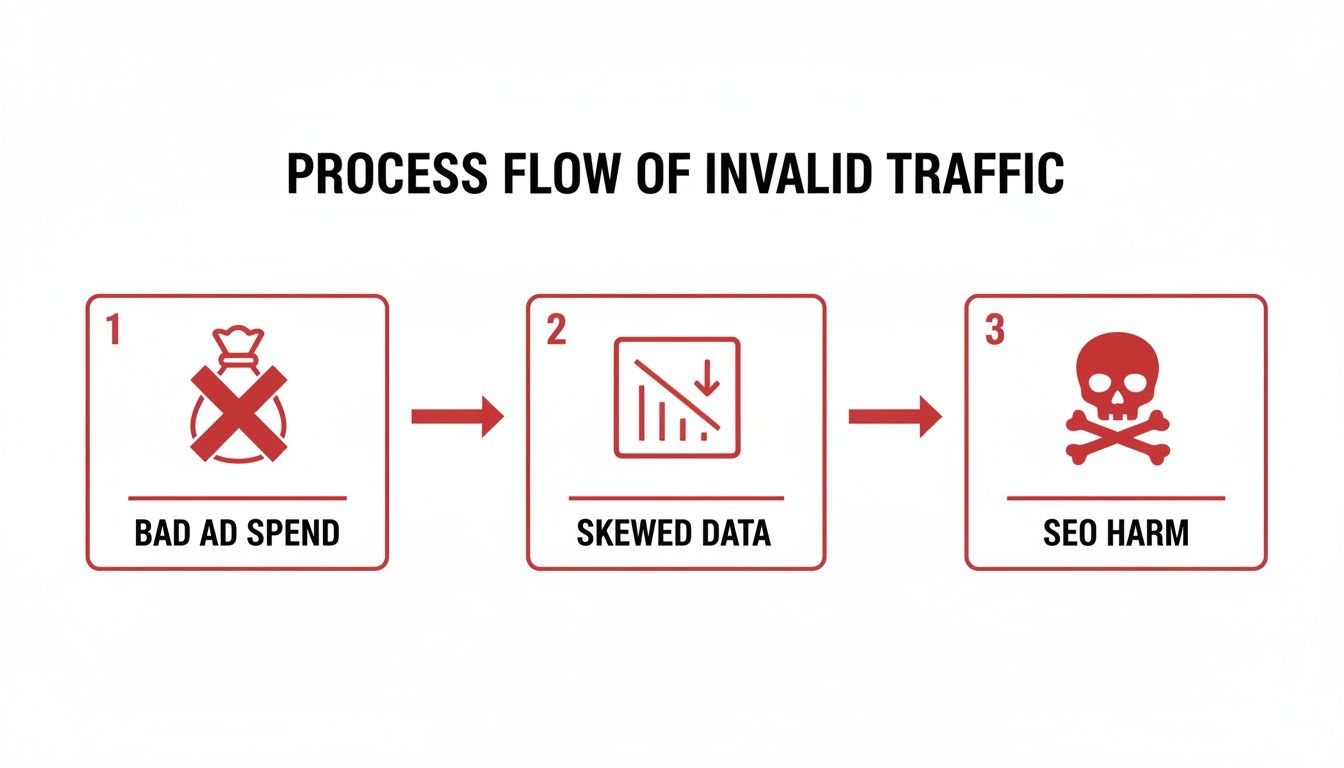
As the diagram shows, invalid traffic can be toxic. It eats your ad budget, pollutes your analytics with skewed data, and can even hurt your search rankings over time. By keeping a close eye on your key metrics, you can spot the signs of bad traffic early and ensure your strategy continues to attract real, engaged people.
Using CTR Optimization to Boost Your Organic Performance
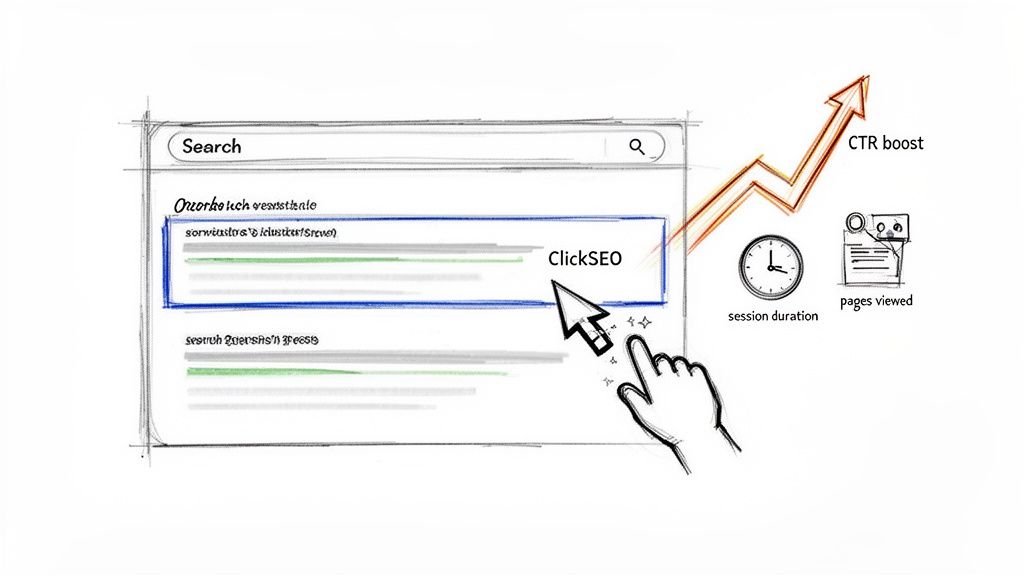
So you've put in the hard work. You've created great content, built some links, and finally—you've landed on the first page of Google. That's a huge win, but the job isn't done. In fact, it's just getting started. All that visibility means nothing if no one actually clicks on your result.
This is the gap where many SEO campaigns stumble. They get the ranking but fail to attract the targeted traffic that actually drives business.
Here's something you need to understand about Google: it watches what users do. If your page is sitting at position seven, but it's getting more clicks than the result at position five, Google pays attention. That click-through rate (CTR) is a direct signal from users telling the search engine which result is the most compelling. A higher CTR suggests your page is a better answer, which can help it climb the ranks.
How to Win the Click on a Crowded Search Page
Think of the Google search results as a bustling main street. Your on-page and technical SEO work got you a spot, like leasing a storefront. But now you have to convince people to walk through your door instead of the ten other shops on the block. Your "storefront" in this case is your title tag and meta description. They have to be irresistible.
A high CTR works like a positive feedback loop. It validates your ranking and often improves it over time. It’s a real-world vote of confidence from searchers, and it's a piece of the SEO puzzle that focuses entirely on human behavior, not just algorithms. If you want to go deeper on this, our guide on what click-through rate is and why it matters is a great place to start.
CTR is essentially a vote of confidence from users. When you win the click, you're telling Google that your content is the best answer for that specific query, which can directly influence your page's ability to climb higher in the rankings.
Improving your CTR is one of the fastest ways to turn your existing rankings into more traffic. But how can you actively and safely influence this critical metric?
The ClickSEO Method: Human-Powered Clicks
This is where a platform like ClickSEO really makes a difference. It’s built to improve your CTR and other on-page engagement signals by using a network of real people, not bots. This is about generating authentic user activity that search engines are designed to reward.
Here’s how it works in a nutshell:
- Real People Search: A vast network of real users, on their own devices and IP addresses, search for your target keywords on Google.
- They Find Your Website: They scroll through the results just like any normal user would and find your page listing.
- Click and Stick Around: They click on your link and then actually spend time on your site, visiting multiple pages and signaling to Google that your content is engaging.
This process gives a direct boost to the metrics that define a good user experience. By driving up your CTR, increasing the time visitors spend on your site, and lowering your bounce rate, you’re sending all the right signals.
Building Positive Momentum for Higher Rankings
Think of it as giving your page a push. If you're stuck on the bottom half of page one, a steady stream of positive engagement signals can be the catalyst that moves you into the top three positions, where the lion's share of clicks happen. You're simply showing Google's algorithm what it wants to see: that people click your result and like what they find.
The secret sauce is authenticity. Automated bots leave obvious, repetitive footprints that can get your site penalized. ClickSEO avoids this risk entirely by using genuine human interaction, which is naturally varied and organic. It's a "white-hat" approach that helps you earn your way to the top.
Of course, you can't improve what you don't measure. To see how your efforts are paying off, a CTR Calculator is an essential tool. It helps you benchmark your performance before you start and track the lift as you work on your titles, descriptions, and overall engagement strategy.
Wrapping Up: Take Control of Your Traffic Quality
If there's one lesson to take away, it's this: stop chasing massive, meaningless traffic numbers. Real growth doesn't come from a firehose of random visitors who leave as quickly as they arrive. It's built by attracting targeted traffic—the right people who are genuinely looking for what you offer. It’s a fundamental shift in perspective, moving from just ‘getting traffic’ to strategically ‘attracting customers.’
This means you have to look past those surface-level analytics and dig into your audience's intent. What are they actually trying to accomplish? Once you know that, you can pick your channels wisely and focus on the engagement metrics that tell the real story. High conversion rates, long session durations, and low bounce rates are the true indicators of quality. They show you what’s actually connecting with people.
Take Command of Your SEO
You can’t just sit back and hope Google figures it all out. To get a real advantage, you have to be proactive in managing the signals you send to search engines. This is where a modern tool like ClickSEO fits into the playbook. It gives you a direct way to:
- Reinforce Positive Signals: By sending real, human clicks to your search results, you improve your CTR and show Google that your page is a fantastic answer to a query.
- Improve Engagement Metrics: When those real users stick around and engage with your site, it sends a powerful message that you’re delivering a quality experience.
This isn't about trying to game the system. It’s about giving search engines clear, undeniable proof of your content's value. When you take control of these engagement signals, you gain the ability to turn your current visibility into real, measurable growth and earn a stronger, more defensible position in the search results.
FAQ
Even the best-laid plans run into questions once you start putting them into practice. Here are some straightforward answers to the most common queries we get about attracting and fine-tuning targeted traffic.
How Long Does It Take to See Results from Targeted Traffic?
That's a great question, and the honest answer is: it really depends on the channels you're using. There’s no universal timeline because each method moves at its own speed.
Paid channels like PPC and social media ads are the sprinters of the marketing world—they can bring in traffic almost instantly. You can set up a campaign in the morning and see visitors arriving that same afternoon. Organic strategies like SEO, however, are a marathon. It’s a long-term play that typically takes 3-6 months of consistent work to build real, lasting momentum in rankings and traffic.
But that doesn't mean you can't speed things up. Focused tactics can definitely accelerate your progress. For instance, when using a CTR optimization tool like ClickSEO, we often see users get a noticeable lift in their rankings in as little as 30–60 days because they're directly improving the user engagement signals Google cares about.
Is It Better to Focus on One Traffic Channel or Multiple?
It can be really tempting to go all-in on a single channel, especially if it's already working well. But putting all your eggs in one basket is a risky game. If you rely completely on one source—say, organic search—your entire business becomes vulnerable. A single Google algorithm update could slash your lead flow overnight.
A diversified, multi-channel approach is always a smarter, more resilient strategy. When you blend different channels, you build a much stronger foundation. Think of it like this: you can use SEO for steady, long-term growth, run PPC campaigns for immediate leads, and use social media to build your brand community. This mix not only protects you from volatility but also helps you meet different segments of your audience right where they hang out.
How Do I Know If My Traffic Is Actually Targeted?
A spike in website visitors might feel good, but it doesn't mean much if none of them are the right people. The real measure of targeted traffic isn't volume—it's the quality of those visitors and how they behave on your site.
The proof is in what people do after they click. High engagement and strong conversion rates are the clearest signs you're attracting the right audience.
To figure out if your efforts are hitting the mark, you need to look past raw traffic numbers and dig into these engagement metrics:
- High Conversion Rates: This is the ultimate goal. Are visitors actually signing up, buying products, or requesting a demo?
- Low Bounce Rates: When the right people land on your page, they stick around. A low bounce rate means your content is delivering on the promise of their search.
- Long Average Session Duration: If visitors are spending significant time on your site, it’s a strong signal that they find your content genuinely valuable and relevant.
Ready to take control of your organic performance? ClickSEO helps you send the right signals to Google with real, human-powered clicks. Start improving your CTR and climbing the rankings by visiting https://clickseo.io to begin your free trial.