Your Ultimate Website Traffic Booster Guide
So, what exactly is a website traffic booster? It's any method you use to get more eyeballs on your site. This could be anything from old-school SEO and paid ads to newer, more direct strategies that improve the user signals Google cares about—like your Click-Through Rate (CTR)—to climb the search rankings.
Why Your Great Content Isn't Getting Traffic

You’ve been there, right? You spend hours, maybe even days, crafting the perfect article or landing page. You hit publish, feeling proud... and then, crickets. It’s buried on the second or third page of Google, where no one ever looks.
It's one of the most common and frustrating problems businesses face. The hard truth is that online visibility isn’t just about having great content; it’s about sending the right signals to search engines that your content is the best answer.
Think of your website like a fantastic new restaurant tucked away in a quiet back alley. The food is incredible, but if nobody knows you exist, your tables will stay empty. A website traffic booster is the glowing neon sign you put up on the main street, pointing everyone your way. It’s what closes the gap between creating something amazing and getting an audience to actually see it.
To understand why this is so critical, let's look at the three main ways businesses try to get that sign up and running.
Here's a quick breakdown of the common paths you can take:
Three Paths to Boosting Website Traffic
| Approach | How It Works | Best For | Time to Results |
|---|---|---|---|
| Traditional SEO | Building authority through backlinks, on-page optimization, and content creation. | Long-term, sustainable growth and building brand authority. | 6-12+ months |
| Paid Advertising | Paying platforms like Google or Facebook to place your ads in front of a target audience. | Immediate traffic, lead generation, and testing offers quickly. | Immediate |
| CTR Optimization | Directly improving user engagement signals (like clicks) on your search results to show Google your page is relevant. | Breaking through ranking plateaus and rapidly increasing organic visibility. | Weeks to months |
Each path has its place, but the visibility problem often comes down to where you land on Google's search results page.
The Invisibility of Page Two
Let’s be blunt: being on the second page of Google is like being invisible. The very first organic result scoops up over 27% of all clicks. The entire first page commands the vast majority of search traffic.
If your amazing content is stuck on page two, it simply doesn't exist for most people. This guide is about getting you off that back alley and onto the main street. The secret is learning to work with the powerful user engagement signals, especially Click-Through Rate (CTR), that Google uses to decide who gets the prime real estate.
Google's Unshakable Dominance
No matter how the internet changes, one thing remains constant: Google is the front door. Back in February 2024, Google.com saw a mind-boggling 88.5 billion monthly visits, completely dwarfing every other site on the web. As these web traffic statistics show, it isn't just a search engine; it's the starting point for almost everything.
Because Google is the gateway for nearly every online journey, boosting your visibility in its search results is non-negotiable for real growth. Simply creating content and hoping for the best is a losing strategy. You have to prove your content's value to the algorithm.
This is where a modern website traffic booster comes into play. Instead of just waiting for visitors, you can actively and ethically improve the signals that Google relies on. By focusing on the clicks and engagement your search results get, you're sending a direct message to the algorithm: "Hey, people love this page. It's a great answer. You should show it to more people."
While foundational SEO is always important, and we've even covered tips to attract organic visitors naturally in our previous guide, this targeted approach is how you break free from a traffic plateau and finally get the visibility your business deserves.
Comparing Your Traffic Boosting Options
So, you need more website traffic. Where do you even start? It can feel like you're staring at a dozen different paths, but most of them lead back to three core strategies: traditional SEO, paid ads, and the lesser-known but powerful approach of user signal optimization, usually through a CTR service.
Each method has its own playbook, and knowing the difference is the first step to picking the right one for your goals and budget. Let's look at how they really stack up.
The Slow Burn of Traditional SEO
Traditional SEO is the bedrock of long-term organic growth. This is the classic grind of optimizing your pages, creating genuinely helpful content, and earning backlinks to show Google you're a legitimate authority. Think of it like building a great reputation in your community—it’s incredibly valuable, but it doesn't happen in a week.
- The traffic you earn is "free," builds real trust with your audience, and is sustainable once you secure those top spots. The long-term ROI can be fantastic.
- But it's slow. You're often looking at 6-12 months—or more—before you see a real payoff. For competitive keywords, breaking through the noise can feel almost impossible.
While SEO is non-negotiable for any serious business, waiting for it to kick in can be a test of patience that many new or smaller companies simply can't afford.
The Instant Gratification of Paid Ads
Paid advertising, or PPC, is the complete opposite. Using platforms like Google Ads, you can jump the line and place your site right at the top of the search results, almost instantly. You're basically renting the best digital real estate available.
This is perfect for getting immediate visitors for a product launch or a limited-time offer. The problem? It's a pay-to-play treadmill. The second you stop feeding the machine, your traffic flatlines. This can burn through a marketing budget with shocking speed, especially if your competitors are willing to pay top dollar for clicks.
A website traffic booster that focuses on user signals sits in that strategic sweet spot. It’s built to speed up your organic SEO results without the never-ending expense of paid ads, making it a game-changer for anyone stuck just off page one.
The Smart Accelerator: CTR Optimization
This leads us to our third option: a website traffic booster designed around click-through rate (CTR). This strategy gets right to the heart of what Google cares about most: user engagement. By sending real people to click on your search result and interact with your page, you're sending a direct, powerful signal to Google that your content is the best answer for that query.
This isn't a replacement for good SEO; it's a powerful accelerant. It helps your existing SEO efforts work faster and hit harder. It’s the secret weapon for businesses stuck on page two or three—the ones that can't outspend giants on ads but need a faster lift than traditional SEO can deliver on its own.
Organic visibility is everything. After all, Google referrals drive a massive 63.41% of all website traffic. But even top-ranking sites are fighting against "web rot" and major algorithm shifts that can tank their traffic overnight. Driving real organic clicks through CTR optimization is a direct countermeasure to these visibility traps. You can see more on these trends in this analysis of website traffic statistics.
As you weigh your options, understanding each tactic's role is key. For those with a physical storefront, digging into specific Local SEO Best Practices is a great example of layering these strategies. By balancing the speed, cost, and sustainability of each method, you can build a growth plan that is both effective and resilient.
How CTR-Based Traffic Boosters Actually Work
So, how do these services actually work? To really get it, you first need to understand how Google decides who gets the coveted top spot. Think of the search results page as an election. Every time someone clicks on a link, they're casting a vote for the most helpful answer to their question.
When your page shows up in the results but gets skipped over for a page ranked below it, Google’s algorithm notices. It sees this as a red flag—your "campaign" isn't connecting with voters. But when the opposite happens and your page earns a higher-than-average number of clicks, it’s a massive vote of confidence.
This is exactly where a CTR-focused service steps in. It taps into a network of real, human users to cast those all-important "votes" for your website. This directly boosts the two metrics that matter most here: Click-Through Rate and Dwell Time.
The User Journey, Broken Down
This isn't about sending a flood of random, low-quality clicks. The entire process is carefully designed to mimic how a real person would naturally find and interact with your site, making it look completely organic to search engines.
The Search: It all starts with a real person, on their own computer or phone, using their own home internet connection (a unique residential IP). They type one of your target keywords into Google, just like millions of users do every day. This isn't a bot—it’s a genuine search.
The Scroll and Find: Next, they scroll through the search results page (SERP), visually scanning for your website's link. They don’t just magically jump to your result; they replicate the natural hunt-and-peck discovery process we all go through.
The Authentic Click: Once they spot your page, they click it. This one action is the heart of what improves your Click-Through Rate (CTR). More clicks for the same number of views (impressions) means a higher CTR, which is a direct, positive signal to Google.
This flowchart gives you a simple visual of how CTR optimization fits into the bigger picture, working alongside traditional SEO and paid ads.
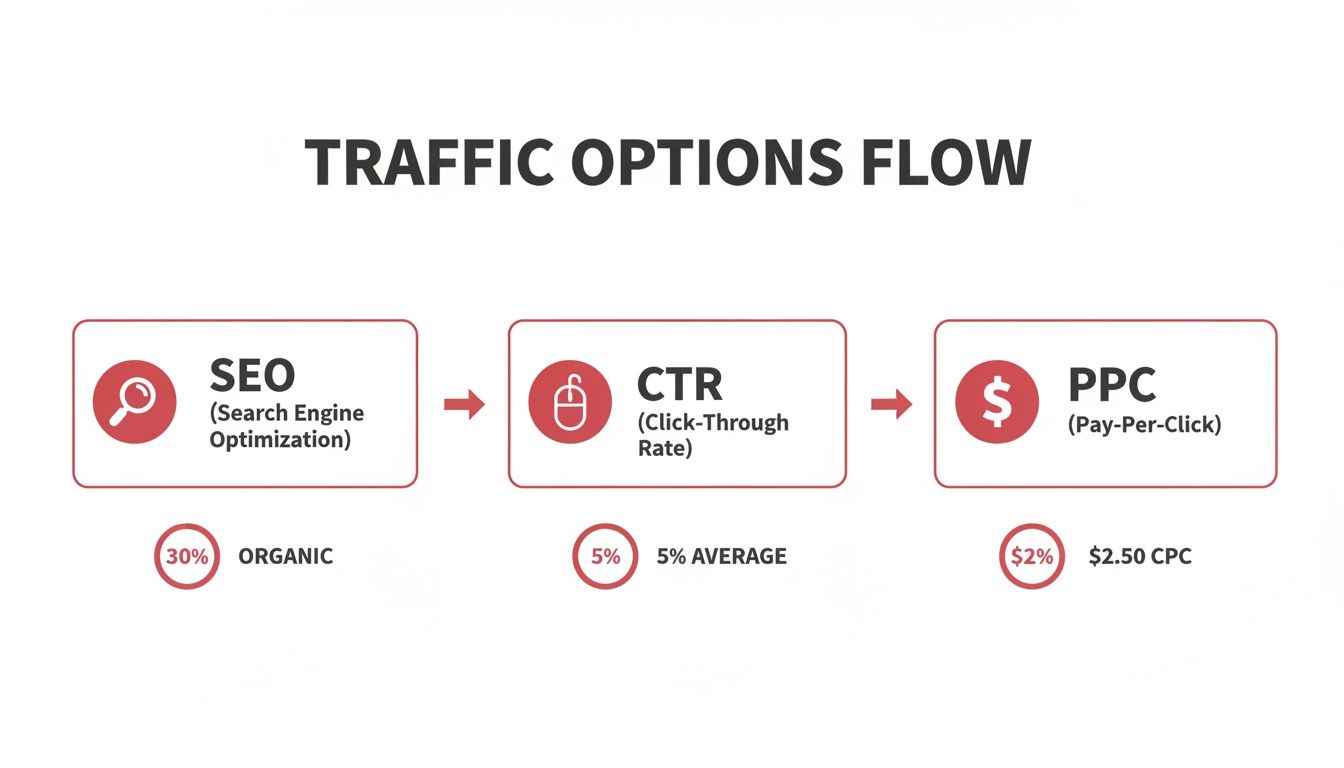
As you can see, CTR acts like a powerful accelerator for the slow-and-steady gains from SEO, directly impacting the user engagement signals that Google values so highly.
Beyond the Click: Proving Your Page is Worthwhile
Getting the click is only half the battle. To really convince Google that your page is a great result, the user has to stick around. This is where Dwell Time and on-site behavior become absolutely critical.
Dwell Time is simply the amount of time someone spends on your page before clicking back to the search results. A long Dwell Time signals to Google that the visitor found what they were looking for and that your content is high-quality.
A good website traffic booster makes sure this happens. Users are instructed to spend a meaningful amount of time on your page—they don’t just click and immediately leave. They stay and engage.
- Meaningful On-Site Interaction: The user will actually read your content, scroll down the page, and might even click to another page or two on your site.
- Reduced Bounce Rate: This simple act of visiting more than one page is huge. It dramatically lowers your bounce rate, another key metric that search engines watch like a hawk.
- Increased Session Duration: All this activity adds up to a longer session duration—the total time spent on your site. This reinforces the idea that you’re providing a great user experience.
If you want to get into the nitty-gritty of the numbers, have a look at our complete guide on what is click-through rate and its direct impact on rankings.
The Human Element vs. Dangerous Bots
It's vital to understand the difference between this human-powered approach and shady, automated bot traffic. Google is incredibly smart and has become an expert at sniffing out fake, robotic clicks.
Automated bots typically run from a few data center IP addresses, behave in unnatural ways, and leave obvious digital footprints. Using this kind of traffic is a fast track to a Google penalty, which can get your site completely removed from the search results.
A legitimate CTR service avoids these risks by relying on:
- Real Human Users: These are actual people, not scripts or software, performing every action.
- Unique Residential IPs: Every click comes from a different home internet connection, making the traffic look just like your other organic visitors from across the globe.
- Natural Behavior: The whole journey, from the initial search to browsing your site, is designed to appear 100% authentic.
By combining a higher CTR with strong post-click signals like longer Dwell Time and a lower bounce rate, you send a clear message to Google: people love this page, and it deserves to rank higher.
How To Choose a Safe Website Traffic Booster
Choosing a website traffic booster can feel like a gamble. Get it right, and your SEO efforts get a serious shot in the arm. But get it wrong, and you risk a Google penalty that could wipe out all your hard-earned progress overnight.
The market is flooded with services, and frankly, most of them are junk. Shady operators use cheap, automated bots that leave a trail of obvious, toxic footprints. Google’s algorithms are designed to spot this kind of manipulation, and they don't take it lightly.
Think of it this way: it’s like hiring a street team to promote your new cafe. A good service sends friendly, professional people to hand out flyers and chat with potential customers in high-traffic areas. A shady service takes your money, dumps the flyers in the nearest bin, and tells you the job is done. You've paid for "distribution," but it's worthless and might even land you a fine for littering.
So, how do you tell a genuine growth partner from a snake oil salesman? It boils down to one thing: the source and quality of the traffic.
Traffic Booster Safety Checklist: Red Flags vs Green Flags
To help you quickly vet potential services, we’ve put together a simple comparison. If a provider shows any of the red flags, you should walk away. A trustworthy service will proudly display all the green flags.
| Feature | Red Flag (Avoid) | Green Flag (Safe & Effective) |
|---|---|---|
| Traffic Source | Uses automated bots, scripts, or clicks from data centers. The traffic is robotic and easily detectable. | Uses 100% real human visitors. Every single action is performed by a real person, creating authentic behavior. |
| IP Addresses | Clicks come from the same few IP addresses or easily identifiable data center IPs. This is a huge red flag for Google. | Traffic originates from unique, geo-diverse residential and mobile IPs, making it indistinguishable from your other organic traffic. |
| Campaign Control | Offers little to no customization. You can't control traffic volume, visitor location, or what they do on your site. | Provides full campaign customization. You can set daily click volumes, target specific countries or cities, and define session duration. |
| Reporting & Analytics | Provides vague reports or uses a private dashboard you can't verify. The data is often completely fabricated. | Offers transparent reporting that is fully verifiable in your own Google Analytics and Search Console. You see the real traffic for yourself. |
A service that checks all the green-flag boxes isn’t trying to trick Google; it’s focused on demonstrating genuine user interest in a way that search engines are built to reward.
Digging Deeper with Key Questions
Once a service passes the initial smell test, it's time to dig a bit deeper. A quality provider will have no problem answering these questions with confidence.
Can You Control On-Site Behavior?
A low-quality service just sends a click and calls it a day. That’s not enough. A high-quality platform lets you influence key engagement metrics like dwell time and the number of pages visited per session. This is critical for sending strong, positive signals to Google.How Do You Handle Keyword Searches?
The whole point is to improve your click-through rate for specific terms. The service must be able to perform a search for your target keyword, find your URL in the search results (even if it's on page 3), and then click it. This direct action on the SERP is what drives CTR improvement.Is the Traffic Visible in All My Analytics Tools?
This is a non-negotiable. Safe, human-driven traffic should appear as normal organic traffic everywhere—in your Google Analytics, Google Search Console, and any other tool you use. If a provider says their traffic is "hidden" or "won't show up," it’s a massive red flag that they're using bots.
By asking these pointed questions, you can cut through the marketing fluff and make an informed decision. For a more detailed breakdown, you can learn more about what constitutes SEO-safe traffic in our comprehensive guide.
Ultimately, choosing a partner who is transparent and obsessed with authentic human engagement is the only way to boost your rankings without putting your website's reputation on the line.
All right, let's move past the theory. Technical specs are one thing, but seeing how a strategy plays out in the real world is where the rubber really meets the road.
So, how does a website traffic booster focused on click-through rate (CTR) actually help a business grow? Let’s look at five common situations where targeted user signals can turn a frustrating plateau into a major win.
The SEO Agency Breaking a Client's Plateau
Imagine an SEO agency working with a high-stakes law firm. They’ve done everything by the book—impeccable on-page SEO, a solid backlink profile—but the client's main service page is just stuck. It's been lingering at position #8 on Google for months, unable to crack the top five where the real money is made.
The core issue? The page's click-through rate was lagging. For its position, not enough people were clicking. To Google's algorithm, this looked like a lack of interest compared to the results ranked higher.
So, the agency got creative. They used a traffic booster to send a consistent, targeted flow of clicks to that specific URL. They set up the campaign to mimic a real user: search for the main keyword, find the listing on page one, and click through.
Within 45 days, the page's CTR started ticking up. Google took notice of the improved engagement, and the ranking climbed from #8 to #4. That seemingly small jump led to a massive 40% increase in qualified leads, making the agency look like heroes.
The E-commerce Store Boosting a High-Value Product
An online shop specializing in custom jewelry had a fantastic, high-margin product. The problem was its page was buried on page two of Google for a critical keyword with high purchase intent. They were throwing money at paid ads to get it seen, but the cost was eating away their profits.
Paid ads can feel like a hamster wheel, especially for e-commerce stores. You have to keep feeding the machine to get traffic. Improving organic rankings for your most profitable products is how you build a sustainable, long-term asset that works for you 24/7.
Their goal was simple: get this product onto the first page to capture organic sales and cut their ad spend.
The product page was stuck at position #14, making it essentially invisible. To fix this, they launched a CTR campaign zeroed in on their main product keyword. The traffic was configured to search the term, scroll to the second page, click the link, and then spend real time browsing the product photos and details.
The result? After two months of this steady activity, the product page shot up from #14 to #7. Landing on the first page brought in a steady stream of organic sales, which allowed them to slash their ad budget by 30% while actually increasing their overall profit.
The Local Business Climbing the Local Pack
Think of a local roofing contractor trying to get into Google's coveted "Map Pack." Their Google Business Profile was fully optimized, and they had a decent number of positive reviews, but bigger competitors always seemed to dominate the top three spots.
Their problem was low engagement. Not enough local searchers were clicking on their business listing in the search results or on the map. This sent a signal to Google that they were less relevant than the competition.
The solution was to use a geo-targeted traffic booster that simulated searches exclusively from within their service area. The campaign was set up to:
- Use users only from their city and surrounding suburbs.
- Search for terms like "roofer near me."
- Click the website link directly from the map listing.
- Navigate to the contact page, signaling intent.
The combination of local searches and positive on-site behavior worked wonders. In less than 60 days, they started showing up consistently in the top three of the local pack, leading to a dramatic spike in phone calls and quote requests.
The Affiliate Marketer Lifting a Money Page
An affiliate marketer had poured their heart into a "best of" review article. It was a masterpiece of content, but it was stranded at the bottom of page one for a super competitive, high-commission keyword.
Stuck at position #9, the page was only getting a tiny fraction of the clicks that the top three results were gobbling up. Every single spot they could climb would mean a huge jump in earnings.
Knowing this, the marketer launched an aggressive campaign to drive up the page's CTR. It was a focused effort to prove to Google that their result was more compelling than the competition's.
It paid off. The page moved from #9 to #5 in the first month. By the end of the second month, it hit the #3 spot. This jump resulted in a mind-blowing 300% increase in affiliate commissions from that one page alone.
The SaaS Company Gaining a Competitive Edge
A new SaaS startup published a brilliant comparison page titled "[Competitor Name] Alternatives." It was exactly what their target audience was searching for, but it was languishing on page three of Google, completely out of sight. Ranking this page was crucial for intercepting users who were actively looking to switch providers.
While some companies might just throw ad money at the problem, organic visibility is often a more powerful long-term play. For examples of how paid strategies can complement organic efforts, it's worth exploring different Google Ads case studies.
Their "alternatives" page had zero visibility and wasn't capturing anyone. To change that, the marketing team used a website traffic booster to target users searching specifically for their competitor's alternatives. The campaign sent clicks to their comparison page, and the traffic was set to spend several minutes on the page to increase dwell time and signal high engagement.
This strategy demonstrated to Google that their content was an excellent answer to the search query. The page climbed to the top half of the first page, started capturing high-intent traffic, and boosted their demo sign-ups by 25% within three months.
Your Quick-Start Implementation Checklist
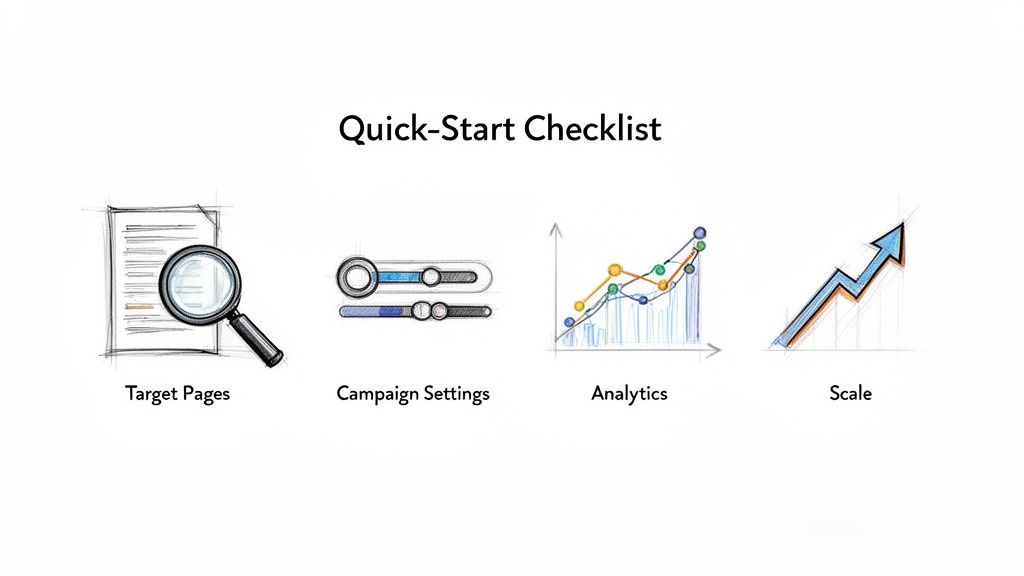
Ready to get your first campaign off the ground? This simple roadmap will walk you through the entire process, cutting through the technical jargon. My goal here is to make your first experience with a website traffic booster straightforward and successful.
Think of this checklist as your pre-flight plan. Following these steps will ensure a smooth takeoff and a clear path toward your ranking goals. Let’s dive in.
Step 1: Identify Your Golden Keywords and Pages
One of the biggest mistakes I see people make is targeting keywords where they already rank #1 or, conversely, where they're buried on page ten. The real sweet spot for a CTR-based booster is what I call the "striking distance" zone.
You want to focus on keywords and pages that are stuck between positions #5 and #30 in Google’s search results. These are your hidden gems—pages that Google already considers relevant but just need a nudge from real user engagement to climb the ladder. This is where you’ll get the fastest and best return.
- Find Your Targets: Fire up Google Search Console and look for pages with plenty of impressions but a disappointingly low CTR. That’s your treasure map.
- Prioritize Value: Don't just pick any page. Start with the ones that target your most valuable, high-intent keywords—those tied directly to your products or services.
Step 2: Configure Your First Campaign
Now it’s time to give your traffic booster its instructions. The secret here is to start slow and steady to create a natural-looking pattern of interest. Think of it as a low-and-slow simmer, not a rapid boil.
You’ll need to set a few key parameters:
- Daily Clicks: Don't go crazy right out of the gate. A conservative number, like 10-20 daily clicks for a single keyword, is a perfectly safe and effective starting point.
- Session Duration: Match this to your content. For a detailed blog post, you might set a session duration of 2-4 minutes. For a simple "contact us" page, 60-90 seconds is far more realistic.
- Geo-Targeting: This is non-negotiable for local businesses. Make absolutely sure your clicks are configured to come from your specific city, state, or service area.
The point of your initial setup isn’t to shock the algorithm with a massive, unbelievable traffic spike. It’s to build a consistent, believable pattern of user interest that Google can recognize and reward over time.
Step 3: Connect and Monitor Your Analytics
Any reputable service will insist on this. You should never have to trust their private dashboard alone; the proof has to show up in your own analytics. This is how you verify the traffic is real and doing its job.
Go ahead and connect your Google Analytics and Google Search Console accounts. The traffic should appear as "Organic" right inside your own platforms. From there, you'll be watching two main metrics:
- Click-Through Rate (CTR): Keep an eye on your Search Console report. You want to see the CTR for your target keywords start to climb.
- Average Session Duration: In Google Analytics, check the target pages to confirm that visitors are staying longer.
Step 4: Interpret Results and Scale Smartly
Patience is a virtue here. You’re building trust with an algorithm, and that doesn't happen overnight. In my experience, most people start seeing real, noticeable ranking movement within 30 to 60 days of consistent activity.
Once you see a positive signal—like a page jumping from #12 to #8—that’s the green light. Now you can confidently increase the daily clicks for that keyword or launch a new campaign for another striking-distance page. This data-first approach makes sure you’re always putting your resources exactly where they'll have the biggest impact.
Common Questions About Traffic Boosters
Whenever you're thinking about a new tool for your website, a healthy dose of skepticism is a good thing. It's your site, your business—you have to protect it. Let's tackle some of the most common questions that pop up when marketers first hear about CTR-based traffic boosters.
Is Using a Website Traffic Booster Safe for My SEO?
This is the big one, and the answer is yes, but with a major caveat. It’s only safe if the service uses 100% real human visitors from unique residential IPs. Safety comes down to authenticity.
Think of it this way: automated bots leave obvious, clumsy footprints all over your analytics. It's like sending a robot to a party—it just doesn't blend in. A quality service, on the other hand, sends real people whose behavior is completely natural and indistinguishable from the rest of your organic traffic. This isn't about tricking Google; it's about genuinely demonstrating user interest, which is exactly what the algorithm is designed to reward.
How Long Does It Take to See Results?
This isn't an overnight fix, so it's important to set the right expectations. While every keyword and website is different, most people start noticing positive ranking changes within 30 to 60 days of consistent activity.
Think of it as earning trust with Google. Each high-engagement click is like a vote of confidence for your page. By sending a steady stream of these positive signals, you gradually build your site's authority for your target keywords, leading to higher, more stable rankings.
It’s an accelerator for your existing SEO efforts, not a magic button.
Can I Target Specific Countries With This Traffic?
Absolutely. Any traffic booster worth its salt will give you precise control over geo-targeting. This isn't just a nice-to-have feature; for many businesses, it's essential.
For example, a local plumber can set the campaign to only send clicks from their specific city, making the traffic incredibly relevant. Likewise, a national e-commerce brand can focus on its primary country of operation. This ensures the engagement you're paying for is directly aligned with your actual customer base and business goals.
Ready to boost your rankings safely and effectively? ClickSEO provides real, human-powered clicks to improve your CTR and drive measurable SEO wins. Start your free trial today at https://clickseo.io.