
Website Traffic Increase Bot Dangers Explained
At its core, a website traffic increase bot is a piece of automated software built to do one thing: fake website visits. It sends waves of non-human traffic to a site to make it look far more popular than it actually is. But these aren't real visitors, and the "traffic" they generate is worse than useless—it can actively damage your business and your search rankings.
The Empty Promise of a Website Traffic Increase Bot
When you're trying to get a new website off the ground or boost your search rankings, the idea of a traffic bot can sound like a magical shortcut. Who wouldn't want to see their visitor numbers skyrocket overnight? It's the digital equivalent of instantly filling a brand-new store with eager shoppers.
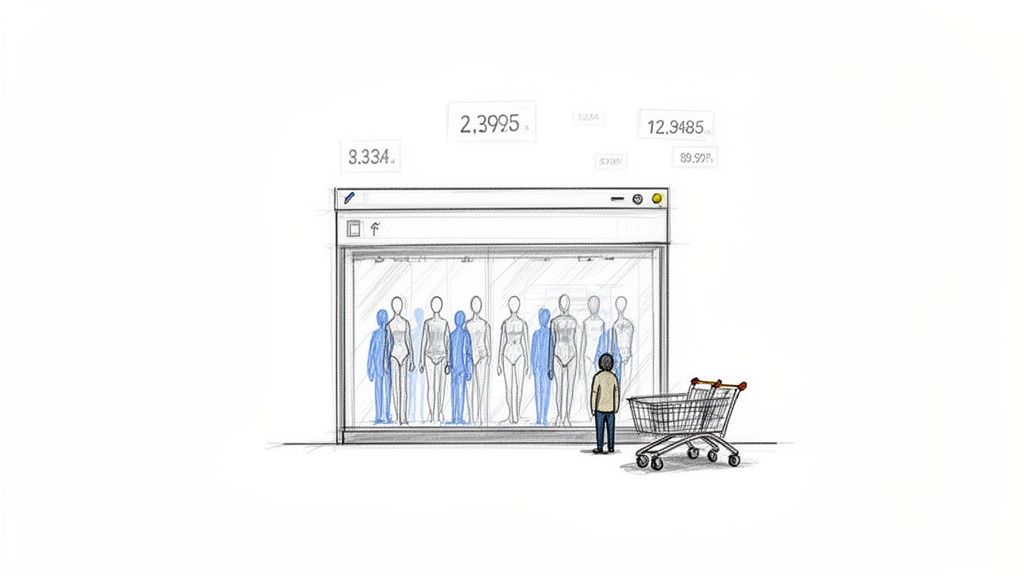
But here’s the catch: a traffic bot doesn't bring you shoppers. It brings you mannequins. Your analytics might show a store packed to the rafters, but nobody is actually buying anything, browsing the aisles, or even talking about your brand. All you have is a digital mirage, a hollow number that creates a dangerous illusion of growth.
An Internet Awash in Automated Threats
This isn't just a niche problem; it's a massive, internet-wide phenomenon. In 2026, we hit a sobering milestone when automated bot traffic officially overtook human traffic, now accounting for 51% of all activity online. This is the first time that's happened in nearly a decade.
Even more concerning is that malicious bots—the kind designed to cause harm—now make up 37% of all internet traffic. This surge is largely thanks to the new wave of AI tools that have made it ridiculously easy for anyone to create and deploy bot armies. As a site owner, you're no longer just competing for attention; you're navigating a minefield of fake activity.
The Mannequin Analogy: Think of bot traffic as stocking your e-commerce store with hundreds of mannequins. Your foot traffic reports would look incredible, but your sales would remain at zero. You might even invest in more inventory or staff based on this fake demand, only to realize your entire strategy was built on a lie.
Why Real Engagement is the Only Way Forward
So, what's the real harm? These automated scripts poison your most critical business asset: your data. They flood your analytics with meaningless noise, making it impossible to understand what your real customers are doing or what's actually working. Your conversion rates plummet, your marketing budget is wasted on ghosts, and your credibility with search engines tanks.
While the quick fix of a traffic bot is tempting, sustainable growth only comes from understanding what organic traffic is and how it drives growth. Genuine human visitors are the only ones who will engage with your content, buy your products, and send the positive signals that Google and other search engines look for.
Before we get into mitigation tactics, it’s vital to see just how deep the damage goes. In the next sections, we'll unpack exactly how these bots dismantle your SEO efforts from the inside out.
How Fake Traffic Silently Destroys Your SEO
Buying bot traffic might feel like a clever shortcut to boost your site’s numbers, but it’s a decision that backfires spectacularly. Think of your analytics as the compass for your entire online strategy. When you flood it with fake visitors, that compass breaks, and you start steering your business based on pure fiction.
This isn't just about vanity metrics. The damage runs deep, poisoning your key performance indicators (KPIs) and making it impossible to tell what’s actually working. Every decision, from the content you write to the products you feature, suddenly becomes a shot in the dark.
The Bounce Rate Catastrophe
One of the first red flags you'll see is a skyrocketing bounce rate. Traffic bots are built for one simple job: land on a page and leave almost instantly. They don't browse, click other links, or engage with your content in any real way.
This creates thousands of sessions that last just a few seconds, pushing your bounce rate toward 100%. For search engines like Google, a high bounce rate is a massive signal that your page is useless or irrelevant. Before you know it, Google starts dropping your rankings because it thinks real users are having a terrible experience on your site.
Destroying Your Data Integrity and Decision Making
Beyond the bounce rate, a website traffic increase bot completely contaminates your most valuable data. Your analytics reports turn from a source of truth into a work of fiction.
Imagine you’re running a crucial A/B test on a landing page to see which headline converts more customers. If bots are hitting both versions of the page, your results will be completely skewed. Bots don't buy anything, so they dilute the behavior of your real users, making it impossible to declare a winner. You could easily end up choosing the weaker page and losing out on actual sales.
This corruption seeps into every part of your strategy. The pages you think are your "most popular" might just be the ones the bots are programmed to visit, not the content your audience actually finds valuable.
For many, the fallout is immediate and costly. Managers of Google Business Profiles and affiliate marketers watch their metrics become useless, making it impossible to measure the ROI of their SEO efforts. It gets even worse in paid advertising, where marketing budgets evaporate on fraudulent clicks. In fact, global losses from this type of ad fraud are now in the hundreds of billions, a problem detailed in Cloudflare's annual internet review. This isn't a small-time issue; it's a massive drain on businesses everywhere.
The Long-Term Erosion of Trust
Ultimately, using bots is a great way to destroy the trust you've built with search engines. Google's entire business model depends on showing people the best, most relevant results. When it sniffs out attempts to game the system, it moves to protect its own integrity.
This can lead to more than just a rankings drop. You could face a manual action penalty, which is Google’s way of putting your site in the penalty box—or removing it from search results altogether. That fleeting high from seeing your traffic numbers jump simply isn't worth the risk of being blacklisted and losing all of your organic visibility for good.
Your Guide to Identifying and Measuring Bot Traffic
Now that you know how a website traffic increase bot can quietly poison your data, it's time to put on your detective hat. The good news is you don't need a cybersecurity degree to spot these fake visitors. You just need to know what to look for. Think of it like spotting counterfeit cash—once you learn the tell-tale signs, the fakes practically jump out at you.
Your two most powerful tools are your analytics platform (like Google Analytics 4) and your server logs. Each gives you a different piece of the puzzle. By using them together, you can build a rock-solid case and confirm whether bots are wrecking your metrics.
Uncovering Bot Clues in Google Analytics 4
Often, the first sign of trouble appears right inside your Google Analytics reports. Bots behave in strangely perfect, unnatural ways that simply don't match the messy, unpredictable patterns of real human visitors.
Keep an eye out for these red flags that almost always point to bot activity:
- Sudden Traffic Spikes: Did your traffic shoot up overnight without a new marketing campaign, PR hit, or viral post to explain it? An abrupt, massive surge is a classic bot footprint.
- Anomalous Geographic Sources: Suddenly getting thousands of hits from a country where you don't do business? If your local Chicago bakery is flooded with traffic from Vietnam, something is definitely wrong.
- Extremely High Bounce Rates: Take a close look at the traffic source in question. If its bounce rate is 99-100%, it means those "visitors" are leaving without a single click or interaction. That's bot behavior, plain and simple.
- Impossibly Low Session Durations: Real people need time to read and browse. If you're seeing thousands of sessions lasting just one or two seconds, you're not looking at fast readers—you're looking at bots.
Isolating these bizarre patterns is the first step to pinpointing the source of your fake traffic. For a deeper dive, check out our guide on how to identify and manage fake web traffic.
Analyzing Server Logs for Hard Evidence
While analytics show you what happened, server logs provide the technical fingerprints to prove who did it. Every single request to your server—from a person or a script—gets recorded. This raw data is where you'll find definitive proof of automation.
Think of a server log as the security camera for your website's front door. It records every entry, noting who arrived, when, and what they looked at. Sifting through this footage reveals the visitors who aren't who they claim to be.
This flowchart shows how that fake activity directly translates into SEO damage and, eventually, lost business.
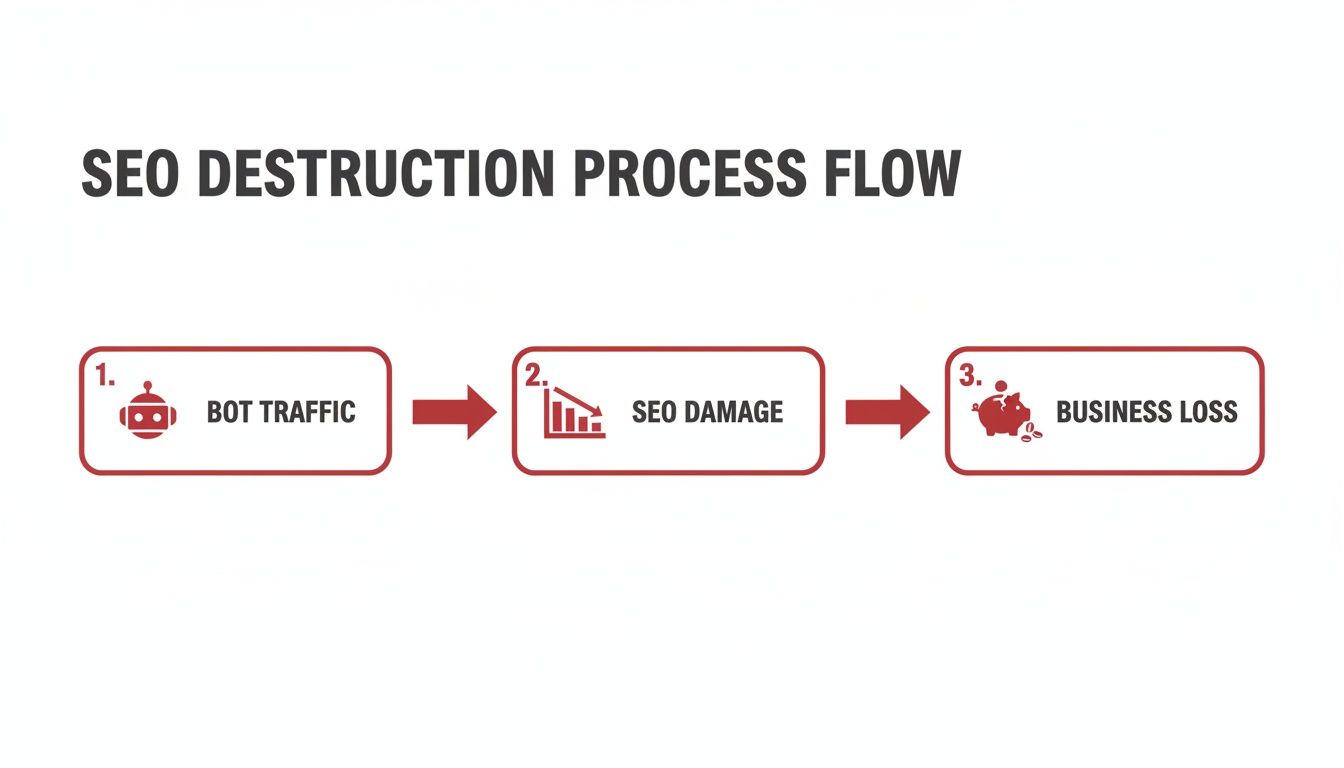
As you can see, this isn't just about vanity metrics. Automated traffic is a direct threat to your search engine rankings and your bottom line.
When you dig into your server logs, you’re hunting for repetition and odd identifiers that give the scripts away.
What to Look For in Server Logs
- Repetitive IP Addresses: Are you seeing hundreds or thousands of requests from a single IP address in a ridiculously short time? No human can browse that quickly. It's a dead giveaway of a script.
- Suspicious User-Agent Strings: The "user agent" identifies the visitor's browser and operating system. Many bots use generic or bizarre strings that don't look like common browsers (Chrome, Safari, Firefox).
- High-Volume, Low-Value Requests: Look for IPs that hit page after page without ever requesting the files that make a site usable, like images, CSS, or JavaScript. A real user's browser loads everything; a simple bot often doesn't bother.
Finding these patterns provides the hard evidence you need. It confirms you’re dealing with a programmed bot, not genuine interest, and gives you the ammo to block the source and start cleaning up your data.
The Real Penalties and Business Risks You Cannot Afford
Forget about messy analytics for a moment. The real cost of using a website traffic increase bot isn't just bad data—it’s a series of business-ending penalties that can completely sink your entire operation. We’re not talking about small bumps in the road; we're talking about total devastation.
Imagine you're playing poker for your life savings, but the casino is owned by Google. If you get caught cheating, you don't just forfeit the pot. You're blacklisted for good. That's the perfect analogy for what happens when you get caught using traffic bots.
The Google Manual Action Nightmare
A Google manual action is exactly what it sounds like: a penalty handed down by a real person at Google. This isn’t a small algorithmic tweak. It’s a human reviewer confirming that your site is breaking the rules, and the consequences are swift and severe.
When this penalty hits, your site can be completely de-indexed. Gone. Vanished from search results overnight.
Your hard-earned organic traffic flatlines to zero. Every bit of authority and all the rankings you might have spent years building are wiped out in an instant. It’s the SEO death penalty, a blow from which very few websites ever recover.
AdSense Bans and Seized Earnings
The financial hit is just as brutal. If you run ads on your site through a network like Google AdSense, using a traffic bot is the fastest way to get yourself permanently banned. Their fraud detection systems are no joke.
Cautionary Tale: An e-commerce site owner decided to use a bot to inflate traffic numbers to look more attractive to investors. Within weeks, their AdSense account was flagged for suspicious activity. The outcome? A permanent ban and over $15,000 in pending ad revenue confiscated by Google. The fake traffic cost them a fortune in real cash.
These ad networks have a zero-tolerance policy for click fraud. Once you’re out, you’re out for life, severing a vital income source with no chance of appeal. If you're on the fence, it's worth understanding the full picture of whether to buy bot traffic or not.
The Shadow of Legal Consequences
But it gets worse. The risk isn't just confined to Google and ad networks. If you use those artificially inflated traffic numbers to sell ad space directly, secure partnerships, or land investors, you're stepping into a legal minefield. Put simply, misrepresenting your traffic data is fraud.
Partners who paid for ads based on your doctored numbers can sue you to get their money back. And while SEO issues are one thing, a sudden, massive flood of bot traffic can also mimic a cyberattack, requiring robust DDoS protection. The fallout from a website traffic increase bot creates a tangled web of financial and legal problems that you simply can't afford.
The Smart Alternative: Human-Powered CTR Engagement
After seeing the kind of damage a website traffic increase bot can do, it’s obvious that these shortcuts only lead to a dead end. If you want to rank higher and stay there, the only way is to earn it with signals search engines actually trust. This means dropping the risky automation and building a strategy around genuine human interest.
So, instead of trying to outsmart bots, what if you could prove your website’s value on demand? This is exactly where human-powered click-through rate (CTR) engagement comes into play, offering a legitimate and effective solution. It’s not about cheating the system; it’s about demonstrating your site’s worth through real human behavior.
From Fake Bots to Real Clicks
The fundamental flaw of any website traffic increase bot is its complete lack of authenticity. Bots are just scripts running from data centers, and they leave a digital trail of unnatural activity that’s easy to spot. Human-powered engagement completely flips this model on its head by using a crowd of real people to visit and interact with your site.
This is the exact principle behind ClickSEO, a service that has become a market-leading, white-hat alternative to dangerous bot traffic. It replaces the fake, high-risk traffic with genuine user journeys performed by actual people.
Here’s a breakdown of how it works:
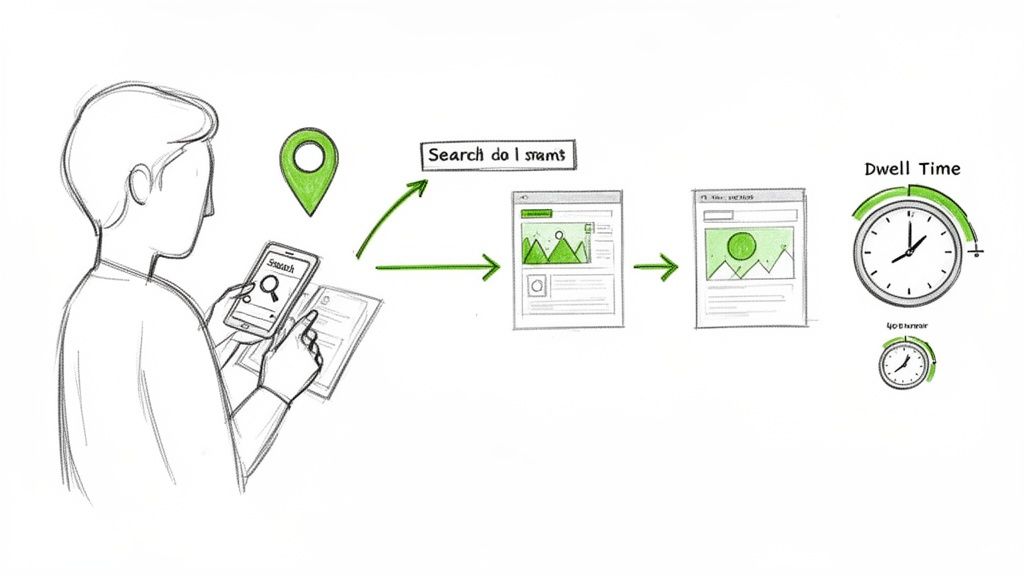
- A real person, using their own phone or computer and a residential internet connection, opens Google.
- They search for one of your target keywords, just like any potential customer would.
- They scroll through the search results until they find your website.
- They click your link, sending a powerful signal to Google that your result was the best answer for that search.
This simple process generates a legitimate, high-value click that boosts your organic CTR—one of the most critical ranking factors Google looks at. And because the click comes from a real person, it's virtually indistinguishable from any other organic visitor.
Simulating Real Interest the Right Way
A single click is a good start, but the real magic happens after the person lands on your page. Bots are notorious for creating 100% bounce rates because they leave instantly. A human-powered service like ClickSEO, on the other hand, encourages the kind of deep engagement that proves your content is valuable.
The Library Analogy: A website traffic increase bot is like someone running into a library, grabbing the first book they see, and immediately throwing it back on the shelf. A human-powered approach is like someone finding a book, sitting down to read a chapter, and then checking out another related book. The librarian (Google) sees this as a clear sign of high-quality, engaging content.
This is where being able to customize engagement metrics becomes so important for signaling value. ClickSEO gives you direct control over specific parameters that mimic the behavior of a genuinely interested visitor.
Key Engagement Signals You Can Control:
- Dwell Time: You can set exactly how long the visitor stays on your landing page. This ensures they spend enough time to "read" the content, signaling its worth to search engines.
- Geo-Targeting: You can have clicks originate from specific countries or even cities, perfectly matching your target market and making the traffic appear completely natural.
- Multi-Page Visits: Visitors can be instructed to navigate to other pages on your site, which directly reduces your bounce rate and increases the average pages per session.
These actions create the positive user experience signals that tell Google your page is doing an excellent job of satisfying user intent. If you're looking for more ways to improve your site's engagement, our detailed guide on SEO traffic services provides actionable strategies. This approach doesn't just avoid penalties; it actively reverses the damage done by bots by replacing negative signals with powerful positive ones.
ClickSEO flips the script entirely. It uses real people to perform keyword-specific searches and clicks, driving authentic increases in CTR, dwell time, and other positive metrics that bots simply can't fake. With support for multiple URLs and broad campaigns across 170+ countries, it can geo-target your most important markets, with results you can see in tools like GA4. You can discover more insights on global traffic trends and their impact from Cloudflare's recent analysis. By focusing on authentic human interaction, you're building the trust and authority needed for long-term SEO success.
Your Questions About Website Traffic Bots Answered
It's easy to get tangled up in the claims and promises surrounding website traffic. The idea of a "safe" traffic bot is especially persistent, so let's clear the air. I've compiled the most common questions I hear from site owners to give you straightforward answers, helping you protect your site and grow it the right way.
Can Google Detect All Traffic From a Website Traffic Increase Bot?
I get asked this all the time. The short answer is yes, absolutely. Google's algorithms are incredibly sophisticated, looking at hundreds of signals at once, not just a few basic metrics. They see everything from the IP address and browser type to how a "visitor" moves their mouse, how fast they scroll, and how long they stay on a page.
No matter how advanced a bot claims to be, it still runs on code. That means it acts in predictable, unnatural ways that humans just don't. Imagine thousands of "visits" all coming from the same block of servers or having identical session times down to the second. These are glaring red flags for Google, which is built to sniff out exactly this kind of manipulation. Sooner or later, it will flag the traffic, and the penalties can be severe.
Is There Any Safe Way to Use a Website Traffic Bot?
Here's the hard truth: no. There is no "safe" or "white-hat" traffic bot for boosting your SEO, ad revenue, or anything else. Every single one of them violates the terms of service for search engines like Google and ad networks like AdSense.
The risk isn't just a slap on the wrist. You're looking at penalties that can completely wipe out your search rankings, get your ad accounts banned for good, and pollute all your business data. The only traffic that's truly safe is the kind that comes from real people who are genuinely interested in what you have to offer.
How Is Human-Powered CTR Different From a Bot?
This is where the distinction becomes critical, and it all comes down to one thing: authenticity.
A bot is just a script. It’s a ghost in the machine, running from a data center on a commercial IP address. Its actions are hollow, repetitive, and stick out like a sore thumb to modern analytics.
A human-powered service, like ClickSEO, is the complete opposite. It relies on a distributed network of actual people, each using their own unique device, their own internet connection (a residential IP), and their own browser history. These aren't fake clicks; they are real human interactions:
- A real person types your keyword into Google.
- They scroll through the results, find your website, and click on it.
- They actually spend time on your page, engaging with the content just like any other visitor.
This process generates legitimate user signals—the exact kind of positive feedback Google is designed to reward. It's not about fooling an algorithm; it's about showing the algorithm your site is valuable to real humans. A bot can never fake that.
What Should I Do if I Suspect My Site Has Bot Traffic?
If you think your site is being hit with bot traffic, you need to act fast. First, confirm your suspicions. Dive into your Google Analytics 4 data and server logs, using the detection methods we covered earlier. Look for those tell-tale patterns and try to pinpoint the source—it could be anything from a competitor to a service you hired.
If you paid for a traffic service, cancel it immediately. Next, you’ll want to block the junk traffic. You can do this with your server's firewall or a dedicated security tool. Once the immediate threat is gone, it's time to refocus on what works: creating excellent content, practicing legitimate SEO, and building real engagement.
Ready to trade risky bots for authentic human engagement? ClickSEO offers a proven and safe way to boost your click-through rate and send Google the positive user signals it wants to see. It’s time to let your site’s real value shine through and watch your rankings improve. Get started with a free trial today!