
How Dwell Time Affects Website SEO
The most common advice on dwell time is also the least useful: stop arguing about whether it’s a “direct ranking factor.”
That debate doesn’t help you fix pages that attract clicks and then lose visitors in seconds. It doesn’t help you diagnose why a page ranks briefly, slips, and never stabilizes. And it definitely doesn’t help when a promising page gets impressions, earns traffic, but fails to turn that visibility into sustained rankings.
For practitioners, the question is simpler. Does user behavior after the click affect SEO outcomes? Yes. Search engines are trying to rank pages that satisfy intent. If your result gets clicked and users stay, read, scroll, watch, compare, and continue their journey on your site, that creates a very different pattern from a click followed by a fast return to the search results.
That’s why understanding how dwell time affects website seo matters. Not as a vanity metric. Not as a trick. As a way to see whether your page delivers on the promise your title tag, meta description, and ranking position made.
The Great Debate Is Over Why Dwell Time Matters
SEO teams often get stuck on the wrong distinction. They ask whether Google has a field named “dwell time” in its ranking system, as if that’s the only thing that matters.
In practice, that’s not how strong SEO decisions get made. You optimize for behaviors that signal satisfaction, relevance, and alignment with search intent. Dwell time sits right in the middle of that.
When a user clicks your page from search and stays long enough to engage, that usually means a few things happened correctly. The snippet matched the page. The page loaded well enough to keep attention. The content answered the question or pulled the visitor deeper into the topic. Those are the same outcomes modern search systems are built to reward.
Practical rule: If a page wins the click but loses the visitor fast, treat that as an SEO problem, not just a UX problem.
This is why dwell time matters even if you don’t treat it as a standalone ranking lever. It influences the signals around it. A page that satisfies intent is less likely to trigger pogo-sticking. It’s more likely to earn secondary pageviews, stronger engagement, and more stable rankings over time. A page that disappoints tends to create the opposite pattern.
Why practitioners should care
Clients don’t hire SEO consultants to win semantic debates. They hire them to improve rankings, increase qualified traffic, and protect visibility from decline.
That means looking at dwell time as a second-order signal. It doesn’t live in isolation. It affects how well your CTR holds up after initial testing, whether users bounce back to compare other results, and whether your content earns trust quickly enough to keep readers engaged.
A lot of ranking problems that look technical or competitive are satisfaction problems. The page is indexed. The query is relevant. The links are decent. But the visit itself is weak.
What works and what doesn’t
What works is a user-centered approach:
- Match intent tightly: Informational, commercial, and navigational searches need different page structures.
- Deliver fast clarity: Users should know within seconds they’re in the right place.
- Create a next step: Internal links, product comparisons, demos, and supporting content extend useful engagement.
What doesn’t work is trying to “inflate” time on page with filler intros, slow-loading design, or clickbait titles that overpromise. Those tactics may earn the click, but they usually collapse after the first impression.
Decoding User Engagement Metrics Dwell Time And Its Cousins
Dwell time gets confused with almost every other engagement metric. That creates bad analysis. If you don’t separate these signals, you’ll fix the wrong problem.
The easiest way to think about it is a retail store.
A person walks in because your storefront looked relevant. If they step inside, glance around, and leave because it’s clearly not what they expected, that’s one kind of signal. If they stay, browse a few aisles, and then leave satisfied, that’s another. If they ask for one specific item, get it immediately, and walk out, that can still be a successful visit even though it was short.
That’s how engagement works in search.
What dwell time actually is
Dwell time is the time between a user clicking your result in the search engine results page and returning to that results page. It functions as a proxy for content quality and user satisfaction, influencing how search engines evaluate page relevance and ranking position. When users remain on a page longer, it signals stronger relevance and satisfaction, which can support better rankings through related behavioral signals, as explained in Shopify’s guide to dwell time in SEO.
The important phrase there is returning to the search results. That’s what makes dwell time different from metrics inside your analytics platform.
The cousins that people mix up
Here’s the clean comparison.
| Metric | What It Measures | Key Signal |
|---|---|---|
| Dwell Time | Time from SERP click to return to SERP | Whether the page satisfied search intent after the click |
| Bounce Rate | Single-page visits with no further interaction or pageview | Whether visitors left without continuing deeper into the site |
| Session Duration | Total length of a visit across pages | Overall engagement across the session |
| Pogo-sticking | Repeated back-and-forth from SERP to multiple results | Frustration or mismatch between query intent and page content |
A bounce isn’t always bad. A user can land on a contact page, get the phone number, and leave. That’s still a successful visit.
Session duration is broader. It can be useful, but it doesn’t tell you whether the original page solved the searcher’s need.
Pogo-sticking is the warning sign most SEOs should take seriously. If users click your page, hit back, then choose another result, your page likely failed to meet the expectation set in the SERP.
Where these metrics help in practice
You won’t usually see “dwell time” as a native metric in analytics tools. You infer it using related data like organic landing page engagement, bounce patterns, and return-to-SERP behavior where available through SEO tools and search analysis.
That’s why I don’t review one metric in isolation. I look for combinations:
- High CTR and weak engagement: Your snippet is persuasive, but the page disappoints.
- Low CTR and strong on-page engagement: The page may satisfy users well, but the SERP presentation is weak.
- High bounce and low depth on key landing pages: Users aren’t finding a reason to continue.
If bounce rate is part of your diagnosis, this practical guide on how to reduce bounce rate on a website is a useful companion because many bounce issues begin with the same causes that shorten dwell time.
A short visit isn’t automatically a failure. A short visit followed by a return to search and another click often is.
That distinction matters. SEO teams sometimes chase longer visits when they should be chasing better satisfaction.
The Evidence Does Dwell Time Actually Impact SEO Rankings
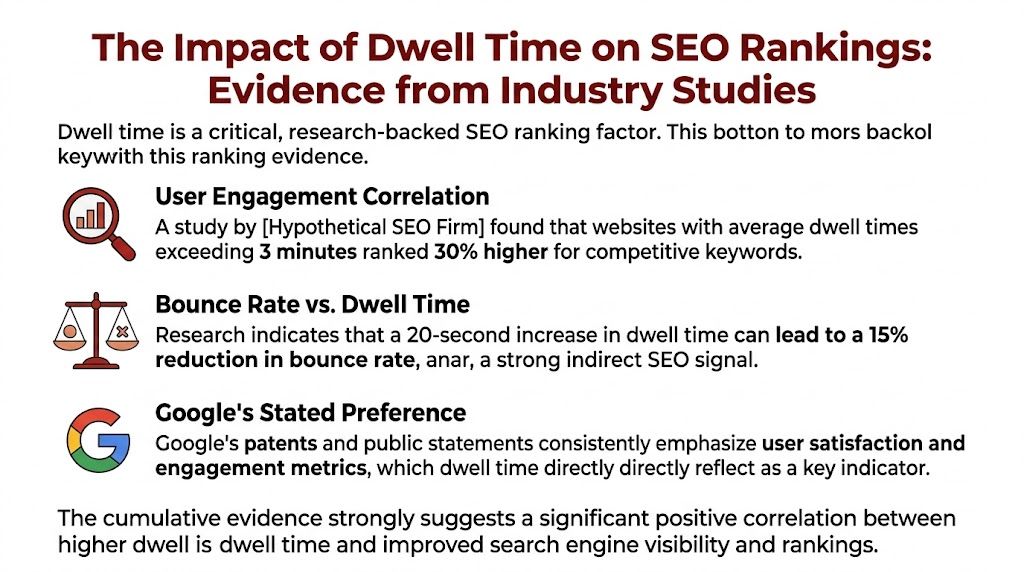
If you want a clean benchmark, the strongest data point in circulation is hard to ignore. Research summarized by SEO Discovery reports that pages ranking in Google’s top three positions average 3 minutes and 10 seconds of dwell time, according to SEMrush findings on how dwell time affects website SEO.
That doesn’t prove a simple one-metric algorithm. It does prove something useful for practitioners: high-ranking pages and sustained user engagement show up together with unusual consistency.
Correlation is enough to guide action
Google doesn’t need to publish a neat checkbox called “dwell time” for this to matter. Search systems are built to rank results that satisfy users. If users click a result and remain engaged, that aligns with what Google wants to reward. If they click and return to search quickly, that’s a sign of mismatch, weak UX, or poor content fit.
That’s why practitioners should stop treating this as a binary question. The better question is whether dwell time supports the broader set of behavior patterns associated with stronger visibility.
It does.
A page with healthy dwell time often also has:
- Better alignment between snippet and page content
- Lower likelihood of pogo-sticking
- More opportunities for deeper internal navigation
- Stronger user satisfaction signals after the click
These aren’t abstract benefits. They influence whether a page holds position after the first ranking lift.
Why this matters more than isolated CTR
A lot of teams focus on CTR because it’s visible in Search Console. CTR matters, but a click is only the first half of the job. If your listing earns attention and then the page fails to keep it, the click can become a negative signal instead of a positive one.
That’s why I look at SERP behavior and on-page behavior together. This is also why the relationship between SERP clicks and SEO matters. Search engines don’t just observe whether users click. They observe what happens after they click.
The strongest pages don’t just win curiosity. They resolve it.
That’s also where the broader conversation about improving search engine rankings gets more practical. Ranking improvements aren’t only about acquiring more links or publishing more pages. They often come from reducing the gap between what the query expects and what the page delivers once the visitor arrives.
Benchmarks matter, but context matters more
The top-three average of 3 minutes and 10 seconds is useful because it gives teams a real benchmark. It tells you that top-ranking pages often hold attention well beyond a quick skim.
But don’t misuse that number.
A glossary page, a login page, or a store-hours page can satisfy intent quickly. A short dwell time there may be perfectly healthy. On the other hand, a commercial investigation page, in-depth guide, or category page should usually create a longer and richer visit because users are evaluating options, reading details, and comparing information.
So the practical framework is:
- Start with search intent
- Compare dwell-time proxies by page type
- Look for mismatch patterns, not just low numbers
- Prioritize pages with impressions and underwhelming engagement
What the evidence really tells you
It tells you to stop optimizing content purely for entry and start optimizing for completion.
That means the title tag, opening lines, layout, internal links, media, and page speed all need to work together. A ranking page isn’t just relevant enough to appear. It’s satisfying enough to keep the visitor there.
When I audit underperforming pages, the ranking issue often isn’t “Google doesn’t understand this page.” It’s “users don’t stay with this page long enough to confirm its value.”
How To Measure And Interpret Your Dwell Time Data
You won’t find a native “dwell time” report in GA4. That confuses a lot of teams, especially when they’re trying to connect SEO traffic with engagement quality.
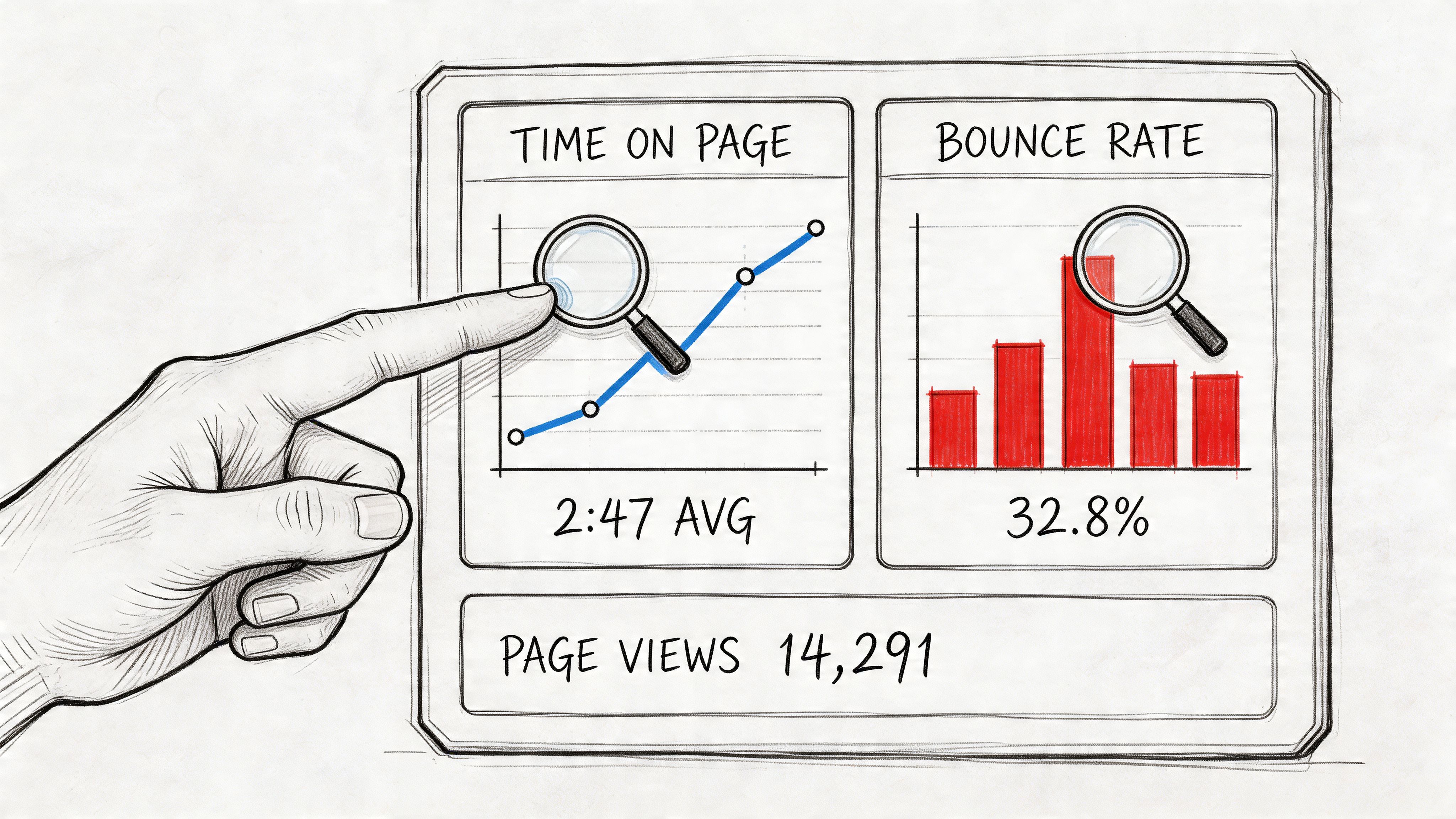
The practical proxy is average engagement time, segmented carefully enough that the data tells a useful story.
Use GA4 the right way
If you review all traffic together, the metric becomes muddy fast. Paid traffic, email traffic, direct visits, and branded searches all behave differently.
Start with organic landing pages.
- Open GA4 and go to Reports or Explorations
- Filter for organic search traffic
- Break data down by landing page
- Add average engagement time, engaged sessions, views, and bounce-related metrics
- Compare by device category
That last step matters. Mobile behavior is different enough that a blended average can hide serious problems on smaller screens.
Research compiled by StudioHawk notes that mobile users average 72 seconds of dwell time compared with 150 seconds on desktop, and that 55% of all website visitors spend less than 15 seconds on a webpage, while top results average 3 minutes and 10 seconds of dwell time in Google’s top three positions. The same analysis also notes that a 16-second increase in dwell time has been linked to a 50% jump in conversions, and that a healthy range often falls between 2 to 4 minutes, with 4+ minutes considered top-performing, as covered in this analysis of dwell time benchmarks and SEO outcomes.
Those numbers shouldn’t make you panic. They should help you segment and prioritize.
What to look for inside the data
The patterns matter more than the dashboard itself.
Look for pages with:
- Strong impressions but weak CTR: The snippet may not be compelling enough.
- Healthy CTR but poor engagement time: The snippet is working, but the page isn’t matching expectation.
- Large mobile drop-offs: The content may be readable on desktop and frustrating on mobile.
- Traffic without next-step behavior: Visitors arrive, consume little, and leave.
That second pattern is where many SEO opportunities live. The query says one thing. The page opens with generic copy, a slow hero image, an intrusive banner, or a vague intro. Users don’t need much time to decide they should go back to search.
Pair GA4 with Search Console
Search Console gives you the pre-click side. GA4 gives you the post-click side.
Use them together.
A practical workflow looks like this:
| Data source | What to inspect | Why it matters |
|---|---|---|
| Search Console | Queries, impressions, CTR, average position | Shows where Google is testing or exposing the page |
| GA4 | Average engagement time by landing page | Shows whether the visit holds attention |
| Device breakdown | Mobile vs desktop engagement | Identifies layout and speed issues by context |
If a page has impressions, moderate position, and poor CTR, you may need to improve the title tag or meta description. If it has clicks but weak engagement, the problem is usually on-page alignment.
Later in the review process, a short walkthrough like this can help teams align on where to click in the interface:
Interpretation beats reporting
Don’t report engagement time as a vanity KPI. Use it to make decisions.
A low-engagement FAQ page may be fine if it resolves a specific question quickly. A low-engagement service page targeting a competitive commercial keyword is a problem. A category page with lots of search impressions and shallow interaction is often a bigger opportunity than a blog post with modest traffic.
Review dwell-time proxies by intent, not just by URL. The same number can mean success on one page and failure on another.
That’s what turns analytics into SEO work. You’re not just asking, “How long did people stay?” You’re asking, “Did this page satisfy the reason they searched?”
Actionable Strategies To Improve Dwell Time On Your Website
Most dwell time advice is too soft. “Write better content” isn’t wrong, but it isn’t enough to change rankings.
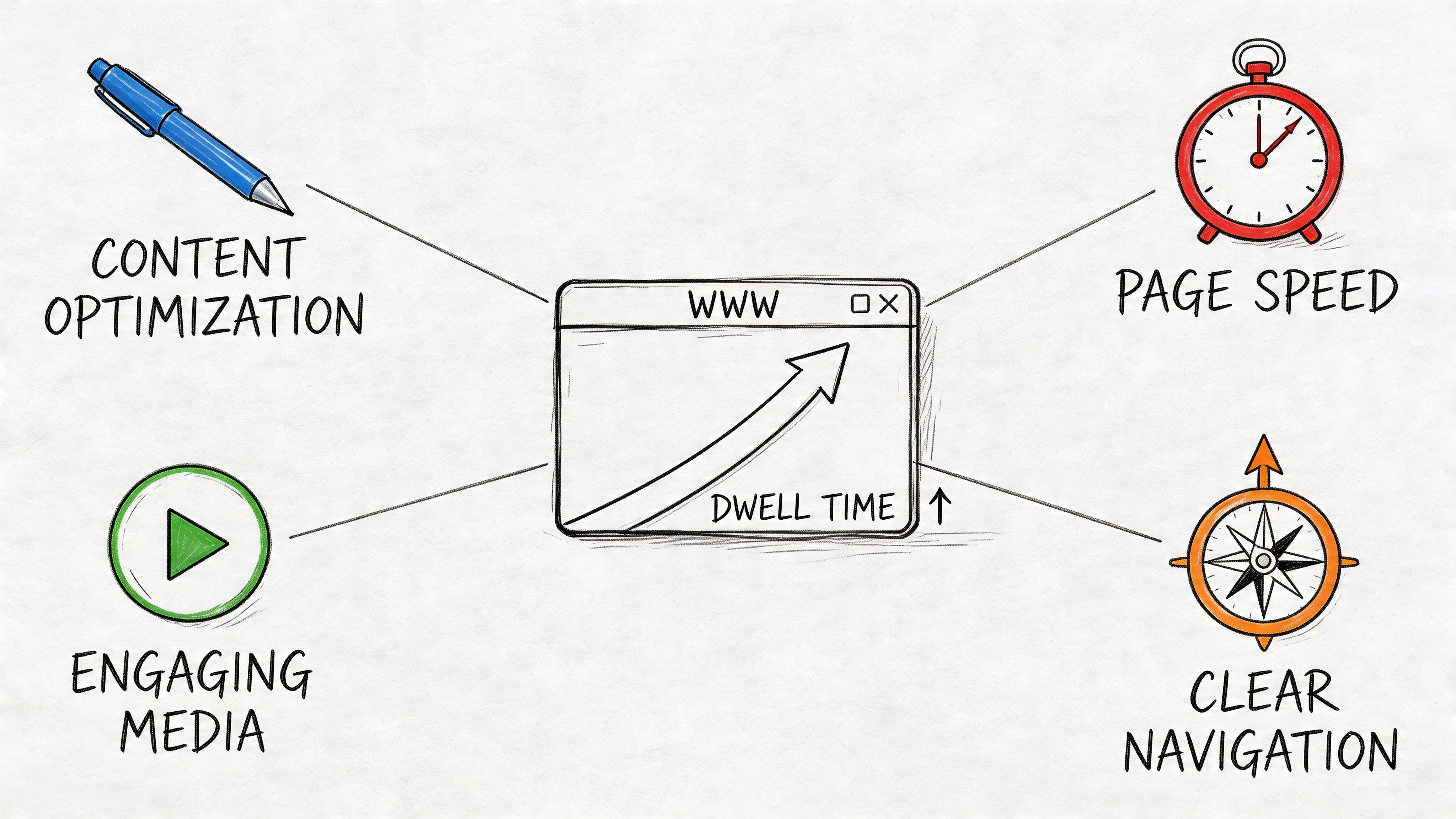
The pages that keep users engaged usually win for three reasons at once. They reassure visitors immediately, reduce friction while reading, and create a useful next step. If one of those elements is missing, dwell time often collapses.
Fix the first ten seconds
Users decide fast whether a page deserves more of their attention. Your opening has one job: confirm they clicked the right result.
I use a simple opening structure on important landing pages:
- Agree: State the problem or goal the searcher likely has.
- Promise: Tell them what they’ll get from the page.
- Preview: Show how the answer is organized.
This works because it lowers uncertainty. If the user searched for “best CRM for small sales teams,” they shouldn’t land on a page that spends three paragraphs talking about digital transformation. They should immediately see that the page compares options, explains trade-offs, and helps them choose.
Tighten content design, not just content quality
A good page can still underperform if it looks hard to consume.
I usually audit these elements first:
- Headings that do real work: Subheadings should help skimmers find their way, not just decorate the page.
- Short paragraphs: Dense blocks discourage reading, especially on mobile.
- Visible answers near the top: Don’t bury the key point beneath scene-setting copy.
- Comparison elements: Tables, checklists, and decision criteria keep users moving down the page.
One of the easiest wins is rewriting vague intros. If the first screen is all branding and no substance, users leave before the useful content starts.
Improve speed because engagement depends on it
Technical performance isn’t separate from dwell time. It shapes the first impression before content has a chance.
Research summarized by Shopify notes that reducing page load times by 1 second boosts dwell time by nearly 5%. That’s why speed work should sit inside your engagement strategy, not beside it.
Pages that feel slow lose attention before persuasion begins. In audits, the common problems are oversized media, heavy scripts, delayed content rendering, and intrusive overlays that block the page before users can engage.
Build information journeys with internal links
Many pages lose visitors not because the initial page is weak, but because there’s nowhere obvious to go next. Consequently, internal linking becomes a serious dwell time lever.
Strategic internal linking can increase dwell time by about 40% by guiding users to relevant related pages, as noted earlier in the Shopify research. In practice, this means linking with intent, not sprinkling random related posts at the bottom.
A strong internal link should answer one of these questions:
- What should the user compare next?
- What detail might they need before making a decision?
- What adjacent problem are they likely to care about?
If you want a deeper tactical breakdown, this guide on how to increase dwell time on your website covers many of the same mechanics from a website optimization angle.
Good internal links don’t interrupt the journey. They continue it.
Use media that helps the page do its job
Adding media just to “increase time on page” is a mistake. Most decorative media slows the page and adds nothing.
Useful media earns attention because it reduces effort:
- A short demo video on a product page
- A comparison chart on a service page
- Annotated screenshots in a tutorial
- A calculator or selector tool on a pricing page
If you embed video, make it easier to consume. For example, this resource on time stamping YouTube videos to improve user engagement is useful because timestamps let visitors jump straight to the section they care about instead of abandoning the page or scrubbing blindly through the video.
Align the snippet and the page
One of the fastest ways to damage dwell time is to write title tags and meta descriptions that promise one thing while the page delivers another.
This often happens when teams optimize for CTR in isolation. They make the snippet more curiosity-driven, but the page doesn’t satisfy the curiosity it creates.
That’s why CTR optimization needs guardrails. If you improve clicks without improving post-click satisfaction, you can create a worse SEO outcome.
Managed CTR testing can help when it’s used as validation rather than manipulation. For example, ClickSEO is a tool that sends real organic clicks through search results and allows campaign settings such as session length and page depth. Used carefully, a system like that can help test whether a page holds visitors once the click happens, rather than relying on bots or low-quality traffic patterns. The key is that the page still has to satisfy intent. If it doesn’t, no engagement strategy will save it for long.
Match the page to the query type
Many dwell time efforts fail. Teams apply one content format to every keyword.
That doesn’t work.
For informational searches, users often want depth, examples, steps, and supporting media. For commercial queries, they want proof, comparisons, pricing context, FAQs, and trust signals. For local or navigational intent, they want speed and clarity.
A quick practical checklist:
| Query type | What users usually need | What often hurts dwell time |
|---|---|---|
| Informational | Clear answer, depth, structure, examples | Long intros, weak hierarchy, fluff |
| Commercial | Comparisons, proof, pricing context, next step | Generic copy, no differentiation, thin detail |
| Transactional | Frictionless path, trust, visible action | Slow checkout paths, clutter, distraction |
| Local or navigational | Fast access to details | Buried contact info, poor mobile UX |
Remove friction that breaks trust
A lot of dwell time issues don’t come from content quality at all. They come from preventable annoyances.
Common offenders include:
- Aggressive pop-ups: Especially before the user has seen any content
- Layout shifts: Elements moving while someone is trying to read
- Weak mobile formatting: Tiny text, crowded buttons, poor spacing
- False urgency: Copy that feels manipulative rather than useful
These issues don’t just reduce dwell time. They signal that the site prioritizes conversion pressure over user satisfaction.
When teams fix them, engagement often improves without rewriting a word.
Real World Examples Of High Dwell Time Content
The easiest way to understand dwell time is to compare pages that earn it with pages that lose it.
Example one, the blog post that keeps attention
A strong informational article usually does three things well from the start. It answers the main question early, proves depth quickly, and gives the reader a clear path through the page.
A high-dwell blog post on a topic like email deliverability might open with a direct answer, follow with a short comparison table, include screenshots, and embed a relevant tutorial video halfway down the page. The headings make skimming easy. Internal links point to adjacent questions such as warm-up, sender reputation, and authentication basics. The visitor doesn’t need to go back to search because the page keeps resolving the next question.
What often makes this kind of page work isn’t length alone. It’s structure. The page feels complete and easy to use.
Example two, the e-commerce category page that loses users
Now compare that to a weak category page.
The title promises “best running shoes for flat feet,” but the page is mostly a product grid with thin introductory copy, slow-loading images, and no filtering help. There’s no guide to fit, no explanation of arch support, no comparison cues, and no links to buyer guidance. A shopper lands, sees friction, and returns to search to find a page that helps them decide.
That page may have decent products. It still underperforms because it doesn’t support the user’s decision-making process.
Pages with low dwell time often have enough relevance to rank, but not enough usefulness to hold the click.
Example three, a realistic improvement scenario
Consider a service business page targeting a commercial keyword. The page originally opens with generic brand messaging, includes no proof points near the top, and forces users to scroll before understanding the offer.
The revised version changes a few things:
- It replaces the vague hero text with a direct problem-solution headline.
- It adds a comparison table showing service options.
- It places testimonials and FAQs closer to the top.
- It links to related resources that answer common objections.
- It embeds a short explainer video for visitors who prefer visual content.
None of those changes are flashy. Together, they make the visit easier to continue. Users understand the offer faster, find support for their decision, and have a next step if they’re not ready to convert.
That’s what high-dwell content usually looks like in a practical sense. Not gimmicks. Better sequencing.
The common thread
Across blog posts, category pages, and service pages, the pattern is consistent. High dwell time comes from reducing uncertainty and increasing relevance after the click.
Low dwell time usually comes from one of three failures:
| Failure | What the user experiences | Likely outcome |
|---|---|---|
| Intent mismatch | “This isn’t what I expected” | Fast return to search |
| Friction | “This is harder to use than it should be” | Early abandonment |
| No journey | “There’s nowhere useful to go next” | Session ends too soon |
When you diagnose pages through that lens, optimization gets simpler.
Frequently Asked Questions About Dwell Time And SEO
Is low dwell time always bad
No. Some searches are solved quickly. If someone wants a phone number, opening hours, a definition, or one specific fact, a short visit can still mean the page did its job well.
The issue is context. Short engagement on a quick-answer page may be fine. Short engagement on a high-intent service page, product comparison page, or long-form guide usually points to a mismatch.
What counts as a good dwell time
There isn’t one universal threshold for every page type. For broad guidance, earlier benchmark data showed that 2 to 4 minutes is a healthy range for many content types, with 4+ minutes often reflecting top-performing pages, while top-three Google results average 3 minutes and 10 seconds.
Use those numbers as reference points, not rigid rules. Compare pages against others with the same intent and format.
Can you improve dwell time without changing rankings first
Yes. In fact, that’s often the right order. Improve the page experience before pushing harder for more clicks. If the page satisfies visitors better, ranking improvements tend to be more durable when they come.
Should you try to manipulate dwell time
Low-quality bots are a bad idea. They create patterns that don’t reflect real human behavior and can distort your analysis.
Risk-aware engagement testing is different. If you use human-driven CTR or session testing, the point should be to validate whether your page holds attention after the click. If the page can’t satisfy intent, artificial traffic won’t solve the underlying issue.
What should you fix first
Start with the pages that already have search visibility. Look for URLs with impressions, some clicks, and weak engagement. Those are often the fastest wins because Google is already giving you a chance. Your job is to turn that opportunity into a satisfying visit.
If you’re already getting impressions but your pages aren’t holding attention long enough to turn clicks into stronger SEO signals, ClickSEO is one option to test post-click engagement more deliberately. It’s built around real organic click behavior and configurable session patterns, which can help teams evaluate whether a page experience matches the promise made in the SERP. Used carefully, it fits best as a validation layer alongside stronger content, faster pages, and tighter intent matching.