
How to Generate Traffic on Website: SEO & Beyond

Website traffic usually stalls for a simpler reason than marketers want to admit. The site has pages with ranking potential, but those pages do not win enough clicks to break through.
Publishing more content does not fix that by itself. Backlinks do not fix it by themselves either. If a page sits in positions 8 through 15 with a weak title, vague meta description, or a search snippet that does not match intent, it can stay stuck for months. I see this pattern often on sites that already did the hard part of getting pages indexed and moderately ranked.
That is why traffic growth needs to be treated as a system with a few different time horizons. Technical SEO makes pages crawlable and fast. Content creates more entry points around real searches. Authority signals help rankings hold. Email and referrals bring visitors back. CTR optimization gives you a faster lever to pull on pages that are close to producing results but underperform in search.
That last lever gets overlooked. A lot of teams assume low traffic means they need net new articles, even when existing pages are already close to page one and fail to earn the click. In practice, rewriting titles, sharpening search intent, and improving how a result is framed can produce earlier gains than waiting for another content cycle or another link campaign.
Traffic also needs to connect to business outcomes. A visit from the wrong keyword rarely helps. Qualified traffic, repeat traffic, and traffic that converts are the signals that matter, especially for B2B, SaaS, and e-commerce teams trying to turn search visibility into pipeline. That is also why a broader modern B2B demand generation strategy matters. It ties acquisition work to revenue, not just session volume.
Your Starting Point for Sustainable Website Traffic
Going viral is a poor traffic plan. Sustainable growth comes from repeatable gains on pages and channels you can measure, improve, and connect to revenue.
That changes the starting point. The question is not how to get more visits in the abstract. The question is where qualified visitors should come from first, which pages are already close to producing them, and what is blocking the click.
Many teams still treat traffic as a publishing problem. Publish more posts, wait for rankings, ask for links later. That approach misses one of the fastest organic levers available: improving click-through rate on pages that already have ranking potential. If a page sits in positions 6 through 15, a stronger title, tighter search-intent match, and sharper snippet framing can move traffic sooner than another month of content production.
That does not make SEO a short game. It is still a compounding channel built on technical health, useful content, and authority. But growth teams that ignore CTR leave demand on the table, especially on pages that are indexed, moderately visible, and underclicked.
Stop treating traffic like a content volume contest
A weak traffic program usually has the same pattern. Articles go live without a clear keyword target, without a distribution plan, and without a review cycle for pages that nearly rank. Then the team concludes the niche is saturated.
The more common issues are operational:
- Pages target terms with weak business intent
- Search snippets fail to earn the click
- No owned audience brings visitors back
- Traffic reports focus on volume instead of quality
- Near-ranking pages do not get updated fast enough
Content still matters. Distribution, page framing, and return channels matter just as much.
For B2B teams, this is also why a broader modern B2B demand generation strategy matters. Traffic works better when acquisition, nurture, and conversion are planned together instead of handed off channel by channel.
What sustainable traffic actually looks like
Sustainable traffic has three characteristics.
- It matches intent. The page solves the exact problem behind the query.
- It comes from more than one source. Search is valuable, but email, referrals, partnerships, and direct visits reduce dependence on one channel.
- It leads to an outcome. The visit supports a signup, demo request, sale, or assisted conversion.
This is the practical starting point for anyone asking how to generate traffic on website without wasting time. Build around qualified demand, use SEO as the long-term engine, and treat CTR optimization as the accelerator for pages that are already close.
Building Your Technical SEO Bedrock
Technical SEO is where traffic campaigns either gain an advantage or leak it. Before you publish more content, make sure search engines can crawl the site cleanly and users can load pages without friction.
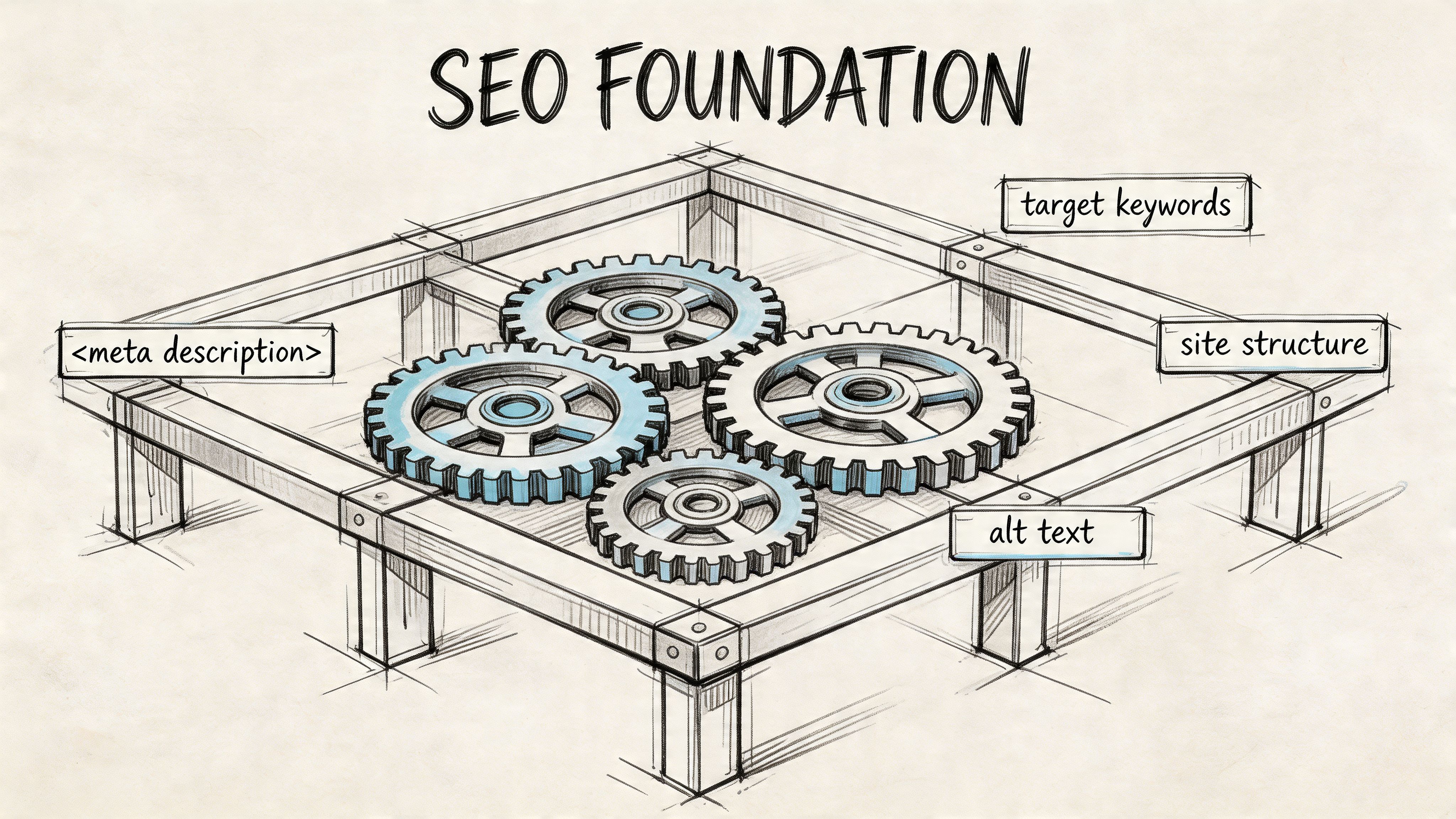
Audit the basics first
You don’t need an enterprise stack to spot common issues. Start with Google Search Console, Google PageSpeed Insights, Screaming Frog, and your CMS settings.
Check these first:
- Indexing status. Important pages should be indexable and present in search.
- Crawl waste. Filter pages, thin archives, tag pages, and duplicate URLs often absorb crawl attention.
- Broken internal links. These weaken navigation and strand authority.
- Canonical signals. Product variants, tracking parameters, and duplicate category pages often create confusion.
If the site has grown organically over time, bad architecture is common. Teams add pages without rethinking structure. Search engines then get a mess of overlapping URLs and shallow navigation.
Prioritize speed and mobile use
Page speed matters because users leave slow pages fast. Search engines also read those weak engagement patterns.
A practical speed pass usually includes:
- Compress oversized images and serve modern formats where possible.
- Remove bloated plugins that inject scripts sitewide.
- Delay non-essential scripts such as chat widgets and heavy visual effects.
- Use caching and a capable host so repeat visits don’t reload everything from scratch.
Mobile experience matters just as much. Buttons need spacing. Menus need to be usable with thumbs. Product filters shouldn’t trap users. If someone lands from search and can’t browse comfortably on a phone, the click is wasted.
Practical rule: If your page feels slow on a normal phone connection, fix that before you publish more.
Simplify site architecture
A clean site structure helps both crawling and user flow. Every important commercial page should be reachable through obvious navigation and contextual internal links.
Here’s a simple model:
| Area | What good looks like | Common failure |
|---|---|---|
| Service pages | Linked from main nav and relevant blog posts | Buried three layers deep |
| Blog categories | Built around real topic themes | Dozens of thin categories |
| Product pages | Clear parent-child hierarchy | Duplicate paths and filters |
| Internal links | Point to related, high-value pages | Random links added for SEO only |
Keep your important pages close to the surface. If key URLs require too many clicks from the homepage, both users and crawlers lose efficiency.
Add structured data where it helps
Schema won’t rescue weak content, but it helps search engines interpret page type and context. For many sites, the basics are enough:
- Organization schema for business identity
- Article schema for editorial content
- FAQ or product schema where relevant and accurate
- Breadcrumb schema to reinforce structure
This is one of those tasks teams postpone because it feels technical. In practice, many SEO plugins and CMS tools make basic implementation manageable.
Fix friction before scaling
Don’t think of technical SEO as a one-time setup. Every redesign, plugin install, and content migration can create new problems. Run a light audit regularly.
The upside is simple. Once the site is crawlable, fast, and easy to use, every future effort gets more efficient. Your new content ranks faster, your internal links pass value better, and your engagement signals become easier to improve.
Creating Content That Attracts Your Ideal Audience
Publishing more content does not fix a weak traffic strategy. Targeting the wrong query, writing for an audience that will never buy, or creating another article that competes with an existing URL usually creates more drag than growth.
Content earns traffic when each page has three things: clear search intent, a defined reader, and an obvious next step. That sounds simple. In practice, many teams skip the second and third parts, then wonder why rankings do not turn into pipeline.
Go after long-tail intent first
Broad head terms look attractive because they promise volume. They also bring mixed intent and heavier competition. For most sites, long-tail keywords are the faster way to get qualified traffic, and long-tail keyword strategy guidance explains why they often convert better.
The practical approach is straightforward:
- Find keywords where an existing page already shows traction
- Improve that page before creating a new one
- Add internal links from relevant supporting content
- Strengthen the page with examples, missing subtopics, and clearer structure
- Review Search Console data after updates and refine the page again
I see this mistake often on service sites. A page ranks at the bottom of page one or near page two, but the team publishes a fresh article on the same topic instead of improving the URL that already has history. That splits relevance and slows progress.
Build topic clusters around commercial goals
A content program works best when it supports revenue pages, not when it runs beside them. Topic clusters help because they connect early research content to pages that can convert.
A practical cluster usually includes:
- A core service or category page for high-intent searches
- Supporting guides that answer use-case questions
- Comparison pages for buyers evaluating options
- Problem-first articles for earlier-stage discovery
- Case-led pages that reduce risk for decision-ready visitors
If your distribution plan includes search, social, and repurposed content, align those formats from the start. This guide to content strategy for social media is a useful reference for planning how one topic can travel across channels without turning your calendar into a pile of disconnected assets.
Write pages that move the visitor forward
Traffic without progression is just activity.
Every page needs a job. Some pages introduce the problem. Some compare options. Some answer objections. Some should drive a demo request, quote form, trial signup, or product view.
Use these questions before publishing:
- What query is this page trying to win?
- What level of awareness does the visitor have?
- What should they click next if the page works?
- What proof or detail helps them take that step?
A good article does more than answer the query. It creates the next logical action with internal links, examples, product context, or a lead capture that fits the page. If you want ideas for improving underperforming pages that already get impressions, this CTR booster workflow for organic pages pairs well with content updates.
Set a cadence you can keep
Cadence matters because search visibility grows through repetition, updates, and topical depth. That does not mean every business needs a high-volume publishing machine. It means sporadic posting with no refresh cycle rarely builds momentum.
A workable cadence usually includes:
- A small set of core pages reviewed on a schedule
- Supporting articles tied to target themes, not random ideas
- Planned refreshes for URLs already earning impressions
- Distribution tasks attached to each publish date
One strong page that targets the right query and supports a money page will usually outperform several vague posts that bring the wrong audience.
Here’s a simple planning view:
| Content type | Purpose | Best use |
|---|---|---|
| Service page | Convert high-intent visitors | Commercial terms |
| How-to guide | Capture problem-aware searches | Mid-funnel discovery |
| Comparison page | Help buyers evaluate options | Bottom-funnel intent |
| Glossary or basics | Support internal linking and relevance | Top-funnel support |
A useful walkthrough on search-focused content execution is below.
Refresh pages before replacing them
Older URLs often have more potential than new drafts. If a page already gets impressions, has some links, or ranks for related terms, improve that asset first.
Useful refresh work includes:
- Expanding thin sections that only partially answer the query
- Rewriting headings to match the language searchers use
- Adding better examples, proof, or screenshots
- Linking in from related articles that already attract traffic
- Improving title tags and meta descriptions after rankings start to rise
That is how content compounds. Treat published pages like assets you improve over time, not one-time posts you abandon after hitting publish.
Boosting Rankings with CTR Optimization
Publishing more content is not always the fastest way to grow organic traffic. In many cases, the better move is to improve the pages that already earn impressions but fail to win the click.
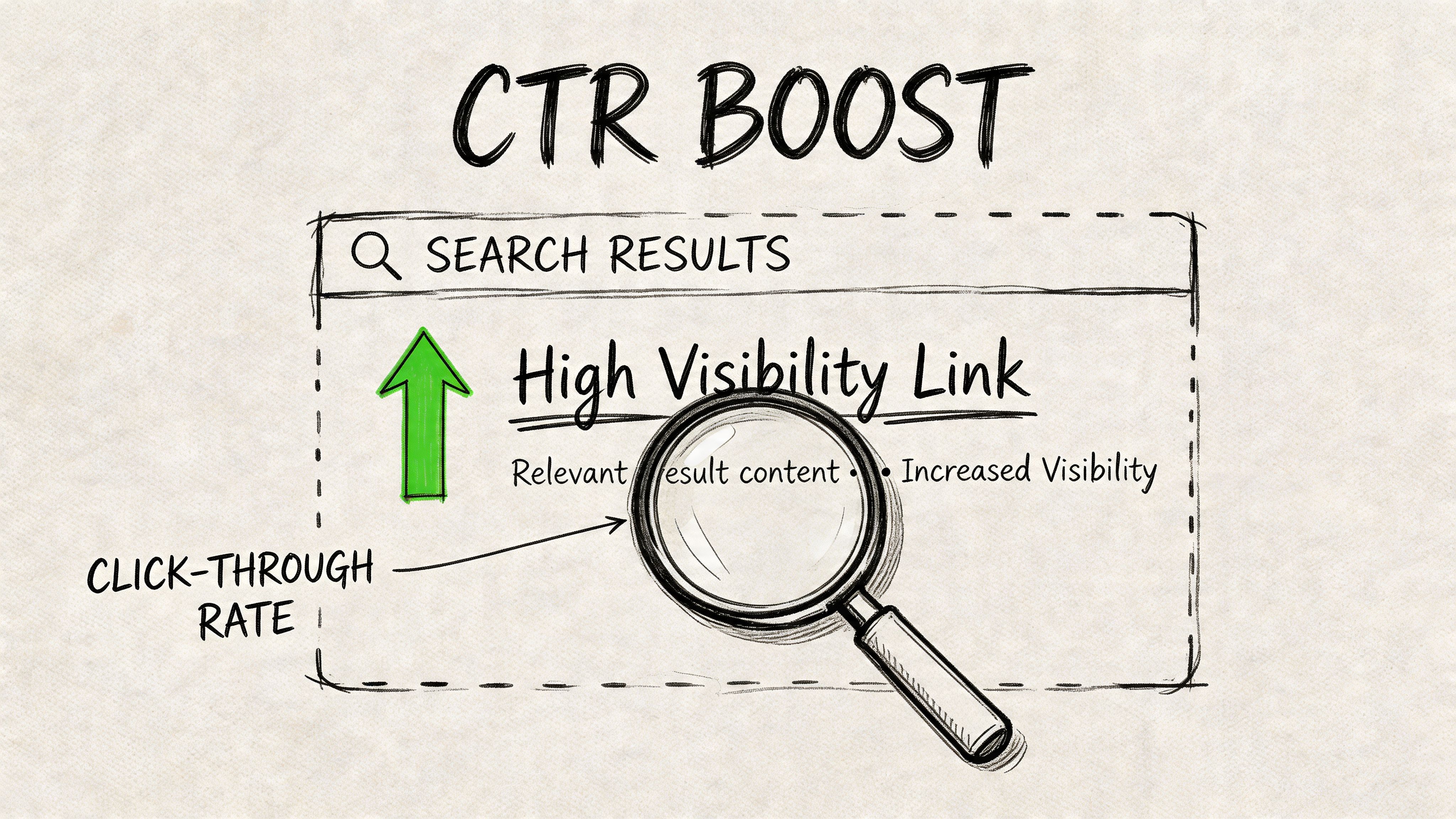
CTR optimization matters most for URLs sitting in striking distance. These pages already have relevance. They often rank on the bottom of page one or near the top of page two, which means a stronger title, a clearer snippet, and a better first-screen experience can produce traffic gains faster than starting a new article from scratch.
Why CTR deserves a place in the SEO workflow
A page can rank without pulling its weight. It shows up, gets seen, and still gets skipped.
That usually happens for one of three reasons. The title is vague. The snippet does not match search intent. The page promises one thing in search results and delivers something weaker after the click. All three problems suppress traffic, and they often cap ranking growth too.
Search engines want results that satisfy the query. If your page earns impressions but searchers consistently choose another result, that is a signal worth taking seriously.
Focus on pages that are close enough to move
The highest-upside CTR work usually starts with pages that already have momentum. Look for URLs with:
- High impressions in Google Search Console
- Average positions just outside the top results
- Lower click-through rates than their visibility suggests
- Clear intent match once someone lands on the page
Those are the pages where a better snippet can change the traffic curve quickly.
My usual review process is simple:
- Export page and query data from Search Console
- Filter for high-impression pages with weak CTR
- Compare the current title against the actual query language
- Rewrite titles for specificity, clarity, and intent match
- Improve the meta description so the benefit is obvious
- Check the first screen of the page to confirm it delivers fast
- Add internal links from related pages that already get traffic
Improve the snippet first, then the landing experience
Title tags do the heavy lifting. They decide whether your result feels relevant enough to click.
Good titles are specific. They mirror the wording of the query without stuffing it. They hint at the payoff. Weak titles tend to be broad, clever, or generic. Those styles often look fine in a CMS and underperform in the search results.
Meta descriptions matter too, even if Google rewrites them sometimes. A strong description can reinforce the promise of the title and help the searcher self-qualify before the click.
Then the page has to confirm that promise immediately.
If someone clicks a result about pricing, they should not have to scroll through a long brand story before seeing pricing context. If the query suggests comparison intent, open with the comparison. If the searcher wants steps, lead with steps. CTR work fails when the snippet gets the click but the page wastes the visit.
A title can win the click. Only the page can keep it.
Use CTR optimization as an accelerator, not a substitute
This tactic works best on pages with existing ranking potential. It does not rescue weak pages with poor intent match, thin information, or no reason to rank.
That trade-off matters. Rewriting titles on a page that already sits near page one is often efficient. Trying to manufacture clicks to a page that does not satisfy the query is usually a short-term move with little staying power.
For teams that want a practical workflow, this guide to a CTR booster for organic rankings shows how marketers approach pages that are visible enough to benefit from stronger click signals.
One tool option in that category is ClickSEO. It focuses on real organic clicks through keyword searches and on-page browsing behavior. Used carefully, that type of tool fits pages with existing relevance. It does not replace technical SEO, content quality, or internal linking.
What tends to work, and what usually backfires
| Works | Usually fails |
|---|---|
| Testing title variations on already-ranking pages | Chasing broad keywords with weak intent |
| Matching snippet language to the exact query | Writing clickbait titles that disappoint after the click |
| Improving the first screen so the answer appears fast | Sending visitors to thin pages or muddled openings |
| Supporting CTR gains with internal links and page refreshes | Treating CTR as a replacement for core SEO work |
CTR optimization is often neglected because it sits between classic SEO and conversion work. That is exactly why it can move traffic faster than expected. When a page already has impressions, better click appeal and better post-click satisfaction can turn latent visibility into real visits.
Expanding Your Reach Beyond Organic Search
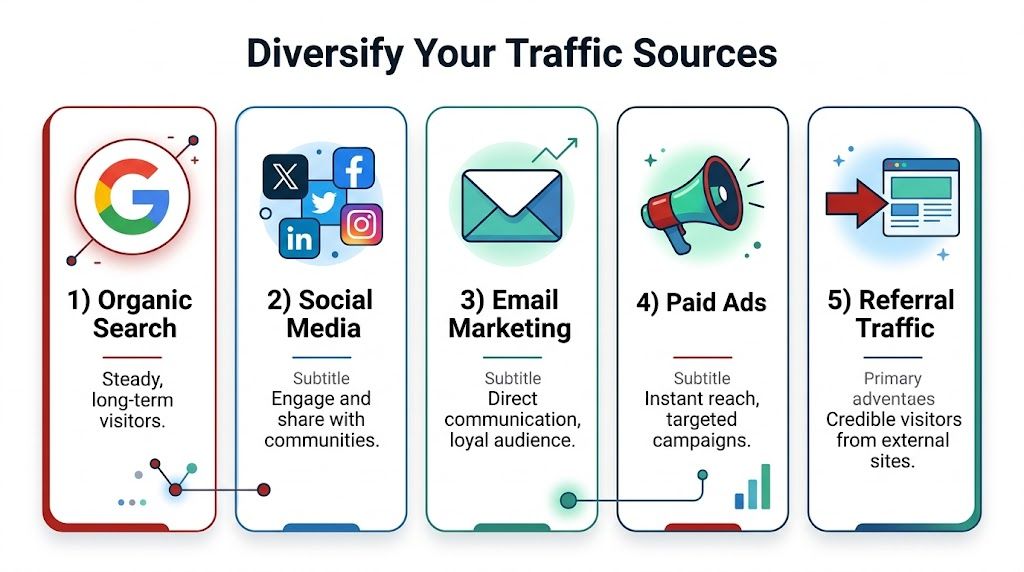
Google matters, but depending on it alone is fragile. Rankings fluctuate. Search features crowd results. A single channel concentration can wipe out momentum fast.
The stronger approach is channel diversity. Organic search can stay central while email, referral communities, and selected niche platforms create a second and third line of traffic.
Use communities for targeted referral traffic
Mainstream social platforms are noisy and often poor at sustained referral clicks. Niche communities can work better when your contribution is useful before it’s promotional.
Reddit and Quora are the obvious examples. They reward relevance, expertise, and timing. They also punish lazy self-promotion.
A workable pattern looks like this:
- Answer the exact question being discussed
- Give enough detail in-platform so the response stands on its own
- Link only when your page adds needed depth
- Use a real profile with topic consistency
Done well, these communities can become recurring referral channels instead of one-off spikes. If you’re comparing tools and workflows for broader acquisition, this roundup of traffic generation tools and channel options is a practical place to evaluate what fits your model.
Treat Pinterest like search, not social
Pinterest works differently from feed-first social networks. It behaves more like a visual search engine, especially for evergreen topics, e-commerce inspiration, tutorials, design, recipes, and niche publishing.
The value is durability. One strong visual asset can keep sending visitors long after posting day. That makes Pinterest useful for content libraries with lasting relevance.
Build for it by focusing on:
- Clear vertical visuals
- Descriptive titles aligned with search language
- Landing pages that match the promise of the pin
- Consistent publishing instead of bursts
Turn email into a repeat traffic engine
Email is still the most controllable channel because you own the audience relationship. It’s also where generic execution wastes the most opportunity.
According to email traffic generation research, advanced email marketing that uses audience segmentation and behavioral personalization significantly outperforms generic campaigns, and BuzzFeed’s example shows how interest-based segmentation and send-time optimization can turn newsletters into primary traffic drivers.
That matters because repeat visitors behave differently from cold clicks. They know your brand. They’re more likely to read deeper, browse more pages, and return again.
A stronger email program usually includes:
- Interest tags based on what people signed up for
- Behavioral segments based on clicks and prior visits
- Send-time testing based on when segments engage
- Dynamic content blocks so each segment sees different recommendations
Email works best when the subscriber feels the message was assembled for them, not blasted to everyone.
Balance owned and rented channels
Here’s the simple distinction:
| Channel type | Example | What you control |
|---|---|---|
| Owned | Email list, website, newsletter archive | Audience access and distribution |
| Rented | Reddit, Quora, Pinterest, search platforms | Exposure only, not the rules |
You need both. Rented channels help you get discovered. Owned channels let you keep the relationship.
That’s the practical answer to how to generate traffic on website without becoming dependent on a single algorithm. Search brings in discovery. Community platforms widen the funnel. Email captures repeat attention. Together, they create resilience.
Earning Authority with Strategic Off-Page SEO
Authority still matters. You can publish strong content on a technically sound site and still lose to domains that search engines trust more.
Off-page SEO is how that trust gets built. Not through spammy volume. Through relevant mentions, credible links, and consistent association with your topic.
Think relevance before scale
A backlink from a site in your niche usually matters more than a random mention from an unrelated directory or low-quality blog network. That’s why good off-page work starts with fit.
Ask three questions before pursuing a placement:
- Is the site relevant to the audience I want?
- Would a link here make sense even without SEO value?
- Does the page have editorial standards?
If the answer is no, skip it. Cheap links usually create busywork, not authority.
Use several link earning routes
Off-page SEO works best when you combine methods instead of forcing one template.
Guest contributions work when you have an angle worth publishing. Digital PR works when you have a story, dataset, or contrarian point editors care about. Resource page outreach works when your asset is helpful. Partnerships work when both sides serve overlapping audiences.
Those methods feel different in execution, but the principle is the same. Earn placement because the content deserves inclusion.
A practical split:
- Guest posts for topic expertise and referral relevance
- Digital PR for mentions from publications and industry sites
- Resource outreach for guides, tools, and evergreen assets
- Partner content for adjacent audiences and shared credibility
Match link targets to money pages
A common mistake is building links only to blog posts because they’re easier to pitch. That can work, but it often leaves service and product pages underpowered.
Instead, build a path:
- Earn links to strong informational assets.
- Internally link from those assets to commercial pages.
- Add some direct authority signals to key money pages where natural.
- Refresh anchor text patterns so they stay sensible and varied.
This avoids a lopsided site where all authority pools in educational content and never reaches the URLs that matter commercially.
Niche communities can support authority too
Authority isn’t only about links from traditional publishers. Relevant visibility in communities can reinforce branded search, referral visits, and content discovery.
That’s part of why niche platforms matter. According to non-social traffic channel analysis, Reddit and Quora can yield 2-5x ROI over paid ads for affiliate marketers, and Pinterest’s AI visual search update drove a 28% YoY traffic uplift for niche publishers. The direct traffic matters, but the secondary effects matter too. More mentions, more saved content, more branded searches, and more natural sharing all support a stronger footprint.
Good off-page SEO looks like reputation building with search benefits, not link collecting with a thin cover story.
Outreach quality decides the outcome
Most outreach fails because it’s lazy. Generic templates, obvious self-interest, and irrelevant pitches get ignored.
Better outreach is short, specific, and tied to the recipient’s audience. Show that you know the publication, explain why your asset helps their readers, and make it easy to review.
That’s slower than bulk blasting. It also works better.
Tracking Success and Planning Your Next Move
Traffic work gets expensive when you can’t tell what’s moving the business. Measurement solves that. It also prevents one of the most common mistakes in growth work, which is doubling down on the loudest channel instead of the most productive one.
Use a small KPI set for each channel
You don’t need a giant reporting dashboard. You need a few metrics that reveal whether the channel is earning attention and quality.
A practical set looks like this:
- Organic search. Rankings, impressions, CTR, landing page sessions
- Content. Entrances, scroll depth, assisted conversions, internal click paths
- Email. Open patterns, click behavior by segment, return visits
- Referral channels. Sessions, engagement quality, assisted conversions
- CTR-focused pages. Query-level CTR, average position, landing page engagement
If you’re improving pages near page one, watch changes at the query and URL level. Aggregate traffic numbers won’t show enough detail.
Build one operating view in GA4 and Search Console
Keep it simple. In GA4, monitor landing pages, source and medium, engaged sessions, and conversions. In Search Console, track impressions, clicks, average position, and CTR by page and query.
Then connect them manually in a review rhythm.
A weekly review can answer:
- Which pages gained impressions but not clicks?
- Which channels sent visitors who engaged?
- Which articles brought new visitors into the site?
- Which pages lost traction and need a refresh?
This gives you a workflow, not just a report.
Measure engagement, not just visits
A traffic spike with weak engagement isn’t always a win. If people land and leave, the page or channel may be mismatched.
That’s why dwell and page depth matter directionally. They help you judge whether the visit had substance. If you want a deeper explanation of that relationship, this piece on how dwell time affects website SEO is worth reviewing alongside your page-level data.
Decide what to do next with a simple matrix
| Scenario | Likely next move |
|---|---|
| High impressions, low CTR | Rewrite title and meta, test snippet angle |
| Good CTR, weak engagement | Improve first screen, tighten intent match |
| Strong engagement, low rankings | Build links, strengthen internal linking |
| Good referral traffic, no repeat visits | Add stronger email capture and next-step offers |
The best traffic plans are iterative. Teams publish, measure, sharpen, and redistribute. Then they do it again.
That loop matters more than any single tactic. If you keep measuring by page, channel, and intent, your next move usually becomes obvious.
Frequently Asked Questions About Website Traffic
How long does it take to generate website traffic?
It depends on the channel. Paid traffic can start quickly, but it stops when spend stops. SEO and content usually take longer because pages need indexing, links, user response, and time. Email and referral communities can sit in the middle. They can produce earlier wins if you already have an audience or a credible profile.
Should I focus on SEO or social first?
For most businesses, start with SEO plus one repeatable distribution channel. Search gives durable discovery. A second channel such as email, Reddit, Quora, or Pinterest reduces risk. Pure social-first strategies often create short bursts without much lasting value unless you already have strong distribution.
Is more traffic always better?
No. Qualified traffic is better. A smaller number of visitors with clear intent usually beats a bigger audience that doesn’t care about your offer. The best pages often attract fewer people than broad top-funnel articles, but convert more efficiently because the query is specific.
What’s the fastest organic lever if my page is already ranking?
CTR and on-page engagement are the fastest levers for pages already near page one. If a page has impressions and weak click-through rate, improve the title, meta description, opening content, and internal links before writing a new article. Those changes usually have a shorter feedback loop than launching a fresh URL.
How many traffic channels should a small team manage?
Usually two or three well-run channels beat six neglected ones. A practical mix is search, email, and one niche referral platform. That gives you discovery, retention, and diversification without stretching the team too thin.
When should I refresh old content instead of creating new content?
Refresh first when the page already ranks, gets impressions, or has backlinks. New content makes more sense when you have a real topic gap or a new audience problem to address. Existing pages often contain unrealized value, especially if they sit just outside the strongest positions.
If your site has pages stuck near the top of page two or the lower half of page one, ClickSEO can support the CTR side of your traffic strategy by driving real organic clicks tied to your target keywords and engagement goals. It fits best as an accelerator alongside technical SEO, content improvement, and authority building, not as a substitute for them.