How to Get on First Page of Google: A 2026 Roadmap
Most advice on how to get on first page of google is incomplete.
“Publish great content” sounds right, but it leaves out the part that decides whether great content gets seen at all. A solid article sitting on page two is still invisible for most businesses. Agencies feel this when client reports show “ranking improvements” but leads barely move. E-commerce teams feel it when category pages hover just outside the top results. Local businesses feel it when they’re technically present in search, yet calls still go to competitors.
The practical playbook is less romantic than the usual SEO slogans. You need keywords you can win, content structured for search intent, a site Google can crawl and trust, backlinks that transfer authority, and one factor many guides barely address: user engagement from the search results themselves. That last part often decides whether a page breaks through or stays stuck.
Why Page One Is the Only Page That Matters
The phrase “just keep publishing” has misled a lot of teams. Publishing alone doesn't solve distribution, and in Google search, distribution is brutally concentrated.
The first page of Google captures over 90% of all clicks, and only 0.63% of users go to page two, according to ProtoFuse’s breakdown of first-page click behavior. The same analysis notes that position #1 averages a 36.4% CTR, followed by 12.5% for position #2 and 9.5% for position #3. That means the crucial contest isn't “can I rank somewhere?” It's “can I get into the set of results users click?”
That’s why serious Search Engine Optimization (SEO) work starts with page-one viability, not vanity rankings. A page at position eleven may look close in a rank tracker, but commercially it often behaves like a different universe.
Practical rule: Treat page two as a diagnosis, not a destination. It usually means the page is relevant enough to be considered, but not compelling enough to win the click or strong enough to hold trust.
For agencies, this changes reporting. “Moved from 28 to 14” is progress, but it’s not the same as visibility. For e-commerce, a collection page on page two won’t collect much. For SaaS, a high-intent feature or comparison page outside the top ten usually won’t generate meaningful pipeline.
A better mindset is simple. Build every SEO effort backward from the click economy. If the keyword matters, page one is the goal. If page one isn't realistically achievable, the keyword strategy or page strategy needs to change.
Find Winning Keywords and Create Content Google Loves
Ranking starts before writing. Most pages fail because they target terms they can't realistically win or because they mismatch intent.

If you're trying to learn how to get on first page of google, the first move isn't drafting content. It's filtering for opportunities where your site has a believable path to page one.
Start with winnable keywords
A practical workflow in Semrush starts with a seed topic, then narrows toward terms with lower difficulty and clear intent. According to Nelio’s guide to first-page rankings, pages targeting low-competition keywords with Keyword Difficulty below 30 can reach page one in under 7 days when paired with immediate indexing through Google Search Console. The same source recommends meta titles at 50 to 60 characters and content that exceeds 1,500 words.
That doesn't mean every low-difficulty keyword is worth targeting. It means low difficulty gives you a route in, provided the query aligns with what your business offers.
Use this filter before you approve a keyword:
- Intent fit: Is the searcher looking for information, a product, a local provider, or a comparison?
- Page fit: Should this be a blog post, service page, category page, landing page, or tool page?
- Business fit: If the page ranks, does it create revenue opportunity or only empty traffic?
- SERP fit: Are current top results beatable with a stronger page, cleaner structure, or better engagement?
A SaaS company often overinvests in broad educational terms that attract students and casual browsers. An e-commerce store often underinvests in collection and subcategory keywords with obvious buying intent. Agencies often chase flashy “SEO” head terms instead of service-plus-location or service-plus-problem searches that convert faster.
Build the page around search intent
Once the keyword is chosen, the page should answer the exact query fast. Don't bury the answer under brand storytelling.
A strong page usually gets these fundamentals right:
- Title tag: Put the primary keyword in a title that reads naturally and earns the click.
- H1: Keep it clear and aligned with the term the page targets.
- Opening paragraph: Confirm relevance quickly so both users and Google understand the page’s purpose.
- Body structure: Use H2s and H3s that map to the sub-questions behind the query.
- Internal links: Connect the page to related commercial and supporting content.
- Schema markup: Add structured data where it fits the page type.
One useful benchmark from the same Nelio source is content length above 1,500 words for pages that need to compete seriously. That doesn't give you permission to add filler. It means you need enough depth to cover the topic completely.
Good SEO content doesn't feel long. It feels complete.
Write for E-E-A-T without sounding manufactured
Google rewards pages that look like they were created by people who know the topic, not by templates that merely imitate expertise. For a local service company, that means using real service language, real locations, real process details, and real constraints. For e-commerce, that means category copy that helps shoppers decide, not generic copy blocks stuffed with attributes. For agencies and consultants, that means showing process clarity and commercial understanding.
Use specifics such as:
- what the service includes
- who it’s for and not for
- common mistakes buyers make
- how implementation works
- what trade-offs exist between options
If you’re publishing supporting content, tie it into a larger topical cluster. A buyer’s guide should link to service pages. A comparison page should link to product or demo pages. An educational article should move readers deeper into your site, not leave them at the end of a dead page.
For teams testing engagement-focused SEO alongside content improvements, this overview of an organic traffic generator is one example of how practitioners think about reinforcing visibility once a page is already close enough to compete.
Index quickly and update with intent
Publishing and waiting is lazy SEO. After the page goes live, inspect and submit it in Google Search Console. Then watch what the query set does over the next few weeks.
If a page gets impressions but weak clicks, the title and snippet likely need work. If it gets clicks but little movement, the page may need stronger internal linking, richer coverage, or better supporting authority.
The video below gives a useful visual walkthrough for thinking about page-one strategy from the ground up.
What works and what usually doesn't
The best-performing pages usually share a few traits:
- They target one primary intent: They don't try to rank one page for every stage of the funnel.
- They solve the query early: Readers know within seconds they landed in the right place.
- They include supporting depth: FAQs, comparisons, examples, and internal references make the page more useful.
- They earn the next click: A related service page, product page, or deeper guide is always available.
What usually fails is easier to spot:
- Broad vanity keywords: Nice for ego, poor for early wins.
- Thin AI-expanded drafts: Long enough to count, too generic to trust.
- Mismatched page types: Trying to rank a blog post for a transactional term or a product page for an educational query.
- Keyword obsession: Repeating the phrase instead of covering the topic.
A lot of SEO gets better when the brief gets stricter. Pick a keyword you can win. Match the page to the intent. Give Google enough clarity to understand it and enough quality to trust it.
Fixing the Technical Issues Holding You Back
Some pages don't rank because they're weak. Others don't rank because the site keeps getting in their way.
Technical SEO isn't glamorous, but it decides whether Google can crawl the page efficiently, render it properly on mobile, and trust the user experience enough to surface it. A well-written page on a slow, messy site often underperforms a slightly weaker page on a cleaner domain.

Prioritize the fixes that change rankings
According to Power Marketing International’s first-page guide, over 90% of traffic derives from page one, which is why technical performance matters so much once you're competing for top visibility. The same source says speed-optimized sites see a 20 to 32% uplift in rankings within 30 days, and for local businesses, an optimized Google Business Profile increases visibility by 70%.
Those are meaningful gains, but only if you work the right checklist. Start with the items that block discovery, hurt usability, or send poor experience signals.
The non-negotiable checklist
Use this order.
- Crawlability and indexability: Confirm the page is discoverable, internally linked, and not blocked by accidental noindex directives or broken navigation.
- Core Web Vitals: Review Largest Contentful Paint, First Input Delay, and Cumulative Layout Shift in PageSpeed Insights and Search Console.
- Mobile usability: Check that layouts, tap targets, menus, and forms work cleanly on phones.
- HTTPS and trust signals: Secure pages are the baseline. If users get browser warnings or mixed-content issues, rankings won't be your biggest problem.
- Broken links and error pages: Fix internal 404s, redirect retired URLs properly, and remove dead ends from navigation.
- Duplicate or overlapping content: Consolidate pages that compete with each other or dilute topical relevance.
A technical audit isn't a scavenger hunt. It's a prioritization exercise. Fix what blocks indexing first, what hurts experience second, and what creates inefficiency third.
What these metrics mean in practice
Core Web Vitals can sound abstract until you attach them to user behavior.
- Largest Contentful Paint: How quickly the main visible content loads.
- First Input Delay: How quickly the site responds when someone taps or clicks.
- Cumulative Layout Shift: How stable the page remains while loading.
When any of these break badly, users don't need a score report to tell them. They feel it. The page loads late, buttons jump, images shift, and they leave.
A lot of the fixes are operational rather than strategic:
| Issue | Common cause | Practical fix |
|---|---|---|
| Slow pages | oversized media, bloated scripts | compress images, defer non-critical scripts, remove unnecessary apps |
| Mobile friction | desktop-first templates | simplify layout, reduce intrusive popups, test core pages on actual devices |
| Indexing gaps | orphan pages, weak internal linking | add contextual links from relevant pages and submit key URLs in Search Console |
| Duplicate content | multiple similar pages | merge, canonicalize, or rewrite to clarify each page’s purpose |
For teams tracking broader ranking inputs, this guide to SEO ranking factors in 2026 is a useful companion when you need to connect technical cleanup to overall search performance.
Local SEO needs its own technical discipline
Local businesses often miss first-page opportunities because they treat Google Business Profile like a directory listing instead of a ranking asset.
Keep the profile complete. Match business details across your site and listings. Use real service descriptions, accurate categories, and fresh photos. Then connect your location pages and local service pages logically so Google can understand both the business entity and the website context around it.
For local SEO, technical work isn't limited to the site. The profile, map presence, local landing pages, and on-site schema all support the same goal. Make the business easy to verify, easy to trust, and easy to choose.
Earn Backlinks That Actually Move the Needle
Many sites plateau because they’ve done the on-page basics and cleaned up technical problems, but Google still doesn’t see enough authority behind the domain or the page.
Backlinks remain one of the clearest off-page signals of trust. Not because every link is valuable, but because the right links help Google discover pages, understand relevance, and weigh authority in competitive SERPs.
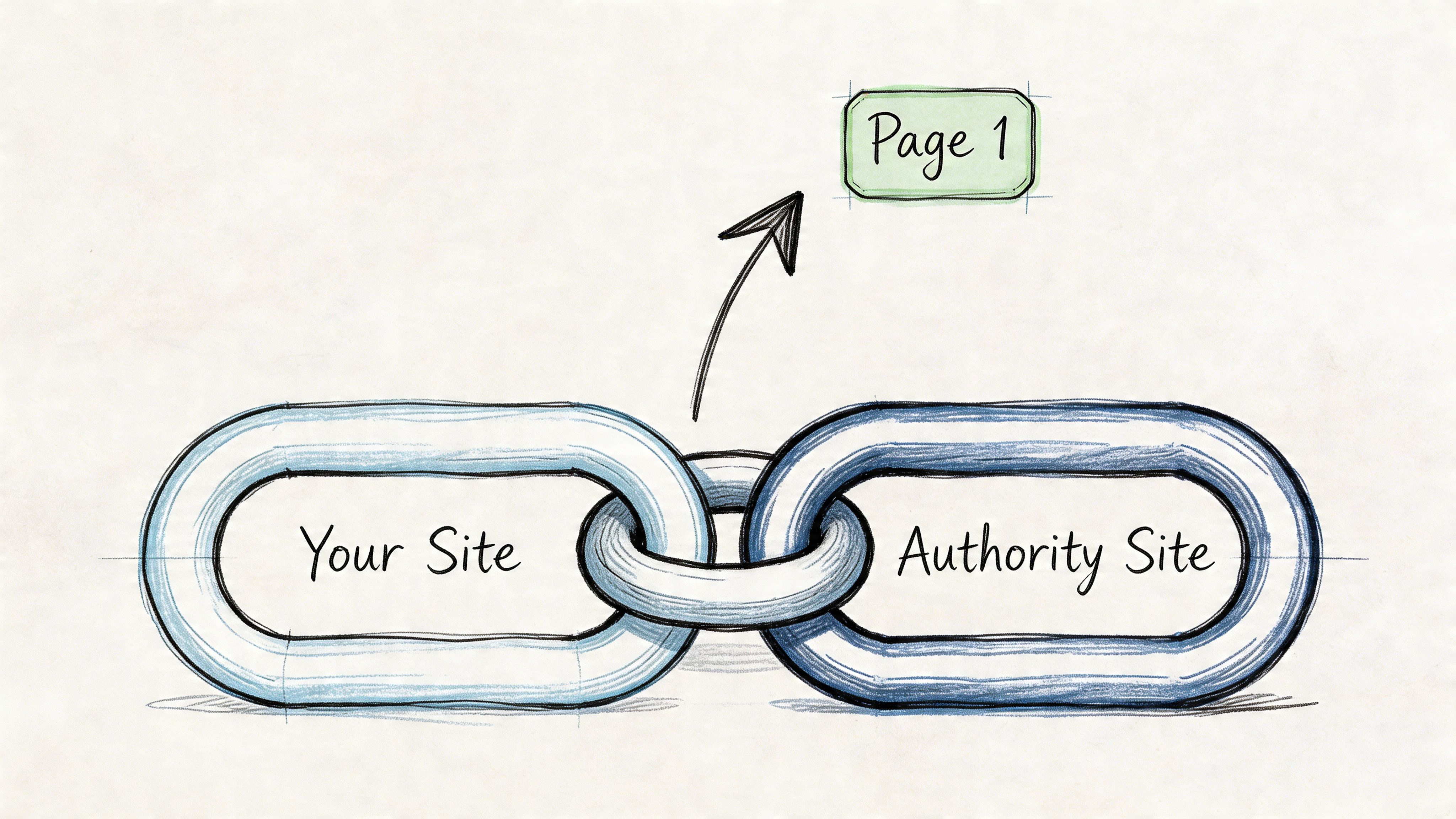
A useful grounding point comes from Google indexing and discovery guidance discussed in this video reference: visibility on Google demands external backlinks, Google's crawlers rely on links to discover the web’s 5 trillion+ pages, and sites with quality backlinks plus user-friendly design outperform sites that are unlinked or technically flawed.
Why quality beats volume
Buying piles of weak links still tempts people because it feels measurable. You can count them, show them in a spreadsheet, and pretend progress is happening. In practice, irrelevant links from junk sites rarely move rankings in a durable way.
A single relevant mention from an industry publication, niche association, respected blog, or local news outlet usually matters more than a large batch of low-trust placements. Relevance sharpens authority. Context matters.
Agencies often go wrong for clients by outsourcing link building to vendors who sell quantity. The report looks busy. The rankings don't.
The right backlink profile looks earned, uneven, and connected to real topics your business deserves to be associated with.
Link acquisition methods worth your time
Focus on methods that create both visibility and authority.
- Digital PR: Publish data-backed or opinion-led content that journalists, newsletters, and trade sites can cite.
- Podcast appearances: These often produce branded links, entity reinforcement, and referral traffic from relevant audiences.
- Unlinked brand mentions: If someone names your company without linking, ask for the citation to be turned into a link.
- Linkable assets: Build pages people refer to, such as original frameworks, templates, comparison guides, glossaries, or tools.
- Partnership and vendor pages: Legitimate business relationships often create natural linking opportunities.
Different business models should lean into different assets. A local service business may win with community partnerships and regional press. A SaaS brand may do better with comparison pages, original research, and integration ecosystem links. E-commerce brands often benefit from gift guides, product roundups, and niche publisher outreach.
What to avoid
A few warning signs usually mean the campaign is off track:
- Irrelevant placements: If the site has nothing to do with your market, the link is weaker than it looks.
- Template outreach at scale: Personalization matters because real editors ignore generic pitches.
- Homepage-only linking: Deep links to relevant pages often help more than forcing everything to the homepage.
- Anchor text manipulation: Over-optimized anchors create an unnatural pattern.
The simplest test is this. If a human reviewer looked at the linking page, would the mention make sense without SEO as a motive? If the answer is no, skip it.
Backlinks work best when they confirm what your content and technical setup already suggest. They are not a substitute for quality. They are a multiplier for pages that deserve to rank.
The Page Two Trap and How to Escape It with User Signals
A lot of pages aren't stuck because the keyword is wrong or the content is terrible. They're stuck because Google has tested them enough to see them, but not enough users choose them.
That’s the page two trap.
A page near the top of page two often has just enough relevance to appear, but not enough click appeal or engagement momentum to break into the first set of results. Most SEO playbooks stop at content, links, and speed. Those matter. But they don't fully explain why one competent page climbs and another equally competent page stalls.

Why page two is such a hard place to escape
According to WordStream’s discussion of first-page ranking barriers, low CTR on page two is often below 2 to 5%, and that weak click response can signal irrelevance even when the page is otherwise strong. The same source notes that improving CTR through authentic organic clicks can lift rankings in 30 to 60 days by reinforcing engagement signals like dwell time, described there as a top-3 ranking factor in 2025.
That dynamic matters because page-two pages suffer from a feedback loop:
- They get fewer impressions with intent-rich clicks.
- Their low click rate makes them look less attractive.
- Google keeps preferring results that win more interaction.
- The page remains visible enough to tease progress, but not enough to drive business.
For agencies, client frustration reaches its peak at this stage. The keyword is “close.” The page has been optimized. Links were built. Yet it won’t crack the top ten. For e-commerce, this often happens to category pages with acceptable content but weak snippet appeal. For local businesses, it shows up on service-area pages that rank decently but don't convert enough searchers into action.
Improve the click before you ask for the ranking
The first fix is manual, not mechanical. Earn more clicks from the SERP itself.
Work these levers:
- Rewrite titles for intent and curiosity: Clear beats clever. The user should know what they’ll get.
- Tighten meta descriptions: Use them to clarify value, not to repeat the title.
- Match the query language: If the search is transactional, sound transactional. If it’s comparative, reflect comparison.
- Use structured data where appropriate: Richer snippets can increase visibility and improve click appeal.
- Reduce pogo-sticking: Make sure the landing page immediately matches what the title promised.
The goal isn't manipulation. It's alignment. The page should look like the best next click because it is the best next click.
If your result is technically relevant but visually weaker, the SERP will treat it as second-tier even when the page itself is strong.
Engagement after the click matters too
Google doesn't just measure whether someone clicked. It cares what the session looks like after that click.
When users land, stay, read, and continue into another page, the page looks more satisfactory than one that causes an instant bounce back to search. This is why many ranking gains stall after on-page optimization alone. Teams improve relevance but ignore behavior.
Strong post-click engagement usually comes from simple execution:
- fast load times
- clear opening paragraphs
- obvious page structure
- useful internal links
- no bait-and-switch between title and content
- friction-free mobile experience
For pages already close to page one, some teams also test user-signal reinforcement. One example is ClickSEO’s SearchSEO approach, which describes using organic search behavior patterns to strengthen CTR and session-quality signals for target keywords. Used carefully, this fits a practical reality many SEO practitioners already understand: once the foundation is in place, the pages that attract and hold searchers often beat pages that are merely optimized on paper.
That doesn’t replace content, links, or technical work. It only matters once those are credible. Trying to prop up a weak page with engagement tactics is a short-term move at best. But when a page is already relevant and just underperforming in user response, engagement becomes the missing variable.
A workable page-two recovery sequence
If a page is stuck between positions just outside page one, use this order:
| Priority | What to check | Why it matters |
|---|---|---|
| First | title tag and snippet appeal | weak SERP presentation suppresses clicks before the page gets a fair test |
| Second | intent match on landing | clicks won't help if users bounce because the page misses the query |
| Third | internal links from stronger pages | authority and context still need reinforcement |
| Fourth | engagement signals | session depth and dwell behavior can help break a tie between similar results |
Most SEO teams underuse this sequence because CTR feels less tangible than content production. But in competitive SERPs, the result that gets chosen more often keeps getting more chances. That's how pages graduate from “almost there” to visible.
Tailoring Your Strategy for Your Business Type
The same SEO checklist won't produce the same outcome for every business. A local roofer, a SaaS startup, an affiliate publisher, and an online store all compete under different constraints.
The fastest way to waste budget is to copy a playbook built for another model. Agencies should build around service and proof pages. E-commerce teams need category and product discovery. Local businesses need map visibility and service-area relevance. Affiliate sites live or die on content quality, intent targeting, and trust.
Here’s the practical split.
First-page SEO priorities by business model
| Business Type | Top Priority (First 30 Days) | Key Metric to Track | Long-Term Focus |
|---|---|---|---|
| Local business | Clean up Google Business Profile, location pages, and service-page intent | Qualified calls, direction requests, local landing page clicks | Location authority, review quality, service-area expansion |
| E-commerce store | Optimize category pages, collection titles, filters, and internal links | Organic clicks to category pages and product-page engagement | Category authority, merchandising content, repeatable indexable page structure |
| B2B SaaS | Build commercial pages around use cases, alternatives, integrations, and problems solved | Demo-driven organic visits and assisted conversions | Topical authority across problem-aware and solution-aware queries |
| SEO agency or consultant | Target service plus niche, service plus location, and proof-driven pages | Qualified leads from service pages | Brand authority, case-led content, strategic backlinks |
| Affiliate or niche publisher | Publish intent-matched content clusters with stronger comparison and buyer pages | CTR from search and page-level engagement | Trust signals, content refresh cycles, deeper monetization paths |
What this changes in execution
A local business shouldn't spend its first month writing broad thought leadership. It should fix local relevance, tighten core pages, and make its profile and site support each other.
An e-commerce brand shouldn't treat every blog post as equal. Category pages usually carry more commercial value, so they deserve stronger copy, cleaner structure, and better click appeal.
A SaaS company often needs two layers at once. It needs problem-solving content to earn discovery and commercial pages that capture intent once users are ready to evaluate.
Common Questions on Getting to Google's First Page
How long does it take to get on the first page?
It depends on competition, site authority, technical health, and whether the page is targeting a realistic keyword. Some low-competition pages can move quickly when they’re indexed immediately and built correctly. Competitive terms often take longer because Google wants more proof from content quality, backlinks, and user response.
Is content still the main thing?
Content is foundational, but it isn't enough by itself. Pages rank when content, technical performance, authority, and user behavior support the same outcome. A good article on a weak site or a good site with poor click appeal will still underperform.
What's the biggest mistake businesses make?
They target terms they want instead of terms they can win. The second mistake is stopping after “basic optimization” and ignoring why pages get stuck just outside page one.
Do backlinks still matter?
Yes. They still help discovery, authority, and trust. But relevance matters more than raw volume. A few strong links tied to your market usually outperform a pile of weak ones.
Can local businesses compete without a huge website?
Yes, if they align the site with local intent and keep their Google Business Profile accurate and active. Local SEO often rewards clarity, trust, and service relevance more than sheer site size.
Is CTR optimization risky?
It depends on the method. Low-quality bots and fake traffic patterns create obvious risk. Human-like, query-based engagement strategies are a different category and should only be considered after the page itself deserves to rank. The safer approach is always the same: fix the fundamentals first, then reinforce genuine engagement.
If your pages are already optimized but still stuck short of page one, ClickSEO is a practical option to test user-signal reinforcement. It focuses on organic search clicks and on-site engagement behavior for target keywords, which can complement content, technical SEO, and link building when the fundamental problem is the page two barrier rather than page quality itself.