
Boost SEO: Get Premium Website Traffic & High-Quality Visitors

When we talk about premium website traffic, we're not just talking about getting more clicks. We're talking about attracting the right kind of visitors: real, high-intent people who find you through organic search because they're actively looking for what you offer. This isn't about opening the floodgates; it's about building a steady, reliable stream of potential customers who are genuinely interested in your solutions.
Decoding Premium Website Traffic
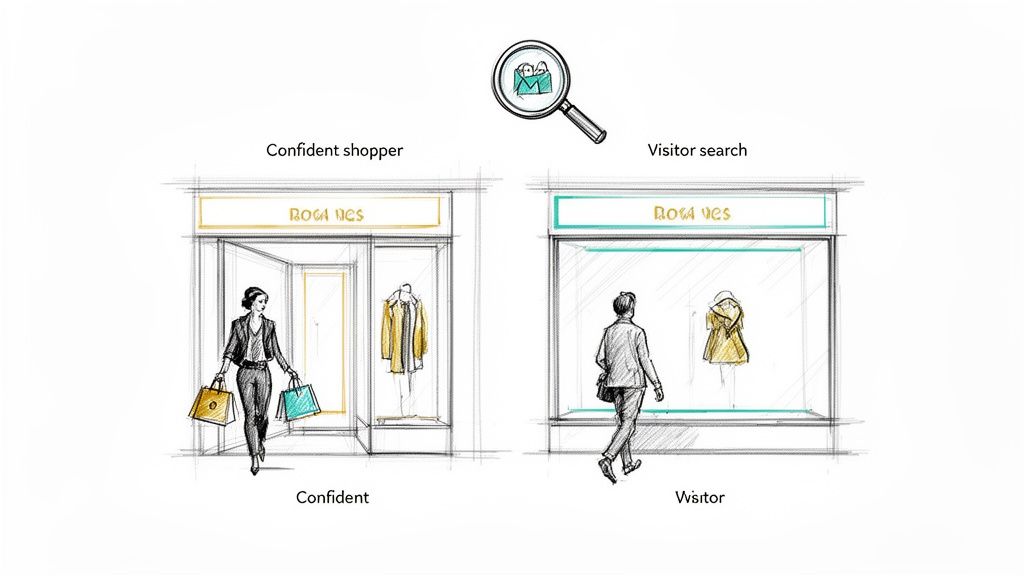
Think of your website as a brick-and-mortar store on a busy street. Lots of people walk by. Some are just window shopping, others are lost, and a few might wander in with no real plan to buy anything. Premium traffic is the person who walks in with a specific purpose, ready to buy. They've done their research and are looking for exactly what you sell.
This simple analogy gets to the heart of what matters. It's a fundamental shift away from chasing vanity metrics like total visits and instead focusing on the quality and intent behind each click. These visitors aren't bots, paid click-farm workers, or people who accidentally clicked a random social media link. They're real human beings who typed a specific problem into Google or Bing, saw your site in the results, and chose you because they believe you can help.
The Foundation of Sustainable SEO
So, why does this specific type of organic traffic matter so much for your long-term SEO? It’s simple: the behavior of these high-intent visitors sends incredibly strong, positive signals to search engines.
When a quality visitor lands on your site, they're far more likely to:
- Stick Around (High Dwell Time): They actually read your content or browse your products, which tells Google your page is a good answer to their query.
- Explore Further (Low Bounce Rate): They don't just hit the back button. They click on other pages, signaling a deeper interest in your brand and offerings.
- Take Action (High Conversion Rate): This is the ultimate proof of value. They sign up, fill out a form, or make a purchase, confirming your site delivers on its promise.
Search engine algorithms are built to recognize and reward these exact engagement patterns. By attracting premium traffic, you’re essentially feeding Google the evidence it needs to rank your site higher for the terms that matter most.
Key Takeaway: High-quality traffic creates a powerful feedback loop. Positive user engagement tells Google your site is valuable, which leads to better rankings. Better rankings, in turn, bring in even more of that valuable, high-quality traffic.
The Power of Organic Dominance
This isn't just theory—it’s the proven strategy behind the world’s most successful websites. Time and again, data shows that organic search is the most powerful and sustainable channel for growth. For many top e-commerce and SaaS companies, premium organic traffic drives 60-70% of all their visits.
The top 1,000 websites in the world generate billions of visits from organic search every single month. You can dig into traffic trend analyses from sources like DataForSEO to see this in action. Their success isn't an accident; it's the direct result of focusing on the quality of their audience, not just the quantity. This is what separates businesses that thrive online from those that just tread water.
The Anatomy of Premium Traffic vs. Low-Quality Visits
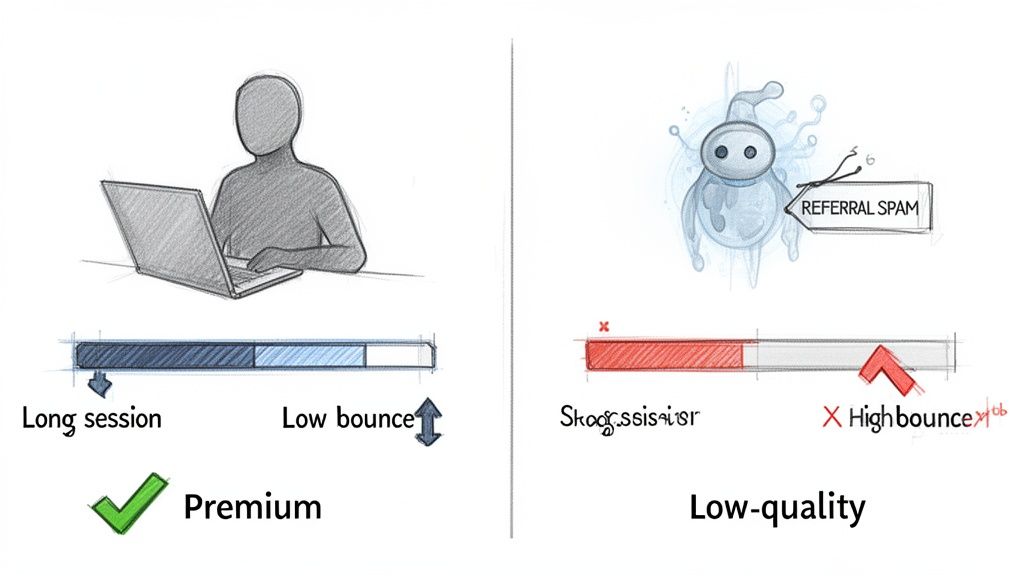
To really get what makes premium traffic so valuable, it helps to see it side-by-side with its polar opposite: low-quality traffic. Think of your website as a high-end restaurant. A premium visitor is like a diner who booked a reservation, studies the menu, enjoys a full three-course meal, and leaves a great review. A low-quality visitor is the person who just pokes their head in the door and leaves without even taking a seat.
One helps build your reputation and brings in revenue. The other just fogs up the glass. This difference is even more critical online, where premium visitors actively boost your site's authority while low-quality traffic can actively harm it.
It all boils down to two things: intent and authenticity. A premium visitor is a real person who landed on your site for a real reason. Their behavior shows it—they stick around, click through to other pages, and actually read or watch your content.
What Defines Low-Quality Traffic
Low-quality traffic is essentially the junk mail of the web. It's completely worthless and usually comes from shady sources that can get you in trouble with search engines.
Here are the usual suspects:
- Automated Bots: These are just scripts, not people. They’re programmed to crawl sites for reasons that have nothing to do with genuine interest. They hit your page and vanish, resulting in a 100% bounce rate and a 0-second session duration.
- Click Farms: This is where people are paid pennies to manually click on links all day. Sure, they're technically "human," but their behavior is completely unnatural. They have no interest in your content, and modern algorithms are smart enough to spot this fake engagement from a mile away.
- Referral Spam: You’ve probably seen this in your analytics. Bots leave fake referral data to get you to visit their spammy websites. It clogs up your reports, making it impossible to get a clear picture of who your real audience is.
This kind of traffic sends all the wrong signals to Google. Sky-high bounce rates and non-existent session times scream that your site isn't giving visitors what they want, which can tank your rankings. For a closer look, you can learn more about how an automated traffic bot can negatively affect your SEO efforts.
A single high-quality visit that leads to a sale or a long, engaged session is worth more than a thousand bot hits that bounce instantly. Quality, not just quantity, is what fuels real, sustainable growth.
Premium Traffic vs. Low-Quality Traffic: A Direct Comparison
To make the difference perfectly clear, let’s compare the core traits of each traffic type side-by-side. This table breaks down the key differences between valuable, high-intent website visitors and low-quality or harmful traffic sources.
This simple framework will help you quickly tell what to aim for and what to avoid when looking at your own site's performance data.
| Characteristic | Premium Website Traffic | Low-Quality Traffic |
|---|---|---|
| Source | Real human users with genuine search intent. | Automated bots, click farms, or irrelevant referrals. |
| Engagement | High session duration, low bounce rate, multiple pages per visit. | Near-instant bounce, zero session duration, one page per visit. |
| Search Intent | Clearly defined; user is looking for an answer, product, or solution. | Non-existent; clicks are random, forced, or automated. |
| Conversion Potential | High; visitors are primed to take action (buy, sign up, inquire). | Zero; no potential for meaningful business interaction. |
| Impact on SEO | Positive; sends strong engagement signals that boost rankings. | Negative; can lead to penalties and polluted analytics data. |
Ultimately, by focusing your efforts on attracting visitors who fit into the "premium" column, you’re playing the long game. You're aligning your strategy with exactly what search engines like Google want: sites that deliver real value to real people. That’s the true foundation for building a strong, lasting online presence.
How to Measure Premium Traffic in Your Analytics
Alright, let's move from theory to the real world—your website's analytics. To actually see the quality of your traffic, you have to learn how to read the story your data is telling you. This isn’t about glancing at a dashboard; it’s about putting on your detective hat and using tools like Google Analytics 4 (GA4) and Google Search Console to find the clues that define premium website traffic.
The goal here is simple: separate your best visitors from the background noise. Once you can spot the specific behaviors and patterns of high-quality traffic, you can diagnose the health of your audience and set clear, realistic goals for improvement. It’s how you stop guessing and start making decisions backed by hard data.
Pinpointing Your Best Visitors in GA4
Think of Google Analytics 4 as your mission control for understanding what people do once they land on your site. It's easy to get lost in the dozens of reports, so let's focus on the metrics that truly signal engagement and intent.
These reports will give you the clearest picture:
- Traffic Acquisition: This is your first stop. Head over to
Reports > Acquisition > Traffic acquisition. The key here is to filter for "Organic Search" as the session default channel group. This instantly tells you how many people are coming from search engines—the bedrock of most premium traffic. - Engagement Metrics: In that same report, look closely at Average engagement time and Engaged sessions per user. Big numbers here are a great sign. It means visitors from search aren't just showing up and leaving; they're sticking around and actually digging into your content.
- Conversions: Now for the moment of truth. Go to
Reports > Engagement > Conversions. By comparing this data against your organic search traffic, you can see if your "premium" visitors are taking the actions that really matter, whether that’s buying a product, signing up for a newsletter, or filling out a contact form.
To really get a handle on your audience and start optimizing for better traffic, you need to know How to Track Visitors to a Website with precision. Mastering this is what turns raw data into conversions.
Decoding Intent with Google Search Console
If GA4 tells you what visitors do on your site, Google Search Console (GSC) tells you why they came in the first place. It’s a goldmine for understanding the search queries that brought people to your digital doorstep.
Open up the Performance report in GSC. This is where you can see the exact keywords your audience is typing into Google. Keep an eye out for long-tail keywords (phrases of three or more words) that signal strong intent. Think "best running shoes for flat feet" instead of a vague term like "shoes."
Key Insight: Clicks from high-intent keywords are one of the strongest indicators of premium traffic. These users have already done the hard work of qualifying themselves by telling Google exactly what they're looking for. Your job is to prove you’re their best answer.
Establishing Your Quality Benchmarks
Once you're comfortable finding these metrics, it's time to set some benchmarks. What does "good" actually look like? While every industry is different, published data gives us a solid starting point for what to expect from high-quality organic traffic.
When you look at engagement benchmarks, traffic from organic search consistently shines. For instance, top-performing domains often see pages per visit between 3.5 and 5.2 from organic visitors, with bounce rates as low as 35-42%. For e-commerce sites, organic traffic conversion rates can sit anywhere from 1.84% to 3.71%, which often doubles what you’d see from low-quality paid or bot traffic. You can explore more of these traffic benchmarks in detail on Semrush's analytics overview.
Use these figures as your guideposts. If your organic traffic metrics are falling short, it’s a clear signal that you have an opportunity to improve both your audience quality and the on-site experience you're providing. By tracking these core metrics over time, you can turn a confusing mess of numbers into a clear roadmap for attracting more of the premium traffic your business needs.
Proven Channels for Acquiring High-Quality Organic Traffic
Attracting premium website traffic isn’t about some secret hack or a magic button. The real work is rooted in building a solid digital presence with time-tested, sustainable SEO practices. Think of your website like a physical building. You wouldn't start by decorating the penthouse; you’d pour a strong foundation and erect a sturdy frame first.
In the same way, getting the right kind of visitors starts with your site's technical health and on-page relevance. These are the absolute prerequisites that allow search engines to find, crawl, and actually understand your content. Without a solid base, even the most amazing content strategy is dead in the water.
Master the Technical and On-Page Essentials
Before you even think about content or backlinks, you have to get your house in order. Your site’s technical and on-page SEO sends powerful signals to search engines about its quality, trustworthiness, and relevance. Getting this right is non-negotiable.
Here are the key areas to lock down:
- Technical SEO: This is your website's foundation. It means having a logical site structure, clean XML sitemaps, and hunting down every last broken link or crawl error. A technically clean site is one that search engine bots can navigate and index without hitting any roadblocks.
- On-Page Optimization: Every single page needs a clear job. This involves fine-tuning your title tags, meta descriptions, and headers (H1, H2, etc.) to include the right keywords and accurately reflect what the page is about.
- Page Speed: Let's be honest, nobody waits for a slow website. Users expect speed, and search engines reward sites that provide a fast, smooth experience. Slow-loading pages kill conversions and rankings.
These fundamentals are the price of entry. To get a much deeper look into these tactics, check out our guide on how to attract organic visitors naturally and start building a real organic presence.
Create Content That Perfectly Matches Search Intent
Once your foundation is solid, it’s time to focus on creating content that truly serves your audience. This goes way beyond just sprinkling keywords throughout an article. It’s about getting inside the head of the searcher and understanding the “why” behind their query.
For instance, someone searching for "how to fix a leaky faucet" doesn't want an academic paper on the history of indoor plumbing. They need a simple, step-by-step guide, probably with pictures or a video. When you match that specific intent, you turn a casual searcher into an engaged visitor who trusts you.
The best content doesn't just get you to the top of the search results; it solves the user's problem so completely that they have no reason to go back to Google. This is the core of attracting premium website traffic—you become the final destination.
Prioritize User Experience and Mobile-First Design
What good is world-class content if your website is a nightmare to use? A confusing layout, tiny text, or a clunky interface will have visitors bouncing in seconds. Your site's user experience (UX) is a direct measure of how much you respect your visitor's time and attention.
And today, that experience almost always happens on a phone. The shift to mobile isn't just a trend; it's a complete takeover. Analysis from Q1 2025 shows that a massive 62.73% of all web traffic now comes from mobile devices. Considering that 76% of consumers say they’d leave a site that’s poorly designed for mobile, a mobile-first strategy isn't optional anymore.
This infographic breaks down how to measure traffic quality, connecting the dots from your analytics all the way to your business goals.
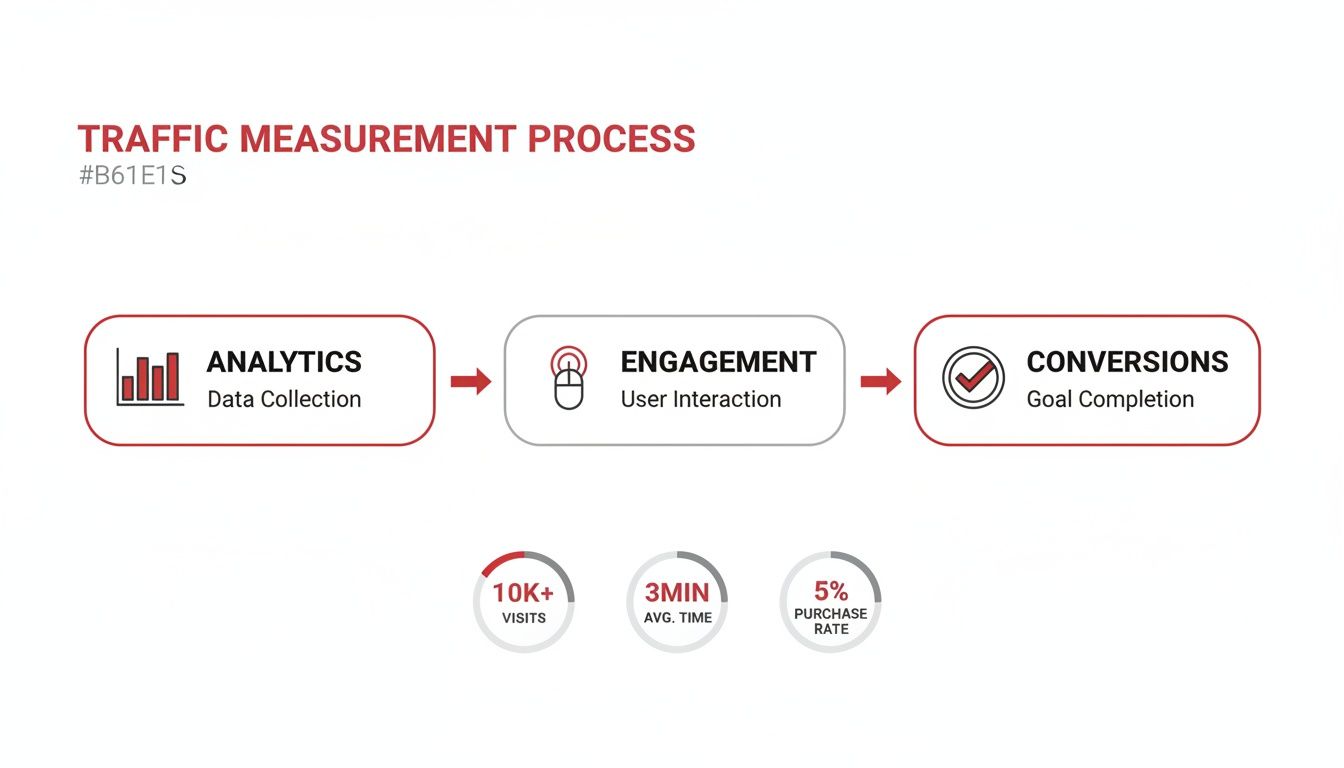
As you can see, getting quality traffic is just step one. The real proof is in measuring how those visitors engage and what they do next.
Optimize Your Click-Through Rate (CTR)
Finally, even the best-ranking content is worthless if nobody clicks on it. Your click-through rate (CTR)—the percentage of people who see your site in the search results and actually click—is one of the most powerful tools you have for attracting premium website traffic. A high CTR tells search engines that your result is exactly what users are looking for.
You can directly influence your CTR by focusing on these three elements:
- Craft Compelling Title Tags: Your title is your one shot to grab attention. Make it compelling, clear, and make sure it includes your main keyword.
- Write Irresistible Meta Descriptions: Think of your meta description as the ad copy for your page. Briefly explain what the user will get and give them a strong reason to click your link over the others.
- Use Schema Markup: Adding structured data like star ratings, FAQs, or event info can make your listing pop in the search results, drawing the eye and earning more clicks.
By mastering these proven channels, you stop chasing random visitors and start strategically attracting the high-quality traffic that leads to real engagement, conversions, and lasting SEO success.
Tailoring Your Premium Traffic Strategy for Your Business
When it comes to getting premium website traffic, there's no magic bullet. A strategy that works wonders for an e-commerce store will fall flat for a local plumber. The biggest mistake you can make is adopting a generic approach, because different businesses have entirely different goals, audiences, and pressures.
Think about it in the real world. A high-end real estate agent and a local coffee shop both want foot traffic, right? But the agent is hunting for qualified buyers actively looking for a home, while the shop owner just needs to catch the eye of anyone craving a caffeine fix. Your online strategy needs that same level of specific targeting to attract digital visitors who are actually likely to convert.
This is all about moving past broad-stroke advice and getting into the nitty-gritty. Whether you’re an agency trying to get a client off a ranking plateau or a local business trying to own the map pack, how you go about attracting high-quality visitors has to be custom-built for the job.
For SEO Agencies Pushing Past Plateaus
If you work at an SEO agency, you know the frustration. You've done everything right, but a client's site is just stuck on page two or three for its most important keywords. More often than not, this happens because the user engagement signals aren't strong enough to give Google the final push of confidence it needs. This is where a sharp, targeted premium traffic campaign can be your secret weapon.
You need to prove to Google that your client's page delivers a better experience.
- Goal: Boost the click-through rate (CTR) and on-page engagement for valuable, underperforming pages.
- Tactic: Pinpoint the keywords where your client is lingering between positions 4 and 20. These are your golden opportunities. Launch a campaign designed to send real, organic-looking clicks straight from the SERPs to those specific URLs.
- Result: This wave of engaged users—people who click, stay a while, and explore—sends powerful positive signals to search engines. It validates the page's relevance and can be just what you need to finally break through that stubborn ranking barrier.
For E-commerce Stores Boosting Product Visibility
In e-commerce, a click is a potential sale. The real battle isn't just getting traffic; it's getting traffic with high purchase intent. Ranking for a broad term is nice, but winning the click on a specific, long-tail product keyword is what pays the bills.
A study of premium publishers found that after Google's AI-driven search changes, median referral traffic from search dropped by 10% in just eight weeks. This makes every high-intent click you do get even more valuable.
Your strategy has to be laser-focused on the keywords that scream "I'm ready to buy."
- Goal: Pull qualified shoppers to specific product pages to drive sales and improve visibility for "buyer intent" keywords.
- Tactic: Zero in on keywords that include purchase-focused terms like "buy," "best," "for sale," or even specific product model numbers. A smart CTR campaign can make your product listing the most compelling option in the search results for these queries.
- Result: You not only see an immediate impact on your bottom line from ready-to-buy shoppers, but you also improve your rankings for the very keywords that generate the most revenue.
For Local Businesses and Affiliate Marketers
Local businesses are defined by their visibility in the neighborhoods they serve, especially within Google Business Profile (GBP) results. The entire game is about being the first and best answer for a local customer's needs. For affiliates, the mission is strikingly similar: get hyper-targeted traffic to your "money pages" to maximize clicks on those valuable affiliate links.
Local Business Strategy:
- Goal: Dominate the local search results and drive more customers through your door.
- Tactic: Run geo-targeted campaigns that simulate searches from users located right in your city or service area. Think keywords like "plumber near me" or "best pizza in [City]."
- Result: This reinforces your local authority in Google's eyes, giving your GBP profile and organic rankings a serious boost for the searches that actually bring in local business.
Affiliate Marketer Strategy:
- Goal: Funnel more qualified visitors to your highest-converting review articles and comparison posts.
- Tactic: Identify your most profitable affiliate pages and the keywords they rank for. Run campaigns to enhance their SERP visibility and attract users who are at the very end of their research phase.
- Result: Getting more of the right eyeballs on your most persuasive content translates directly into higher affiliate commissions.
By tailoring your approach, premium website traffic stops being a simple vanity metric. It becomes a strategic asset that directly fuels your most important business objectives. For a deeper dive into practical ways to attract these visitors, check out these 12 Proven Ways to Increase Organic Traffic.
Building Your SEO Future on Quality Traffic
Let's be honest—chasing huge traffic numbers alone doesn't pay the bills. The real foundation for long-term SEO success is built with premium website traffic, which means getting real, interested people to your site who actually want to be there. This isn’t just a nice idea; it’s a core strategy that directly impacts your rankings and, ultimately, your bottom line.
True growth happens when you attract visitors who do more than just land and leave. You want the ones who stay, click around, and convert. It's all about quality over quantity. Every time a user has a great, engaging experience on your site, it sends a strong positive signal to Google, telling them your content delivered. This kicks off a fantastic feedback loop: better engagement leads to higher rankings, which brings in even more of the right kind of visitors.
Your Roadmap to Resilient SEO
The best part? You're in the driver's seat. The strategies needed to attract this high-value audience are entirely within your grasp. It all starts with a simple change in perspective—stop obsessing over vanity metrics and start focusing on user behavior.
Your first move should be to get familiar with your analytics. Pinpoint which pages are already attracting engaged visitors and what keywords they're using. That’s your treasure map, showing you exactly where to focus your efforts to build a stronger, more dependable online presence.
The secret to modern SEO is surprisingly straightforward: put the user first, and the rankings will naturally follow. When you prioritize engagement metrics like session duration and pages per visit, your goals become perfectly aligned with what search algorithms are designed to reward.
Think about it this way: when you improve how long people stick around, you’re giving search engines direct proof that your content is worthwhile. If you want to master this specific tactic, our guide on how to increase dwell time on your website breaks down the exact steps you can take.
Start digging into your traffic quality today. Focus on the strategies that pull in visitors who are genuinely curious about what you have to say. This is how you build an SEO strategy that doesn't just work for now, but lasts for years to come.
Frequently Asked Questions
When you start talking about premium website traffic, a lot of questions—and some healthy skepticism—naturally come up. Let's tackle some of the most common ones head-on so you can confidently decide how to approach your SEO strategy.
Is Buying Website Traffic a Good Idea?
This is a classic question, and the answer completely depends on what you're actually buying.
If "buying traffic" means paying for cheap, automated bots, then the answer is a hard no. That kind of traffic is worthless. It won't convert, it messes up your analytics, and it can absolutely get your site penalized.
But that’s not what we’re talking about here. Investing in a service that generates premium traffic is a different game entirely. You're not just buying empty numbers; you're strategically improving the genuine user signals that Google rewards, like click-through rates (CTR) and how long people stay on your site.
Think of it less as "buying visitors" and more as an investment in making your site look better to search engines through authentic engagement.
How Long Does It Take to See Results?
The timeline really depends on where your site is now, your industry, and the specific plays you're running.
If your main focus is on boosting user engagement signals like CTR, you can often see the needle move on your rankings within 30 to 60 days. Search engines are constantly looking for these behavioral clues, and they're quick to reward positive changes.
Broader SEO efforts, like a big content marketing push or a technical overhaul, are more of a long game. These strategies build momentum over 3 to 6 months, but the results are incredibly durable and create a strong foundation for long-term growth.
Can Google Penalize My Site for Optimizing CTR?
The risk of a penalty all comes down to how you do it.
Any method that uses bots, click farms, or a small handful of the same IP addresses over and over again is just asking for trouble. Google’s algorithms are incredibly sophisticated and can spot those fake, predictable patterns from a mile away. That’s a fast track to a penalty.
The safe approach, on the other hand, uses a massive, distributed network of real people on their own devices. This simulates what genuine search traffic actually looks like, making it virtually indistinguishable from your regular organic visitors. That’s how you dramatically reduce any risk.
A high-quality CTR optimization service will always guarantee:
- Real Users, Not Bots: Every click comes from a real person using a unique device.
- Diverse IP Network: Clicks are routed through a huge network of residential and mobile IPs, so no red-flag patterns emerge.
- Natural Behavior: These users don’t just click and bounce. They stay, browse, and create the kind of realistic session data that search engines love to see.
The goal isn't to trick Google. It's to reinforce the exact quality signals Google uses to identify the best, most relevant websites for its users. When you do that, you're working with the algorithm, not against it.
Ready to stop guessing and start seeing real ranking improvements? ClickSEO provides the tools you need to boost your CTR and other critical engagement metrics with genuine, high-quality traffic. Start your free trial today and discover why we are the market-leading solution for pushing past ranking plateaus. Learn more at the ClickSEO website.